
Article 5: The Person Left After the Performance

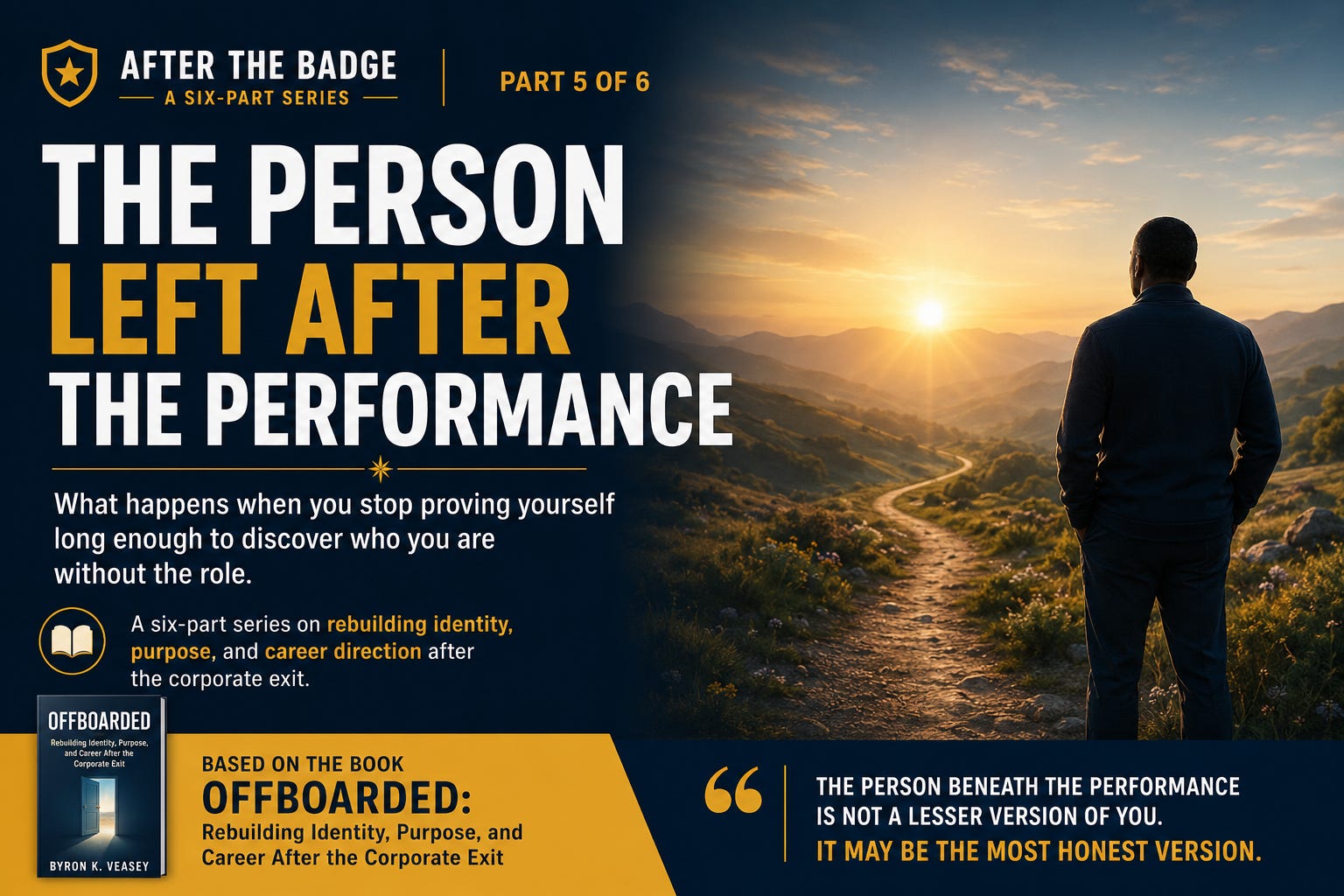
What happens when you stop proving yourself long enough to discover who you are without the role
Series: After the Badge
A six-part series on rebuilding identity, purpose, and career direction after the corporate exit.
For executives, leaders, and experienced professionals who were laid off, offboarded, restructured out, burned out, or quietly separated from the corporate system—and are trying to understand why the loss feels bigger than a job.
Based on the book, Offboarded: Rebuilding Identity, Purpose, and Career After the Corporate Exit.
The Exhaustion Beneath the Loss
One of the strangest experiences after a corporate exit is realizing just how tired you actually are.
Not tired from job searching.
Not tired from updating résumés.
Not tired from networking.
A deeper kind of tired.
The tired that was hidden beneath performance.
For years, you may have been carrying responsibilities that never appeared on an organizational chart.
You carried expectations.
You carried pressure.
You carried visibility.
You carried consequences.
You carried the emotional weight of being dependable.
People knew you as the one who would figure it out.
The one who would stay late.
The one who would absorb uncertainty.
The one who would calm the room.
The one who would keep things moving.
The one who could be trusted.
That identity becomes powerful.
But it can also become consuming.
Because after a while, you stop noticing where the role ends and where you begin.
You stop noticing how much of your energy is being spent maintaining an image.
An image of competence.
An image of certainty.
An image of resilience.
An image of having everything under control.
Then the role ends.
And suddenly the performance has nowhere to go.
The meetings disappear.
The expectations disappear.
The audience disappears.
And for the first time in years, you are left alone with yourself.
That can feel unsettling.
Because many professionals discover they know how to perform success better than they know how to experience themselves without it.
Success Can Become a Costume
Most people think performance means pretending.
It usually does not.
Performance often begins with something real.
You are capable.
You are dependable.
You are experienced.
You are respected.
But over time, the version of yourself that functions professionally can become the version that dominates everything else.
You learn what the organization rewards.
You learn how to communicate.
You learn how to present confidence.
You learn how to manage perceptions.
You learn how to suppress doubt.
You learn how to remain composed even when things are difficult.
None of that is fake.
But eventually the professional identity becomes a costume that never comes off.
You wear it in meetings.
You wear it at home.
You wear it during vacations.
You wear it during conversations.
You wear it so long that you forget it is something you put on.
Then offboarding removes the stage.
And the question appears.
Who is left after the performance?
That question is not a crisis.
It is an invitation.
You May Not Need Reinvention
One of the biggest myths after a corporate exit is that you must reinvent yourself immediately.
Launch something.
Build something.
Become something.
Transform.
Pivot.
Rebrand.
Start over.
Sometimes that pressure comes from fear.
The fear that if you stop moving, you will disappear.
But recovery often begins somewhere quieter.
Not with reinvention.
With recognition.
You do not always need a new identity.
Sometimes you need to recover the parts of yourself that were buried beneath the old one.
The parts that existed before the performance became permanent.
The parts that had curiosity.
The parts that had interests unrelated to advancement.
The parts that enjoyed creating, learning, teaching, exploring, building, helping, or thinking without needing it to become a quarterly objective.
Many professionals are not rebuilding from nothing.
They are reconnecting with what was abandoned while they were busy succeeding.
The Space Between Roles
There is a period after every significant exit where you are no longer who you were, but not yet who you will become.
Most people hate this space.
It feels uncertain.
Unproductive.
Unstructured.
Invisible.
The temptation is to escape it as quickly as possible.
But this space often contains information.
It reveals what you miss.
It reveals what you do not miss.
It reveals what drained you.
It reveals what energized you.
It reveals which parts of your identity were authentic and which parts were survival strategies.
The space between roles can feel uncomfortable.
But it is often where clarity begins.
Because without the noise of constant performance, you finally have the opportunity to hear yourself again.
You Are More Than What the System Measured
Corporate systems are designed to measure contribution.
Revenue.
Performance.
Output.
Results.
Visibility.
Leadership.
Efficiency.
Those measurements have value.
But they are incomplete.
They cannot measure wisdom.
They cannot measure perspective.
They cannot measure character.
They cannot measure growth.
They cannot measure the lessons earned through difficult seasons.
They cannot measure the person who exists beneath the role.
And yet many professionals spend years unconsciously accepting those measurements as the complete story of who they are.
Then the measurements disappear.
And they feel empty.
Not because they are empty.
Because they built their identity around metrics that were never designed to hold it.
You are more than what the system measured.
And part of rebuilding is learning how to believe that again.
The Person Left After the Performance
Eventually recovery becomes less about proving you still matter.
And more about remembering that you mattered before anyone was measuring.
Before the title.
Before the promotion.
Before the organization.
Before the badge.
The person left after the performance is not a lesser version of you.
It may actually be the most honest version.
The one that remains when achievement is no longer speaking on your behalf.
The one that remains when the role is gone.
The one that remains when the market becomes quiet.
The one that remains when nobody is asking what you do.
That person deserves your attention.
Because careers end.
Titles change.
Organizations move on.
Badges stop working.
But the person beneath the performance is the one who has to live through all of it.
And perhaps the most important work after offboarding is not finding another stage.
It is becoming reacquainted with the person who no longer needs one.
About the Author
Byron K. Veasey is a career strategist and leader in data quality engineering focused on helping professionals navigate job searches, burnout, and career reinvention.
He writes Career Strategies, a Substack newsletter read by over 4,900 professionals navigating today’s evolving job market.
👉 Subscribe to Career Strategies