
Article 5: Rebuilding Trust Without Over-Performing

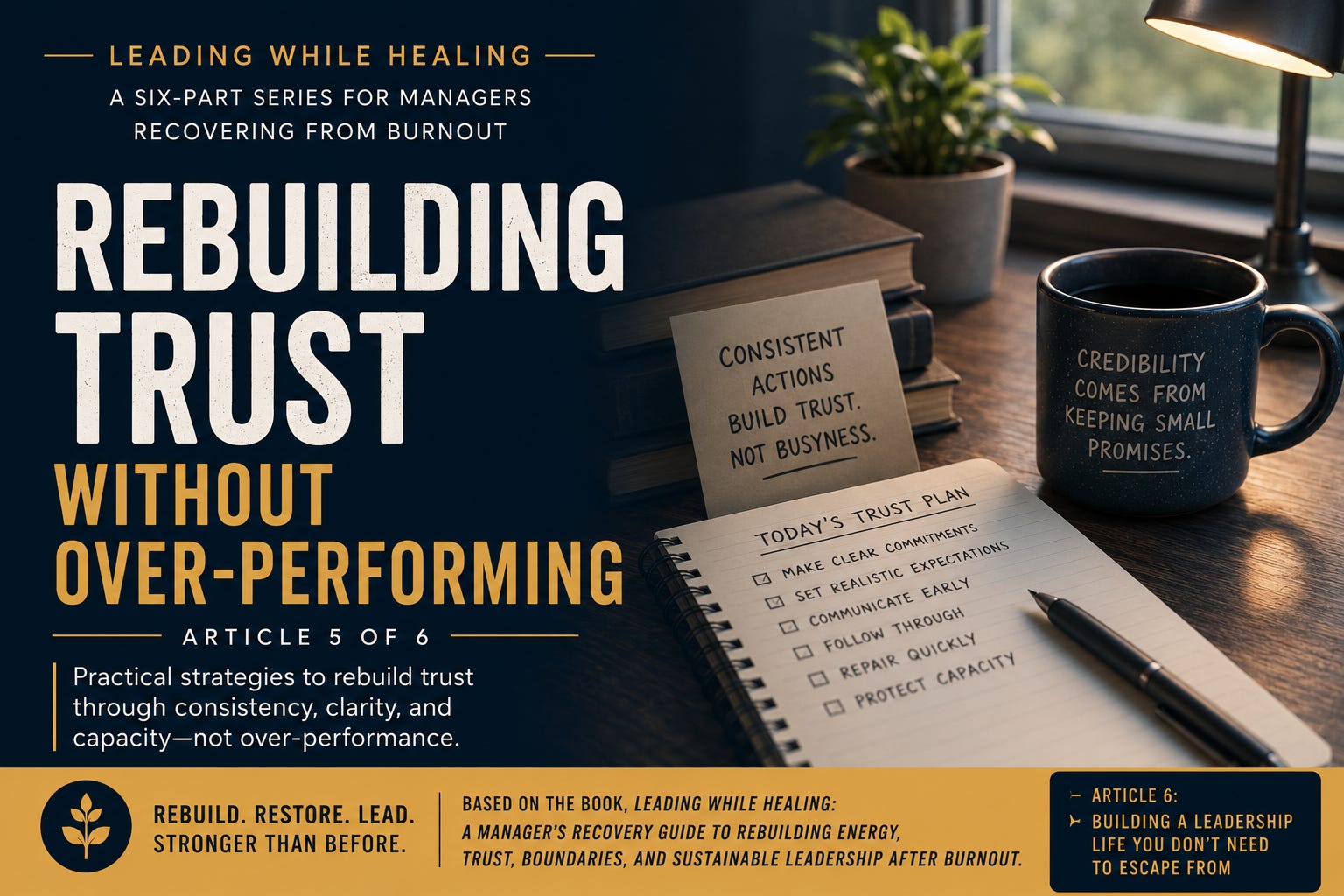
Leading While Healing
Article 5 of 6
A six-part series for managers rebuilding energy, trust, boundaries, and sustainable leadership after burnout.
This series is based on the book Leading While Healing: A Manager’s Recovery Guide to Rebuilding Energy, Trust, Boundaries, and Sustainable Leadership After Burnout.
After burnout, trust can feel complicated.
You may not fully trust your energy.
You may not fully trust your limits.
You may not fully trust your judgment.
You may not fully trust your ability to keep going.
You may not fully trust the workplace that watched you burn down and still kept asking for more.
And if you are honest, you may not fully trust yourself yet.
Not because you are weak.
Not because you are incapable.
Not because you stopped caring.
But because burnout changes your relationship with reliability.
Before burnout, you may have trusted yourself because you could push through almost anything.
You could respond.
You could deliver.
You could stay late.
You could hold the pressure.
You could absorb the complexity.
You could keep everyone else steady.
You could make impossible expectations look manageable.
That may have been your evidence.
I can trust myself because I always find a way.
Then burnout interrupted that story.
Suddenly, the old proof no longer felt safe.
Because the same ability to push through may have been part of what damaged you.
The same reliability people praised may have come from self-abandonment.
The same strength others counted on may have been built on silence.
The same leadership identity that made you valuable may have made you vulnerable.
So now you face a different question.
Not:
How do I prove I am still the leader I used to be?
But:
How do I rebuild trust without returning to the pattern that broke me?
That is the work of this phase.
Because after burnout, trust cannot be rebuilt through over-performing.
It has to be rebuilt through consistency, clarity, capacity, and truth.
The Trust Problem After Burnout
Burnout does not only drain energy.
It damages trust.
Trust in your body.
Trust in your pace.
Trust in your decisions.
Trust in your calendar.
Trust in your workplace.
Trust in other people’s expectations.
Trust in your ability to know when enough is enough.
You may find yourself second-guessing things that used to feel automatic.
Can I handle this meeting?
Should I take this on?
Am I being reasonable?
Am I overreacting?
Is this boundary fair?
Will they think I am less committed?
Will I fall behind if I say no?
Will I collapse again if I say yes?
This internal questioning can be exhausting.
Because the leader in recovery is not only doing the work.
They are also monitoring the cost of the work.
They are tracking energy.
Tracking tone.
Tracking workload.
Tracking warning signs.
Tracking how much they can safely carry.
That is a lot of invisible labor.
And when trust has been shaken, the temptation is to overcorrect.
You try to prove you are okay.
You try to prove you are still capable.
You try to prove you can still deliver.
You try to prove your boundaries have not made you difficult.
You try to prove your recovery has not made you weaker.
You try to prove you are still worth trusting.
But proving can become another form of depletion.
Especially when proving requires you to ignore the very limits recovery is asking you to respect.
Over-Performance Is Not the Same as Trust
Many leaders confuse trust with over-performance.
They think trust means being available.
Trust means saying yes.
Trust means anticipating every need.
Trust means never dropping anything.
Trust means responding quickly.
Trust means carrying the emotional weight.
Trust means making everyone else comfortable.
Trust means being the person who can always be counted on.
But that kind of trust may not be trust at all.
It may be dependency.
It may be habit.
It may be a system built around your over-functioning.
It may be people trusting that you will absorb what the system refuses to fix.
That is not sustainable trust.
That is a liability with praise attached to it.
After burnout, you have to redefine what it means to be trustworthy.
A trustworthy leader is not someone who is endlessly available.
A trustworthy leader is clear.
Consistent.
Honest.
Present within capacity.
Careful with commitments.
Able to name tradeoffs.
Willing to tell the truth before resentment builds.
Strong enough to say no early instead of yes falsely.
That kind of trust may feel less dramatic.
It may not produce the same immediate approval.
It may not make you look heroic.
But it is stronger.
Because people can trust what is real.
They cannot sustainably trust a version of you that only exists because you keep abandoning yourself.
The Old Proof No Longer Works
Before burnout, your proof may have been output.
You proved yourself by producing.
By staying late.
By solving the problem.
By taking the call.
By saving the project.
By being the one who could handle it.
That proof may have worked for a long time.
It may have built your reputation.
It may have opened doors.
It may have made people respect you.
It may have made you feel needed.
But after burnout, that proof becomes dangerous.
Because it asks you to recover by repeating the behavior that helped create the injury.
It says:
Show them you are back.
Take on more.
Be extra responsive.
Do not let anyone question your commitment.
Make up for the time you were not at full capacity.
Rebuild confidence by doing more than expected.
But doing more is not always recovery.
Sometimes doing more is fear wearing a productivity mask.
Sometimes doing more is an attempt to outrun vulnerability.
Sometimes doing more is the old survival pattern trying to regain control.
That does not mean effort is bad.
It means effort needs a new standard.
The question is no longer:
How much can I do to prove myself?
The better question is:
What can I commit to and sustain without damaging my recovery?
That is the shift.
Trust Begins With Smaller, Cleaner Commitments
After burnout, you may need to make fewer promises.
But keep them better.
That sentence may feel uncomfortable if your leadership identity was built on being highly available.
But trust is not rebuilt by saying yes to everything.
Trust is rebuilt by making clear commitments and honoring them.
If you say you will respond tomorrow, respond tomorrow.
If you say you can review the document by Friday, review it by Friday.
If you say you cannot take ownership, do not quietly take ownership later.
If you say a priority must move down before a new one comes in, hold that line.
If you say you are unavailable after hours, do not reward after-hours urgency with immediate response.
If you say you need an agenda before a meeting, do not attend the meeting without one.
This is how trust returns.
Not through speeches.
Not through self-sacrifice.
Not through dramatic effort.
Through alignment.
Your words and actions begin matching again.
Your limits become believable.
Your commitments become cleaner.
Your team learns that your yes means yes.
Your no means no.
Your timeline means something.
Your capacity is real.
That is trust.
You May Need to Rebuild Trust With Yourself First
Before your team can fully trust the new version of your leadership, you may need to trust it.
You may need to prove to yourself that you will not abandon your recovery at the first sign of pressure.
You may need to prove that you can set a boundary without over-explaining.
You may need to prove that you can rest without guilt becoming the manager.
You may need to prove that you can make a mistake without spiraling into shame.
You may need to prove that you can disappoint someone and still remain a good leader.
You may need to prove that you can work at a sustainable pace and still be valuable.
That kind of self-trust is built slowly.
It comes from small moments.
You pause before saying yes.
You ask for clarity.
You name the tradeoff.
You stop before you crash.
You keep the recovery window.
You tell the truth about what you can carry.
You do not punish yourself for having limits.
Each moment sends a message back to your system:
I am not going to use you up the way I did before.
That message matters.
Because burnout often teaches the body that leadership is unsafe.
Self-trust teaches the body that leadership can be rebuilt differently.
Your Team May Be Watching for the Old Pattern
If your team is used to the old version of you, they may expect the old pattern to return.
They may expect instant replies.
They may expect you to absorb unclear work.
They may expect you to rescue last-minute problems.
They may expect you to hold the emotional temperature of the room.
They may expect you to make the system easier by making yourself more available.
Not because they are bad people.
Because systems learn patterns.
If you trained people over time that you would always step in, they may keep leaving space for you to step in.
If you trained people that you would absorb ambiguity, they may keep handing you ambiguity.
If you trained people that you would rescue poor planning, they may keep planning poorly.
This is where trust rebuilding becomes uncomfortable.
Because the team may not immediately interpret your new consistency as trustworthiness.
They may first experience it as change.
And change can create friction.
You may hear:
You seem different.
You are not as available as before.
I thought you would handle this.
We used to move faster.
Can you just jump in quickly?
This is where the old you may feel tempted to return.
To prove you still care.
To avoid tension.
To make the discomfort go away.
But every time you abandon the new pattern to calm someone else’s discomfort, you teach the system that your boundaries are temporary.
Trust requires consistency.
Not harshness.
Consistency.
Explain Less, Clarify More
After burnout, many managers over-explain their limits.
They explain because they feel guilty.
They explain because they want to be understood.
They explain because they fear being judged.
They explain because they do not want people to think they are less committed.
They explain because part of them is still asking for permission to recover.
But over-explaining can weaken a boundary.
It can make your limit sound negotiable.
It can turn a clear statement into a debate.
It can invite people to evaluate whether your reason is good enough.
You do not need to explain everything.
But you do need to clarify.
Clarifying sounds like:
I can review this by Thursday.
I cannot take this on today.
This needs an owner before we move forward.
I am available at 2 p.m., not this morning.
If this becomes urgent, we need to decide what moves down.
I can support the decision, but I cannot own the execution.
That is enough.
Clear language builds trust.
Too much explanation can signal uncertainty.
This does not mean you become cold.
It means you stop making your recovery a courtroom case.
You do not have to defend every limit.
You have to communicate it clearly and honor it consistently.
Trust Requires Predictability
One of the most important parts of leadership trust is predictability.
Not perfection.
Predictability.
People need to know how decisions are made.
How priorities are handled.
How communication works.
What urgent means.
When you are available.
How tradeoffs get resolved.
What you will own.
What you will not own.
What requires escalation.
What requires preparation.
What requires follow-up.
Burnout often creates unpredictability because the leader’s energy becomes unstable.
One day you can handle everything.
The next day you are depleted.
One week you are responsive.
The next week every message feels impossible.
One meeting you are patient.
The next meeting you are shorter than intended.
This does not make you a bad leader.
It means your system is recovering.
But as you rebuild, predictability becomes part of the repair.
Predictable boundaries.
Predictable communication windows.
Predictable decision rules.
Predictable follow-through.
Predictable priorities.
Predictable recovery space.
You do not have to be available all the time to be trustworthy.
You have to be clear enough that people know what to expect.
Do Not Let Guilt Become the Manager
Guilt is one of the most dangerous forces in post-burnout leadership.
Guilt says:
You should be doing more.
You should be easier to reach.
You should make up for being depleted.
You should prove you are still committed.
You should not need this much space.
You should not disappoint anyone.
You should be grateful you can still lead.
But guilt is not a good manager.
Guilt will overbook you.
Guilt will make promises your capacity cannot keep.
Guilt will say yes when wisdom says pause.
Guilt will turn every boundary into an apology.
Guilt will make you confuse discomfort with wrongdoing.
Guilt will pull you back into the exact over-functioning pattern you are trying to leave.
You can listen to guilt without obeying it.
You can say:
I hear that I feel responsible.
I hear that I want to be seen as reliable.
I hear that I do not want to disappoint people.
But I will not rebuild trust by betraying my capacity.
That is the line.
Guilt may be loud.
But it does not get to design your recovery.
The Team Does Not Need the Old You Back
This may be hard to accept.
Your team may not need the old you back.
They may need a healthier version of you.
A clearer version.
A steadier version.
A more sustainable version.
A version who does not rescue every issue.
A version who does not absorb every emotion.
A version who does not turn unclear systems into personal sacrifice.
A version who models capacity instead of pretending to have none.
A version who teaches the team how to operate with more ownership.
That may feel strange.
Because the old you may have been appreciated.
Needed.
Praised.
Trusted.
But sometimes people trust the version of you that keeps the system from having to mature.
That is not the highest form of leadership.
The goal is not to become less caring.
The goal is to stop making your overextension the foundation of everyone else’s stability.
The healthier version of you may frustrate people at first.
But over time, it can build a stronger team.
Because trust becomes shared.
Not stored entirely in your exhaustion.
The Difference Between Repair and Performance
Repair says:
Let’s make the system healthier.
Performance says:
Let me prove I am fine.
Repair says:
Let’s clarify how this will work going forward.
Performance says:
I will handle it so no one questions me.
Repair says:
I can own this part and need support on that part.
Performance says:
I can take it all.
Repair says:
This pace is not sustainable.
Performance says:
I can push through.
Repair says:
I made a commitment I can keep.
Performance says:
I made a commitment because I was afraid to say no.
That difference matters.
Because after burnout, performance can look responsible from the outside while quietly recreating the conditions of collapse.
Repair may look slower.
Less impressive.
Less heroic.
But repair builds the future.
Performance often protects the image of the past.
And the image of the past is not worth another burnout.
Trust Is Also Built Through Repair Conversations
You will not get everything right.
Not during recovery.
Not during leadership.
Not during rebuilding.
There may be moments when you overcommit.
Moments when you react too quickly.
Moments when your tone is sharper than you wanted.
Moments when you withdraw.
Moments when you confuse protection with distance.
Moments when you return to old habits because pressure felt familiar.
That does not mean you failed.
It means you are rebuilding.
Trust is not built by never missing.
Trust is built by repairing.
A repair conversation does not need to be dramatic.
It can sound like:
I moved too quickly on that commitment. I need to reset expectations.
I was short in that meeting. The issue still matters, but I want to address it more clearly.
I took ownership too fast. We need to clarify roles.
I said yes before understanding the capacity impact. Let’s revisit the priority.
I need to correct something before this becomes a pattern.
These conversations build trust because they make reality visible.
They show that you are not hiding from misalignment.
They show that recovery is not an excuse.
They show that you can lead with honesty instead of performance.
The Trust Reset
For the next week, choose one place where trust needs rebuilding.
Not everywhere.
One place.
Maybe it is trust with your team.
Maybe it is trust with your calendar.
Maybe it is trust with your own limits.
Maybe it is trust with your ability to say no.
Maybe it is trust with your follow-through.
Maybe it is trust after overcommitting too many times.
Name the pattern.
Then create one cleaner commitment.
For example:
I will only commit to timelines I can realistically meet.
Or:
I will clarify ownership before accepting responsibility.
Or:
I will stop saying yes in the meeting and ask for time to assess capacity.
Or:
I will respond during set windows instead of reacting all day.
Or:
I will repair one commitment that no longer matches reality.
Then keep that commitment.
Calmly.
Clearly.
Repeatedly.
The goal is not to become perfect.
The goal is to become aligned.
Because trust grows when your words, capacity, and actions start living in the same place.
You Can Be Trusted Without Being Consumed
There is a version of leadership after burnout that does not require over-performance.
It does not require constant availability.
It does not require self-erasure.
It does not require being the emotional shock absorber for every problem.
It does not require saying yes before you know the cost.
It does not require turning recovery into something you must apologize for.
This version of leadership is steadier.
It tells the truth earlier.
It makes fewer false promises.
It keeps cleaner commitments.
It repairs faster.
It communicates limits without making them a confession.
It builds trust through consistency instead of overextension.
This may feel unfamiliar at first.
Especially if your old trust was built on being exceptional under pressure.
But sustainable trust is not built on exception.
It is built on repeatable truth.
People do not need unlimited access to you to trust you.
They need clarity.
They need consistency.
They need honest commitments.
They need follow-through.
They need repair when something changes.
They need a leader who is present enough to lead because they are no longer consumed by proving they can survive.
The New Trust Standard
The old trust standard may have been:
I will prove I am reliable by carrying more than I should.
The new standard is:
I will prove I am reliable by making commitments I can keep.
The old standard may have been:
I will make people comfortable by staying available.
The new standard is:
I will make the system stronger by creating clarity.
The old standard may have been:
I will avoid disappointing people.
The new standard is:
I will tell the truth early enough that disappointment does not become damage.
The old standard may have been:
I will be trusted because I never stop.
The new standard is:
I will be trusted because I know how to sustain.
That is the shift.
Trust after burnout is not about returning to the leader who could carry everything.
It is about becoming the leader who no longer has to.
Final Thought
After burnout, trust has to be rebuilt carefully.
Not through over-performing.
Not through proving.
Not through apology.
Not through making yourself endlessly available again.
Not through carrying the work, emotions, and urgency that should have been shared all along.
Trust is rebuilt through cleaner commitments.
Through clear limits.
Through honest capacity.
Through predictable rhythms.
Through repair conversations.
Through refusing to let guilt become the manager.
Through showing your team that reliability does not require self-abandonment.
You can be trusted without being consumed.
You can be committed without being constantly available.
You can be steady without being silent about your limits.
You can rebuild confidence without returning to the old pattern.
You can lead in a way that makes trust stronger because it is finally based on truth.
Not performance.
Not survival.
Not exhaustion dressed up as dedication.
Truth.
That is the work now.
Not becoming the leader who proves they are fine.
But becoming the leader who can be believed because they are finally leading from what is real.
A leader who keeps clean commitments.
Names tradeoffs.
Repairs quickly.
Protects capacity.
And understands that sustainable trust is not built by giving everything away.
It is built by leading from enough.
That is sustainable leadership.
And for a manager recovering from burnout, that may be the trust reset that changes everything.
About the Author
Byron K. Veasey is a career strategist and leader in data quality engineering focused on helping professionals navigate job searches, burnout, and career reinvention.
He writes Career Strategies, a Substack newsletter read by over 4,900 professionals navigating today’s evolving job market.