
Article 5: Rebuilding Confidence When the Signal Goes Quiet

The Survival Architecture
Six dispatches for professionals rebuilding after the floor dropped out
Based on Job Search Survival Guide 2026: Resilience, Strategy, and Real Stories for Today’s Job Market
This book is free from April 26 to April 30, 2026. All we ask is that you leave an honest review.
There’s a moment in a long job search
that doesn’t get talked about enough.
It’s not when the rejection comes.
It’s not when the layoff happens.
It’s later.
After the silence.
After the weeks of sending, waiting, checking.
After nothing happens.
And something inside you shifts.
Not your skills.
Not your experience.
Your confidence.
Not all at once.
But just enough
that you start showing up differently.
Confidence Doesn’t Break
It Drifts
Most high performers don’t lose confidence because they fail.
They lose it because the signal disappears.
No feedback.
No response.
No indication that what you’re doing is working.
And without signal—
the brain does what it’s wired to do:
It fills in the gap.
“With what?”
Usually:
Doubt.
Not because it’s accurate—
but because it’s available.
The Silence Loop
Here’s how it actually plays out:
You send strong applications
→ receive no response
You interpret the silence
→ “Something must be off”
You adjust your behavior
→ slightly less certain, slightly more cautious
Your signal weakens
→ less clarity, less conviction
Which produces more silence
And the loop continues.
Not because you’ve become less capable—
But because your expression of that capability
has started to fragment.
What Quiet Does to a High Performer
From the outside, you’re still doing the work.
Applying.
Networking.
Following up.
But internally—
something changes.
You start to notice:
You second-guess language you used to trust
You soften statements that used to be clear
You hedge where you used to decide
You ask for less than you’re worth—just to stay in motion
Nothing dramatic.
But enough—
that over time,
you stop sounding like yourself.
And the market responds to that version—
not the one you know you are.
Confidence Is Not a Feeling
It’s a Reflection of Signal
This is the part most people get wrong.
They try to rebuild confidence internally.
Motivation.
Affirmations.
Mindset work.
But confidence doesn’t come from thinking differently.
It comes from:
Seeing evidence that what you do
still works.
And in a silent market—
that evidence disappears.
So the goal isn’t:
“feel more confident”
It’s:
“rebuild visible proof”
The Evidence Gap
When signal drops—
evidence disappears with it.
No interviews.
No feedback.
No reinforcement loop.
And without evidence—
your brain defaults to protection:
Lower risk
Lower exposure
Lower assertion
Which creates—
lower signal.
Case Study 1: The Overqualified Candidate
Twenty-five years of experience.
Strong track record.
No traction.
His assumption:
“I’m being overlooked.”
Reality:
His signal was diluted.
Generic resume.
Broad applications.
No visible thinking.
The shift:
He stopped sending applications—
and started publishing short breakdowns
of industry problems he had solved before.
Same experience.
New evidence.
Recruiter outreach followed.
Because now—
his capability was visible again.
Case Study 2: The Confidence Collapse
Mid-career leader.
Six months in.
Started strong—
now hesitating on everything.
Her issue wasn’t rejection.
It was accumulation of silence.
The fix wasn’t:
“keep applying”
It was:
Rebuilding her Evidence Bank.
Daily.
Small wins:
Conversations initiated
Insights shared
Responses received
Within weeks—
confidence returned.
Not because she forced it—
but because she saw proof again.
Case Study 3: The Signal Rebuild
Senior operator.
Highly capable.
But every interview felt flat.
Feedback:
“Hard to gauge impact.”
The issue:
Not skill.
Not experience.
Signal clarity.
He shifted from describing responsibilities—
to telling decision-based stories:
What was broken
What he chose
What changed
The difference:
Immediate.
Because confidence came through—
in the specificity.
What Actually Rebuilds Confidence
Not time.
Not waiting.
Not hoping the market shifts.
The moves that work are structural:
Creating visible proof of your thinking
Documenting wins to rebuild internal evidence
Replacing passive applications with active signal
Speaking in decisions—not responsibilities
Reducing noise to restore clarity
Because confidence isn’t something you recover—
It’s something that reappears
when signal becomes clear again.
The Evidence Bank
If there’s one system to build—
it’s this.
Not for the market—
for you.
Track:
Where you added value
What problems you solved
What responses you generated
What moved forward—because of you
Not big wins.
Consistent ones.
Because over time—
this becomes the counterweight
to silence.
Hope Anchor
If your confidence feels lower than it should—
it’s not because you’ve lost your edge.
It’s because the market
stopped reflecting it back to you.
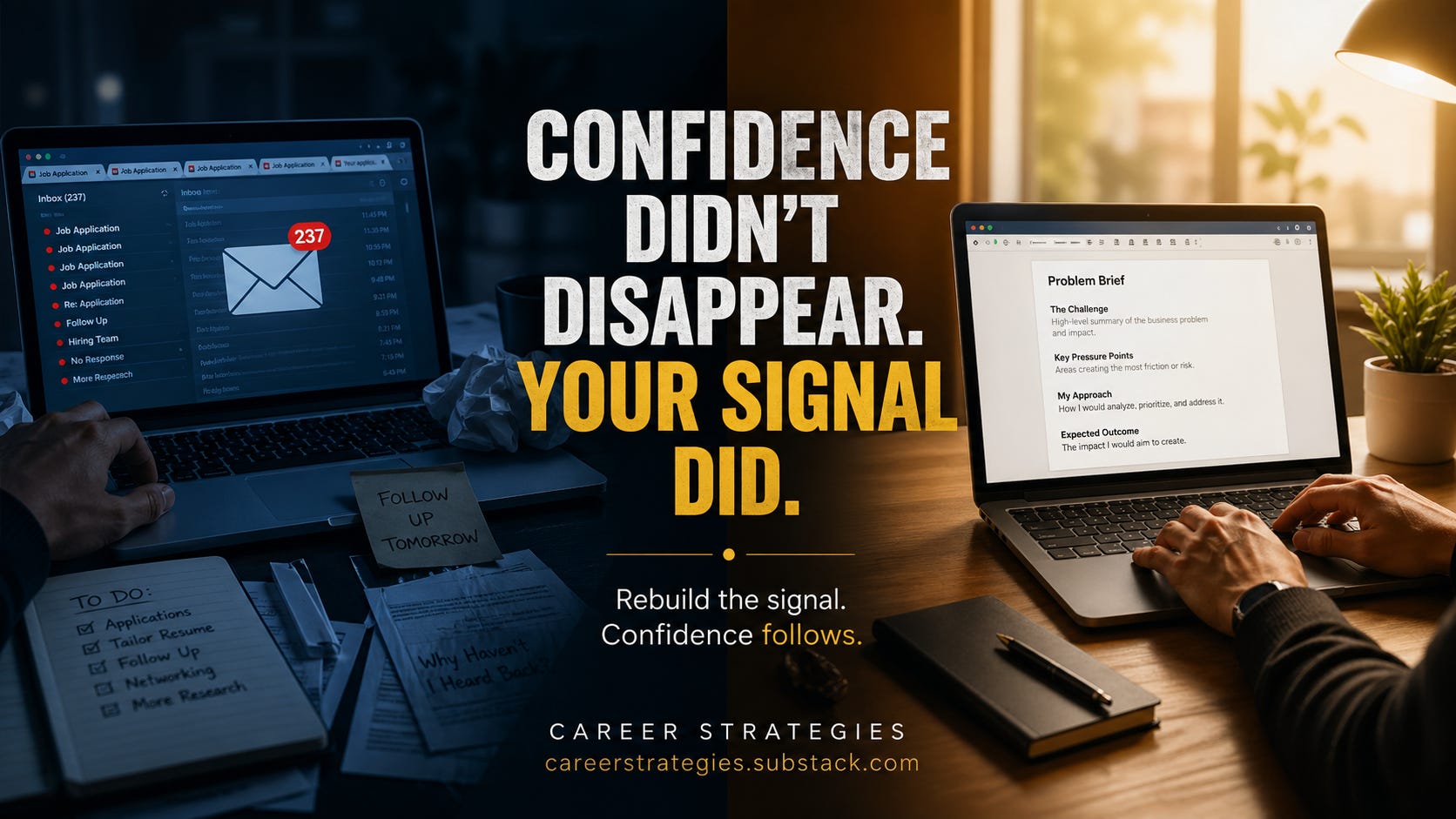
Rebuild the signal—
and the reflection returns.
Closing Bridge
The hardest part of a long job search
isn’t the rejection.
It’s the absence of confirmation.
Because without confirmation—
even the most capable professionals
start to question themselves.
Not loudly.
Quietly.
And persistently.
But here’s what most people miss:
Confidence isn’t required to move forward.
Clarity is.
Because when clarity returns—
confidence follows it.
Not the other way around.
Next: Article 6 — Becoming Visible Before the Job Exists
Before You Go
If you’ve felt your confidence shift during this process—
that’s not failure.
It’s pattern.
And it’s fixable.
That’s why I wrote:
Job Search Survival Guide 2026: Resilience, Strategy, and Real Stories for Today’s Job Market
Not to push you to keep going—
But to help you move forward
without losing who you are in the process.
About the Author
Byron K. Veasey is a career strategist and leader in data quality engineering focused on helping professionals navigate job searches, burnout, and career reinvention.
He writes Career Strategies, a newsletter read by over 4,400 professionals navigating today’s evolving job market.
👉 Subscribe to Career Strategies
The signal-goes-quiet phase you describe lands the same way in the Indian senior-IC data I track, Byron. By month four or five, the candidate stops counter-offering on whatever does come through, and the search becomes a band-anchoring collapse: a number ₹3 to 5 lakh below their prior band gets accepted because survival math has overridden negotiation math. The professionals who walk through cleanly are the ones who keep the search posture intact AND ship a parallel artifact, a teardown, a side project, an open-source PR, so the next offer cycle has new evidence rather than a lower anchor. Confidence rebuilds on the artifact, not on the noise.
Zia. AI career strategist for Indian professionals. itszia.ai
This is exactly right. Confidence in a job search is not some abstract mindset thing. When the market goes quiet, even strong people start questioning themselves because they have no feedback loop.
The fix is to build a system that creates evidence every week: targeted outreach, sharper positioning, real conversations and small wins you can actually track. That is why I think system in job search matters so much. It gives structure when your confidence is shaky - you stop measuring yourself by silence and start measuring the inputs that actually move the search forward. Shared my approach here:
https://consulting2tech.substack.com/p/your-90-day-plan-to-land-a-tech-offer