
Article 4: Your LinkedIn Profile Is a 24/7 Recruiter. Is It Working?

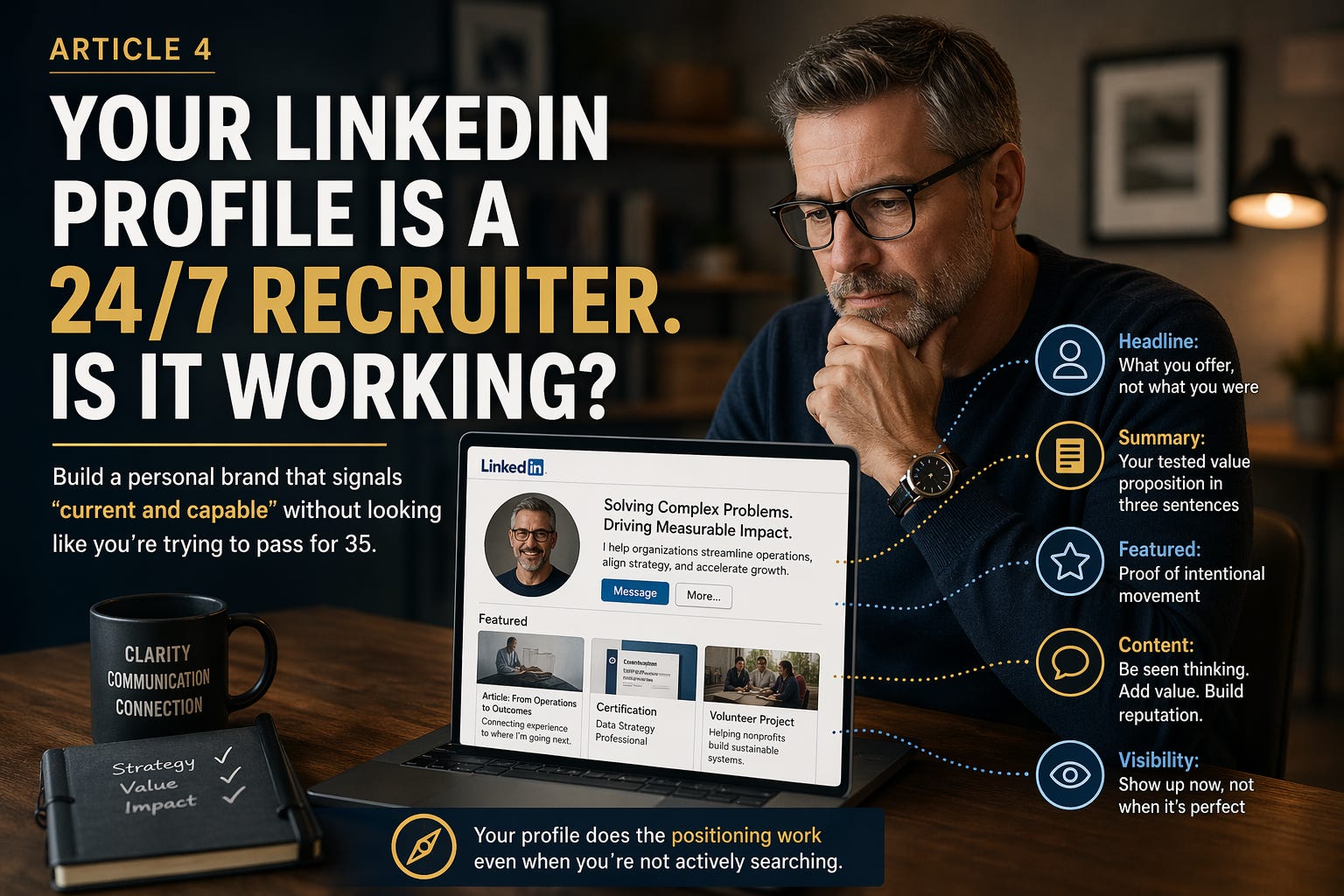
From the series: The Age-Proof Playbook — Five dispatches for experienced professionals who refuse to disappear
Based on the book, Age-Proof Your Job Search: Modern Tactics, AI Tools & Personal Branding for Mature Career Changers
This book is free from April 19 to April 23, 2026. All we ask is that you leave an honest review.
The uncomfortable reality
Right now, someone is clicking your name.
Maybe from a comment you left.
Maybe from a message you sent.
Maybe from a referral you didn’t even know was happening.
And in less than ten seconds, they’re deciding something that affects your next six months:
“Does this person feel current… or outdated?”
Not based on your experience.
Based on how that experience shows up.
Most experienced professionals aren’t losing opportunities because their background is wrong.
They’re losing them because their profile reads like a record of what was—
not a signal of what’s still true.
Static.
Backward-looking.
Carefully documented… and quietly disqualifying.
Your profile isn’t neutral.
It’s either opening doors—
or closing them before you even know they existed.
Your profile isn’t a summary. It’s positioning.
The biggest misunderstanding about personal branding—especially for professionals over 45—is this:
That it’s about marketing.
It isn’t.
It’s about clarity.
Clarity about what you do.
Clarity about how you think.
Clarity about the problems you solve now—not ten years ago.
Because in this market, people don’t hire based on potential alone.
They hire based on interpretability.
How quickly they can understand you.
How easily they can place you.
How confidently they can say:
“This person reduces risk.”
Your LinkedIn profile is where that decision happens—often before a conversation ever starts.
The headline problem
Most headlines tell people what you were.
“Senior Vice President, Global Operations”
“Director of Finance”
“IT Leader | 20+ Years Experience”
Those aren’t headlines.
They’re timestamps.
They force the reader to do the work of figuring out:
What does this person actually do?
And in a market moving this fast, if they have to think—
they move on.
A strong headline does something different.
It answers a forward-looking question:
What do you help organizations do?
Not your title.
Not your tenure.
Not your hierarchy.
Your function.
Your outcome.
Your signal.
For example:
Instead of:
“Senior Vice President, Global Operations”
Try:
“Scaling Operations to Reduce Cost and Complexity in Multi-Region Organizations”
Instead of:
“IT Director | 20+ Years Experience”
Try:
“Aligning Data, Systems, and Business Strategy to Improve Decision Speed”
You’re not hiding your experience.
You’re translating it.
The summary: your tested value proposition
Most summaries fall into one of two traps:
They read like a career timeline.
Or they read like a list of adjectives.
“Strategic leader.”
“Results-driven.”
“Dynamic professional.”
None of that answers the only question that matters:
What happens when we bring you in?
Your summary should do that in three clear sentences:
What you do now (in plain language)
The type of problems you solve
The outcome you consistently create
That’s it.
No long history.
No full autobiography.
No attempt to prove everything at once.
For example:
“I help organizations stabilize and scale their data environments when growth starts to outpace reliability.
My work focuses on reducing inconsistencies, improving trust in reporting, and aligning technical systems with business decisions.
The result is faster, more confident execution without adding operational overhead.”
That’s not marketing.
That’s clarity.
The most underused section on your profile
The Featured section.
Almost nobody uses it well.
And for career changers, it’s one of the highest-leverage tools you have.
Because it shows something your resume and summary can’t fully capture:
Movement.
Intentional movement.
You can pin:
An article connecting your old industry to your new one
A certification that signals direction
A project (paid or unpaid) that shows applied capability
A short write-up explaining how your experience translates
This is where you answer the unspoken question:
“Is this person drifting… or moving with purpose?”
A strong Featured section removes doubt.
It shows you’re not trying to escape your past—
You’re building from it.
The content strategy nobody talks about
Most people think LinkedIn success comes from posting.
It doesn’t.
It comes from being seen thinking.
And that happens just as much in the comments as it does in posts.
Here’s the structure that works without turning your life into content:
Two substantive posts per week
Not viral attempts. Not hot takes.
Just clear, useful perspectives tied to real experience.Five to ten meaningful comments per week
Not “great post.”
Not agreement.Add something.
Extend the idea.
Offer a perspective.
Show how you think.
This is how reputations are built quietly.
Over time, something shifts:
Your name becomes familiar.
Your thinking becomes associated with real problems.
And when someone clicks your profile—
they’re not meeting you for the first time.
The “Open to Work” question
There’s a lot of noise around this.
Here’s the grounded reality:
Private (recruiter-only) keeps your search discreet and avoids signaling urgency
Public increases visibility but can sometimes trigger assumptions about availability
So what should you do?
It depends on your position.
If you’re currently employed and being selective:
→ Keep it private
If you’re in an active search and need visibility:
→ Use it publicly—but pair it with a strong profile
Because the badge doesn’t create opportunity.
Clarity does.
Without that, the badge just amplifies confusion.
Why this feels harder than it should
Updating your profile mid-transition feels exposed.
Because it is.
You’re saying:
“This is who I am becoming… before it’s fully validated.”
That’s uncomfortable.
So most people wait.
They wait until they have the title.
The role.
The clean narrative.
And in that waiting, they lose something far more valuable:
Visibility.
Months of it.
Momentum they could have built.
Conversations that never started.
The professionals who move faster in this market aren’t more certain.
They’re just more willing to be seen in motion.
The real function of your LinkedIn profile
It’s not a profile.
It’s infrastructure.
It supports everything you’re already doing:
The outreach.
The conversations.
The referrals.
The opportunities that never hit a job board.
As you saw in the last article, the shift is from being processed to being considered.
Your LinkedIn profile determines what happens next:
Does your signal strengthen?
Or does it collapse?
Hope Anchor
You don’t need to become someone else to be seen.
You need to become clearer about who you already are—
and let that clarity work for you.
Closing move
The profile, the pitch, the resume—
These are the visible layers.
But there’s something underneath all of them that determines whether they work:
How you show up in the room.
How you’re read.
How you’re trusted.
How you handle the moment when it matters.
That’s next.
Article 5: You’re Being Interviewed Before You Speak. Here’s What They’re Actually Evaluating.
About the Author
Byron K. Veasey is a career strategist and leader in data quality engineering focused on helping professionals navigate job searches, burnout, and career reinvention.
He writes Career Strategies, a newsletter read by over 3,900 professionals navigating today’s evolving job market.
👉 Subscribe to Career Strategies