
Article 4: The Recovery Phase Most People Skip (And Pay For Later)

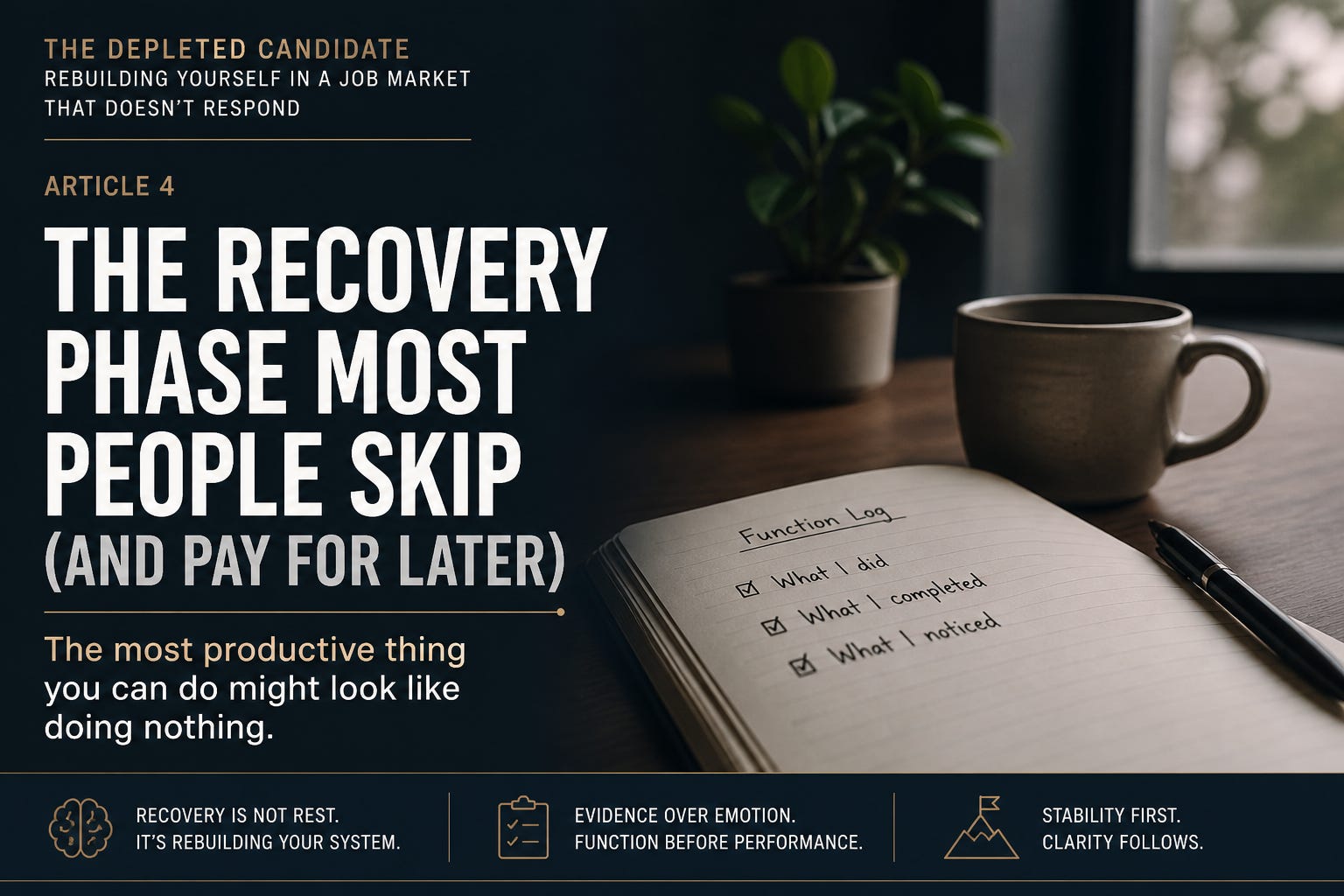
The Depleted Candidate: Rebuilding Yourself in a Job Market That Doesn’t Respond
Six dispatches for professionals rebuilding after the floor dropped out
Based on The Depleted Candidate: How to Stop Executing While Depleted — and the Framework That Actually Works
This book is free from May 3 to May 7, 2026. All we ask is that you leave an honest review.
The most productive thing you can do might look like doing nothing.
And that’s exactly why most people skip it.
The Assumption That Keeps You Stuck
Most professionals carry an unspoken belief:
Momentum comes from action.
So the moment the job ends, the response is immediate:
Update the resume
Start applying
Reach out to everyone
Stay busy
Because stopping feels dangerous.
Because slowing down feels irresponsible.
Because if you’re not moving, you must be falling behind.
The Part No One Tells You
You are not starting from zero.
You are starting from depletion.
And that changes everything.
Because the version of you sending applications right now—
is not the version of you who performed at your highest level.
It’s a version operating with:
Reduced cognitive capacity
Lower emotional regulation
Fragmented confidence
And no external feedback loop
But the system you’re entering?
It assumes stability.
Execution From the Wrong State
This is where the breakdown begins.
You’re doing the “right” things—
but from the wrong state.
So what comes out doesn’t match what you’re capable of.
Your writing becomes heavier
Your answers become longer
Your tone becomes slightly uncertain
Not obvious.
But detectable.
And in a competitive market—
subtle signals decide outcomes.
Why “Just Push Through” Backfires
When results don’t come back, the instinct is predictable:
Do more.
More applications
More networking
More urgency
But here’s what’s actually happening:
Effort increases
Clarity decreases
Confidence erodes
And the loop tightens.
You work harder…
and feel worse.
The Missing Phase
There’s a phase almost no one talks about.
Because it doesn’t produce visible output.
It doesn’t generate immediate results.
And it’s difficult to explain to other people.
That phase is Recovery.
Not rest.
Not avoidance.
Recovery.
What Recovery Actually Is
Recovery is not about feeling better.
It’s about stabilizing your internal system.
Before you try to perform again.
Because performance depends on conditions.
And those conditions are currently gone.
Structure
Feedback
Validation
Clarity
Without them, even high performers degrade.
Not permanently.
But predictably.
Why Motivation Doesn’t Work Here
Most advice tries to solve this with motivation.
Think positive
Stay confident
Keep pushing
But under real stress—
your system doesn’t respond to motivation.
It responds to evidence.
And right now, the evidence your brain sees is:
No responses
No feedback
No confirmation
So when you try to “stay positive”—
it doesn’t land.
It conflicts.
The Function Log: Replacing What Was Lost
At work, you didn’t have to prove you were functioning.
The environment proved it for you.
Meetings attended
Decisions made
Problems solved
Now that system is gone.
So your brain fills the gap with doubt.
The Function Log replaces that.
Not with motivation—
but with data.
You write down:
What you did
What you completed
What you noticed
No judgment.
No interpretation.
Just facts.
Why This Works
Because it gives your brain something it can trust.
Evidence.
You didn’t “do nothing today.”
You moved.
You decided.
You acted.
Even in small ways.
And over time—
those small proofs rebuild stability.
The Shift Most People Miss
You don’t rebuild confidence first.
You rebuild function.
Then confidence follows.
Not the other way around.
The Real Cost of Skipping This
If you skip Recovery—
you don’t save time.
You extend the search.
Because every action you take from depletion:
Converts at a lower rate
Costs more energy
Reinforces negative feedback
So you end up:
Doing more
Getting less
And feeling worse
The Reframe That Changes Everything
Stop asking:
“How do I get results faster?”
Start asking:
“What state am I operating from?”
Because the same action—
from a stable system—
produces a completely different outcome.
Status Upgrade
Stop trying to feel better.
Start tracking what’s real.
Hope Anchor
You are not stuck because you’ve lost ability.
You are stuck because you lost the system that supported it.
Rebuild the system—
and your capacity returns with it.
What Comes Next
In the next article, we shift from stabilization to visibility—
how to rebuild your signal in a way the market can actually recognize.
Final Line
You don’t need motivation.
You need evidence that you’re still functioning.
About the Author
Byron K. Veasey is a career strategist and leader in data quality engineering focused on helping professionals navigate job searches, burnout, and career reinvention.
He writes Career Strategies, a newsletter read by over 4,600 professionals navigating today’s evolving job market.
👉 Subscribe to Career Strategies