
Article 3: When the Calendar Goes Silent, You Lose More Than a Routine

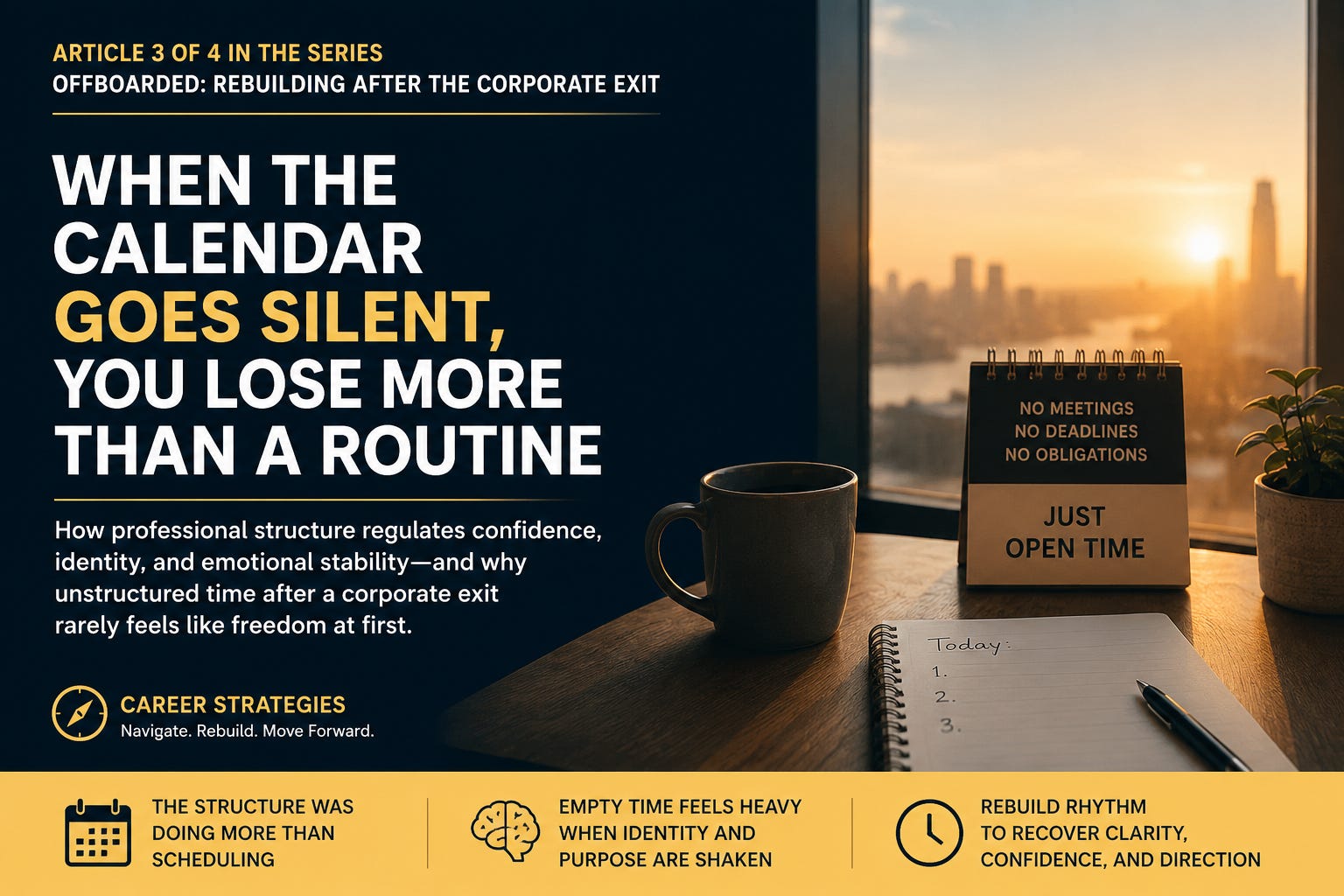
How professional structure regulates confidence, identity, and emotional stability—and why unstructured time after a corporate exit rarely feels like freedom at first.
Article 3 of 4 in the series
Offboarded: Rebuilding After the Corporate Exit
Adapted from Offboarded: Rebuilding Identity, Purpose, and Career After Layoff, Restructuring, or Corporate Exit by Byron K. Veasey.
A few days after the corporate exit, you wake up before the alarm.
For a moment, your body does not remember.
You reach for the phone.
You expect the usual notifications.
A meeting reminder.
An urgent message.
A calendar conflict.
A problem that appeared overnight and somehow became yours before breakfast.
But the screen is quiet.
There is nowhere you are required to be.
No one is waiting for an update.
No meeting begins in thirty minutes.
No problem has been assigned to you.
This is supposed to feel like relief.
Instead, it feels strangely unsettling.
You lie there longer than usual, uncertain whether you should get up, rest, search for work, answer messages, update your résumé, exercise, clean the house, or simply allow yourself to do nothing.
The options are open.
But the openness does not feel spacious.
It feels uncontained.
That is one of the least discussed consequences of a corporate exit.
You do not only lose a job.
You lose the structure that had been telling your body, attention, and emotions how to move through the day.
The calendar goes silent.
And suddenly, you discover how much of your life it had been holding together.
The Calendar Was Doing More Than Scheduling
A professional calendar appears to be a practical tool.
It tells you where to be.
It reminds you what is due.
It coordinates your time with the time of other people.
But after enough years inside an organization, the calendar begins performing deeper functions.
It regulates attention.
It creates urgency.
It divides the day into recognizable units.
It tells you when to prepare, when to perform, when to respond, and when you are allowed to stop.
It creates a rhythm your nervous system learns to anticipate.
Monday feels different from Friday.
Morning feels different from afternoon.
The week has a beginning, a middle, and an end.
Even periods of stress have recognizable boundaries.
You know when the meeting starts.
You know when the report is due.
You know when the quarter closes.
You know when the decision must be made.
The calendar does not merely organize your responsibilities.
It organizes your experience of time.
That organization becomes so familiar that you rarely notice it while it is present.
You notice it when it disappears.
Structure Is Emotional, Not Just Practical
Most people think of structure as a productivity issue.
Without structure, they assume, you may become distracted, inefficient, or disorganized.
That is true.
But incomplete.
Structure is also emotional.
Predictable routines reduce the number of decisions you must make about how to begin.
They help the mind distinguish between what matters now and what can wait.
They create regular moments of activation and release.
They provide repeated evidence that you are participating in something larger than yourself.
A meeting may have been unnecessary.
But it still told you that you belonged somewhere at 10:00 a.m.
A deadline may have been stressful.
But it still gave your effort direction.
A team request may have interrupted your plans.
But it also reminded you that your knowledge had a place to go.
This is why the sudden absence of professional obligations can create more than boredom.
It can create emotional disorientation.
You are not simply asking, “What should I do today?”
You may also be asking:
What makes today different from yesterday?
What deserves my attention?
What am I working toward?
How do I know when I have done enough?
Where does my effort belong now?
Those questions are difficult because the organization used to answer them for you.
Now you must answer them yourself.
Why Empty Time Feels So Heavy
Before a layoff or corporate exit, you may have imagined what you would do with more free time.
You would sleep.
Read.
Exercise.
Take long walks.
Reconnect with people.
Finish neglected projects.
Think more clearly about your future.
But when the free time arrives through disruption rather than choice, it carries a different emotional weight.
It does not feel like vacation.
Vacation has boundaries.
You know why you are away.
You know when you are returning.
Your professional identity remains intact while you rest.
Post-exit time is different.
The absence is indefinite.
The future is unclear.
Rest may feel undeserved because there is no confirmed return date.
Enjoyment may feel irresponsible because important questions remain unanswered.
Even ordinary activities can become psychologically complicated.
You sit outside, but part of you thinks you should be networking.
You watch a movie, but part of you thinks you should be applying.
You take a walk, but part of you calculates how many days have passed since the exit.
You try to rest, but the mind keeps converting time into evidence.
Another morning without progress.
Another afternoon without a response.
Another week without an interview.
The time is technically yours.
But it does not yet feel safe enough to inhabit.
The Loss of External Rhythm
Corporate life creates external rhythm.
Someone else schedules the meeting.
Someone else defines the reporting cycle.
Someone else establishes the operating hours.
Someone else decides what counts as urgent.
Even when you have significant autonomy, you are still moving within a shared system of expectations.
That shared system reduces uncertainty.
You may dislike the pace.
You may resent the interruptions.
You may feel exhausted by the demands.
But you rarely have to invent the entire structure of your day from nothing.
After the exit, that changes.
You become responsible for generating your own momentum.
You must decide when the day begins.
You must decide what deserves priority.
You must decide how much job searching is enough.
You must decide whether recovery is productive.
You must decide when to stop thinking about the future.
Those decisions sound small.
Together, they can become exhausting.
This is one reason experienced professionals may feel unexpectedly depleted after leaving a demanding role.
The workload is gone.
But the internal work of organizing an uncertain life has increased.
When Rest Does Not Feel Restful
One of the cruelest parts of this transition is that the body may need rest while the mind refuses to permit it.
You may have been exhausted long before the role ended.
You may have been carrying years of pressure, responsibility, uncertainty, politics, deadlines, and accumulated fatigue.
The exit creates an opportunity to recover.
But it also creates fear.
Fear says you cannot slow down.
Fear says every day without visible progress puts you further behind.
Fear says employers will interpret a pause as weakness.
Fear says you must prove that you are still disciplined, relevant, and ambitious.
So you recreate work without employment.
You wake early.
You build elaborate spreadsheets.
You track applications.
You rewrite your résumé repeatedly.
You consume career advice for hours.
You schedule networking conversations.
You research certifications.
You update profiles.
You create goals for every day of the week.
Some of this may be useful.
But activity and recovery are not the same thing.
Sometimes the constant motion is not strategy.
It is an attempt to escape the discomfort of no longer being externally needed.
The Productivity Panic
When professional identity has been connected to output, an empty calendar can feel morally suspicious.
You may begin evaluating every day according to how much you accomplished.
Did you apply to enough jobs?
Did you contact enough people?
Did you learn something new?
Did you improve your LinkedIn profile?
Did you follow up?
Did you create a portfolio?
Did you research the market?
Did you make measurable progress?
These are reasonable questions in moderation.
But under emotional pressure, they can become instruments of self-punishment.
A day with fewer applications becomes a wasted day.
A quiet afternoon becomes evidence of laziness.
A week without interviews becomes evidence that your effort is failing.
Rest becomes guilt.
Reflection becomes procrastination.
Recovery becomes something you promise yourself after the next opportunity appears.
This is the productivity panic.
It happens when the mind attempts to replace lost professional legitimacy with constant visible activity.
If you are no longer producing for an employer, you feel compelled to produce proof that you still deserve a future.
The problem is not ambition.
The problem is using activity to negotiate with fear.
The Hidden Shame of Unstructured Days
There is a particular kind of shame that can appear when your days no longer resemble the days of the people around you.
They leave for work.
You remain home.
Their calendars are full.
Yours is open.
They complain about meetings.
You quietly miss having one.
They look forward to Friday.
You realize the days have begun blending together.
This can make ordinary social questions difficult.
“What are you doing this week?”
“How is the job search going?”
“Do you have any interviews lined up?”
“What is next for you?”
The questions may be well-intentioned.
But they expose the absence of structure.
You may begin filling your days partly so that you have something respectable to report.
Consulting.
Research.
Advisory work.
Professional development.
Exploring opportunities.
Working on a few projects.
Those descriptions may be accurate.
But sometimes they are also emotional protection.
They prevent you from having to say:
I am still trying to understand what happened.
I am more tired than I expected.
I do not yet know what comes next.
My days are open, but my mind is not at ease.
I am rebuilding a life structure I once assumed would always be there.
That truth can feel too vulnerable to share.
But it is often closer to the actual work of this stage.
The Nervous System Still Expects the Old Life
The body learns professional routines.
It learns the alarm time.
It learns the commute.
It learns the morning tension.
It learns the Sunday-night anticipation.
It learns when messages usually arrive.
It learns which hours require alertness.
It learns the subtle signals that a workday is beginning.
Those patterns do not disappear when employment ends.
Your mind may understand that the role is over.
Your nervous system may continue behaving as if something is about to be demanded of you.
You may wake with urgency before remembering there is no meeting.
You may feel guilty during the afternoon without knowing why.
You may check your phone repeatedly.
You may experience Sunday evening tension even though Monday has no formal obligations.
You may feel tired after doing very little.
That does not necessarily mean you are becoming less disciplined.
It may mean your system is adjusting to the disappearance of a rhythm it followed for years.
The body is asking:
What environment am I in now?
When must I be alert?
When am I allowed to rest?
What is expected of me?
Am I safe without the old structure?
Until those questions receive new answers, unstructured time may continue feeling more threatening than restorative.
Why Job Search Advice Can Make It Worse
Much of job search culture responds to uncertainty by prescribing more activity.
Treat the search like a full-time job.
Apply every day.
Build your brand.
Post consistently.
Network constantly.
Learn new skills.
Optimize every document.
Track every interaction.
Never lose momentum.
This advice can be useful for someone who needs organization.
But it can be harmful when given without regard for emotional condition.
A person recovering from identity disruption may hear “treat the search like a job” as:
You are not allowed to recover.
You must replace your former workload immediately.
You must earn the right to feel okay.
You must demonstrate your seriousness every day.
You must convert uncertainty into performance.
That can recreate the very conditions the body needs time to process.
The person leaves a demanding corporate system and immediately builds another demanding system inside their own home.
There is no manager now.
But the internal manager may be harsher.
There is no performance review.
But every evening becomes one.
There is no official productivity target.
So the mind invents an impossible one.
More applications.
More outreach.
More learning.
More proof.
The job search becomes not only a path toward employment but a daily trial of worth.
The Difference Between Structure and Pressure
You do need structure during a transition.
But structure and pressure are not the same thing.
Pressure says every hour must produce a measurable result.
Structure says the day needs enough shape to feel inhabitable.
Pressure says you must stay constantly active.
Structure says different kinds of work require different kinds of time.
Pressure treats rest as an obstacle.
Structure recognizes rest as part of sustainable functioning.
Pressure demands certainty.
Structure creates stability while certainty is still unavailable.
Pressure asks, “How much did you accomplish?”
Structure also asks, “What helped you remain clear, connected, and emotionally steady?”
That distinction matters.
Without structure, the day may dissolve.
With excessive pressure, the person may dissolve.
The goal is not to recreate the corporate calendar in miniature.
The goal is to build a rhythm that supports recovery, strategic action, and a wider sense of self.
Rhythm Reconstruction
The next stage of recovery requires something the book describes as rhythm reconstruction.
Rhythm reconstruction is the intentional process of creating a daily and weekly structure after the organization is no longer creating one for you.
It is not a rigid productivity system.
It is not a color-coded attempt to control every hour.
It is a way of helping the mind and body experience time as coherent again.
A healthy transition rhythm answers several important questions:
When does my day begin?
What deserves focused attention?
When will I work on the search?
When will I stop?
Where will connection happen?
How will I care for my physical energy?
What activities remind me that I am more than a candidate?
How will I recognize progress that does not immediately produce an offer?
These questions rebuild orientation.
They transform the calendar from an empty reminder of what was lost into a supportive framework for what is emerging.
Four Anchors for an Uncertain Season
A transition calendar does not need to be full.
It needs to be anchored.
Four kinds of anchors can help.
A beginning anchor
Create a consistent way to begin the day.
Not because every morning must be highly productive.
Because beginnings matter.
The old workday had signals.
An alarm.
A commute.
Coffee before the first meeting.
A login sequence.
A review of messages.
You need a new signal that tells the body:
The day has started.
I am present.
I do not need to panic.
I know what happens next.
That signal may be a walk.
Prayer.
Journaling.
Exercise.
Reading.
Breakfast away from your phone.
Reviewing three priorities.
The specific activity matters less than the consistency.
A beginning anchor prevents the day from opening directly into anxiety.
A contribution anchor
Create a defined period for career activity.
This may include applications, networking, writing, research, interview preparation, consulting, or professional development.
Give this work boundaries.
Decide what you will do.
Decide when you will do it.
Decide what enough looks like.
This protects you from the belief that because the job search is important, it must occupy every available hour.
Focused effort is often more effective than constant anxious effort.
A contribution anchor says:
I am taking my future seriously.
But I will not spend the entire day proving it.
A connection anchor
Corporate life provided regular human contact, even when the contact was imperfect.
After an exit, isolation can arrive quietly.
Days may pass without meaningful conversation.
You may exchange messages online while still feeling socially absent.
Create intentional points of connection.
Meet someone for coffee.
Call a former colleague.
Attend a professional event.
Volunteer.
Join a small group.
Spend time with people who do not evaluate you according to employment status.
Connection helps regulate perspective.
It reminds you that your current situation is part of your life.
It is not the entirety of your identity.
A closing anchor
The job search has no natural end to the day.
There is always another posting.
Another profile to review.
Another message to send.
Another résumé adjustment to consider.
Without a closing ritual, the search can remain psychologically active from morning until sleep.
Create a defined ending.
Review what you completed.
Write down the next step.
Close the browser tabs.
Move away from the workspace.
Take a walk.
Prepare dinner.
Change rooms.
Say, even if only to yourself:
Today’s work is complete.
The future is still unresolved.
But I do not have to solve it tonight.
A closing anchor gives the nervous system permission to stand down.
A Calendar That Serves Recovery
A healthy calendar during transition should contain more than job search tasks.
It should reflect the whole person who is rebuilding.
There may be time for professional action.
There should also be time for physical recovery.
Time for relationships.
Time for administration.
Time for reflection.
Time for creativity.
Time for responsibilities that employment once forced you to postpone.
Time for experiences that produce no résumé line at all.
This can be difficult for professionals who are accustomed to measuring value through output.
A walk may not feel productive.
A conversation may not feel strategic.
An afternoon of rest may not produce visible progress.
But recovery does not always announce its results immediately.
Sometimes progress looks like sleeping more consistently.
Thinking more clearly.
Feeling less panic when someone asks about your future.
Becoming able to concentrate again.
Enjoying an activity without guilt.
Recognizing that one quiet day does not mean your life is disappearing.
These changes matter.
They are not separate from career recovery.
They make sustainable career movement possible.
Measure What the Market Cannot See
One of the frustrations of a job search is that important progress may remain invisible.
You can improve your positioning without receiving an immediate interview.
You can become more emotionally stable without receiving an offer.
You can clarify your direction without having a new title to announce.
You can rebuild confidence before anyone outside your life notices.
The market tends to confirm progress late.
That means you need ways to recognize it earlier.
You may measure:
Conversations started.
Relationships renewed.
Clarity gained.
Applications made with genuine alignment.
New language developed for your experience.
Boundaries maintained.
Energy protected.
Skills refreshed.
Ideas explored.
Days completed without allowing uncertainty to become self-condemnation.
These are not consolation prizes.
They are signs that you are rebuilding the internal capacity required for the next chapter.
The Goal Is Not to Recreate Corporate Life
It may be tempting to reproduce the intensity of your former schedule.
Back-to-back tasks.
Aggressive goals.
Constant availability.
Every hour assigned.
That approach may initially feel familiar.
Familiarity can feel like control.
But the purpose of rebuilding is not to prove that you can remain as busy without the company as you were inside it.
The purpose is to discover a healthier relationship with time, contribution, and identity.
Your former calendar may have made you productive.
It may also have prevented you from noticing exhaustion.
It may have kept difficult questions outside awareness.
It may have rewarded constant responsiveness.
It may have trained you to confuse urgency with importance.
It may have left little room for reflection, relationships, or parts of yourself that did not produce professional outcomes.
The silence after an exit can be painful.
But silence also reveals.
It reveals which demands were truly necessary.
It reveals how much of your pace was chosen and how much was inherited.
It reveals what you neglected to remain professionally available.
It reveals whether your calendar was serving your life or consuming it.
That knowledge can become part of the next chapter.
You do not need to reject discipline.
You may need to redefine it.
Discipline is not only forcing yourself to do more.
Sometimes discipline means ending the search at a reasonable hour.
Sometimes it means resting before exhaustion becomes collapse.
Sometimes it means protecting time from panic.
Sometimes it means refusing to let an uncertain market occupy every room in your mind.
Sometimes it means building a day you can live inside even before the future becomes clear.
The Empty Calendar Is Not an Empty Life
This is the sentence that becomes important during this stage:
An empty calendar is not evidence of an empty life.
Your value is not measured by the number of people requesting your time.
Your relevance is not measured by the number of meetings you attend.
Your intelligence is not suspended because no organization is currently assigning it work.
Your capacity has not disappeared because your inbox is quieter.
The calendar once displayed your obligations.
It did not contain your entire worth.
That distinction may take time to feel true.
For years, busyness may have been evidence that you mattered.
People wanted answers.
Projects needed attention.
Decisions required your presence.
Now the absence of those demands may feel like absence of significance.
But being temporarily unassigned is not the same as being unnecessary.
Your abilities still exist.
Your experience still exists.
Your judgment still exists.
Your capacity to contribute still exists.
What has changed is the structure through which those qualities were previously expressed.
The task now is not to fill every empty hour so you can feel legitimate again.
The task is to create enough rhythm that you can hear yourself think, recover your energy, and choose your next direction without allowing fear to schedule the entire day.
A Question to Sit With
Before filling the calendar, ask:
What did my former schedule protect me from having to feel?
Did constant activity protect me from uncertainty?
Did meetings protect me from loneliness?
Did deadlines protect me from having to choose my own priorities?
Did professional urgency protect me from questions about purpose?
Did being needed protect me from wondering who I was when no one required anything?
Did exhaustion provide a socially acceptable reason not to examine the rest of my life?
These are not accusations.
They are invitations.
The old calendar may have supported you.
It may have given your talents a place to operate.
It may have created belonging, meaning, and momentum.
It may also have become a structure you depended on more deeply than you understood.
Now that structure is gone.
You have the difficult task of creating rhythm without surrendering your life to pressure again.
Start small.
Give the morning a beginning.
Give career work a boundary.
Give connection a place.
Give the day an ending.
Leave room for recovery.
Leave room for thought.
Leave room for the person whose existence was once crowded by obligations.
The calendar does not need to be full to prove that you matter.
It needs to help you live through this season without losing yourself inside it.
The silence may still feel uncomfortable.
But over time, it can become something other than absence.
It can become space.
Space to recover.
Space to reconsider.
Space to hear the parts of your identity that were once drowned out by urgency.
Space to build a future that contains meaningful work without requiring work to contain your entire life.
That is not wasted time.
That is reconstruction.
About the Author
Byron K. Veasey is a career strategist and leader in data quality engineering focused on helping professionals navigate job searches, burnout, and career reinvention.
He writes Career Strategies, a Substack newsletter read by over 4,900 professionals navigating today’s evolving job market.
👉 Subscribe to Career Strategies