
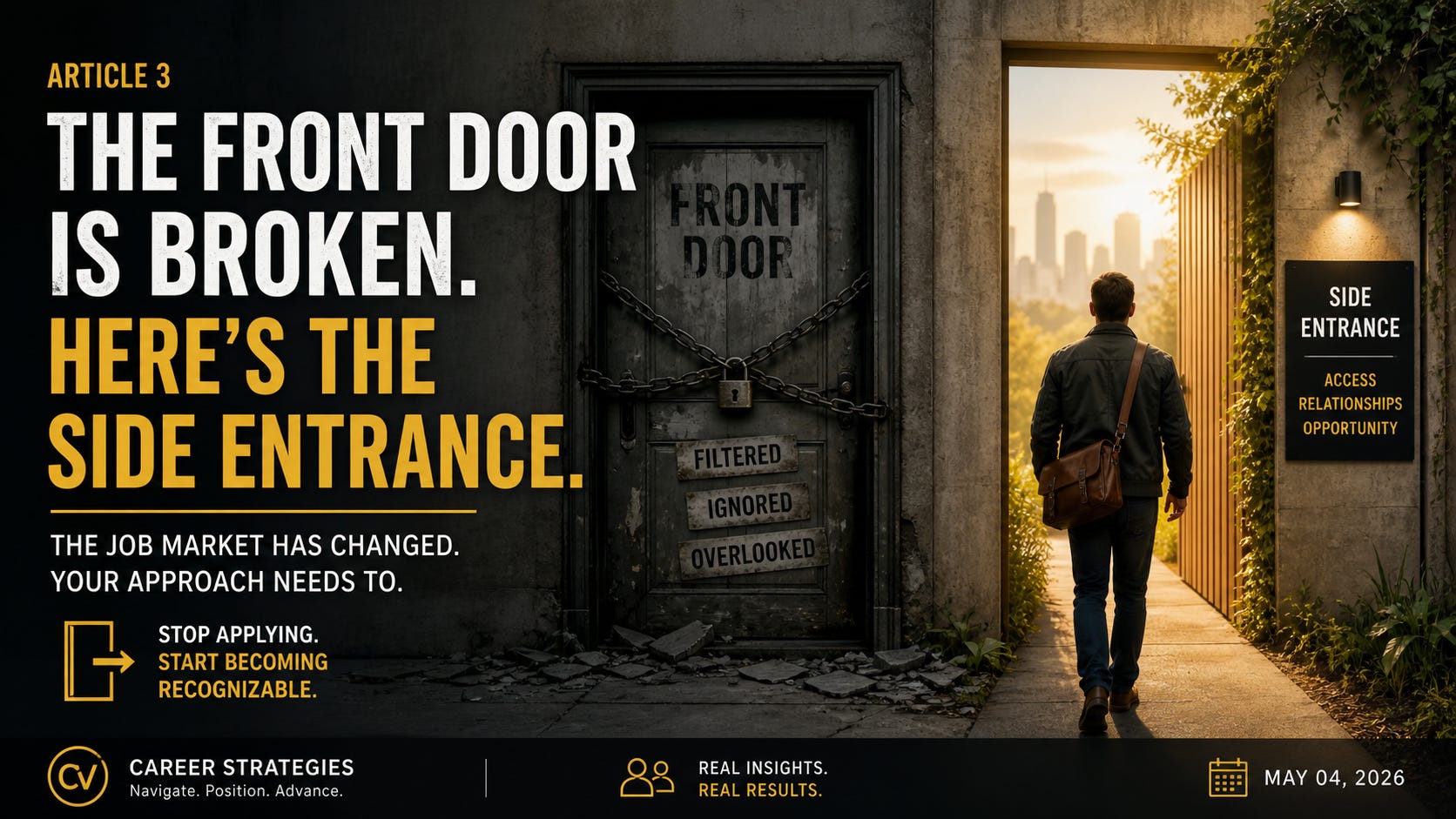
Article 3: The Front Door Is Broken. Here’s the Side Entrance.

The Depleted Candidate: Rebuilding Yourself in a Job Market That Doesn’t Respond
Six dispatches for professionals rebuilding after the floor dropped out
Based on The Depleted Candidate: How to Stop Executing While Depleted — and the Framework That Actually Works
This book is free from May 3 to May 7, 2026. All we ask is that you leave an honest review.
The job search didn’t just get harder.
It got quieter.
And the door you’ve been told to use?
It doesn’t open the way it used to.
The Assumption That No Longer Holds
Most professionals are still operating under an outdated belief:
That the job market is a funnel.
You find a role → you apply → you get evaluated → you move forward.
A clean sequence.
A fair system.
A visible path.
But in 2026, that model is no longer dominant.
Because before your application is evaluated—
it’s interpreted.
And most of the time, it never makes it past that layer.
The Invisible Gatekeeper
The Applicant Tracking System (ATS) was never designed to evaluate talent.
It was designed to manage volume.
Now, layered with AI, it does something more:
It translates you.
Not who you are.
Not what you’ve done.
But how well your experience matches the language it was trained to recognize.
That means:
You can be qualified—and invisible
Experienced—and unreadable
Relevant—and filtered out
Not because you weren’t right for the role.
Because your signal didn’t match the system’s interpretation model.
Rejection Without Evaluation
This is the part most people don’t realize:
You are often being rejected…
before a human being ever sees your name.
No conversation
No context
No nuance
Just pattern matching.
And if your experience doesn’t align with expected phrasing, structure, or signal density—
you disappear.
Not rejected.
Not considered.
Just… removed from the flow.
Why Strong Candidates Feel Stuck
This is why high-performing professionals feel disoriented.
Because they’re used to environments where:
Performance leads to visibility
Visibility leads to opportunity
But now?
Performance doesn’t automatically translate.
And visibility isn’t guaranteed.
So the loop becomes:
You apply → no response
You optimize → no response
You increase effort → no response
And eventually:
“This doesn’t make sense.”
Because it doesn’t.
You’re using a system that was built for a different market.
The Front Door Problem
The “front door” is the traditional application process.
Job boards
Career sites
Online submissions
And while it still exists—
it’s no longer the primary path to opportunity.
It’s a high-volume intake system.
Optimized for efficiency, not discovery.
Which means:
The more competitive the role,
the less likely the front door is how it gets filled.
What Actually Happens Behind the Scenes
Roles are often filled through:
Internal referrals
Dormant networks
Prior relationships
Direct outreach
Reputation-based pulls
Before the job posting ever becomes relevant.
The posting?
That’s often a compliance artifact.
Or a late-stage pipeline filler.
Not the origin of the hire.
The Side Entrance
The professionals landing roles consistently are doing something different:
They are not relying on the front door.
They are creating access before the job exists.
Not by “networking harder.”
But by becoming visible in the right way.
Visibility Is Not Exposure
Most people misunderstand visibility.
They think it means:
Posting more
Commenting more
Being louder
That’s exposure.
Visibility is different.
Visibility is:
Being legible to the right people
In the right context
For the right type of work
It’s not volume.
It’s alignment.
The Shift That Changes Everything
Instead of asking:
“How do I apply better?”
You need to start asking:
“How do I become recognizable before I apply?”
Because once someone already understands your value—
you’re no longer entering as an unknown.
You’re entering as a known signal.
And that changes everything.
The New Access Model
Here’s how the system actually works now:
Unknown candidate → filtered
Known signal → considered
Trusted signal → pursued
The front door only works for the first category.
And that’s the hardest position to win from.
Why This Feels Uncomfortable
Because it requires a shift most professionals resist:
From private competence
to public clarity
You can no longer rely on your experience existing.
It has to be seen.
Understood.
Recognized.
Not everywhere.
But in the right places.
This Isn’t Gaming the System
Let’s correct another misconception:
This is not about bypassing fairness.
It’s about adapting to structure.
The system already filters.
The system already prioritizes familiarity.
The system already rewards recognition.
You’re not breaking it.
You’re learning how it actually functions.
The Real Risk
The risk isn’t that the front door doesn’t work.
It’s that you keep using it as your primary strategy—
while your confidence erodes inside a system that was never designed to see you.
The Reframe That Unlocks Movement
Stop asking:
“Why isn’t this working?”
Start asking:
“What channel is this system actually rewarding?”
Because once you align with that—
you stop forcing effort into low-return paths
and start building signal where it actually matters.
Status Upgrade
Stop trying to be selected from a pile.
Start becoming someone who never enters the pile in the first place.
Hope Anchor
You are not invisible.
You are operating in a system that only recognizes certain forms of visibility.
Change the signal—
and you change the outcome.
What Comes Next
In the next article, we’ll go deeper into what happens over time:
The psychological and behavioral shift that hits around month four or five—
when effort continues, but momentum disappears.
Final Line
The front door didn’t close.
It just stopped being the way in.
About the Author
Byron K. Veasey is a career strategist and leader in data quality engineering focused on helping professionals navigate job searches, burnout, and career reinvention.
He writes Career Strategies, a newsletter read by over 4,600 professionals navigating today’s evolving job market.
👉 Subscribe to Career Strategies