
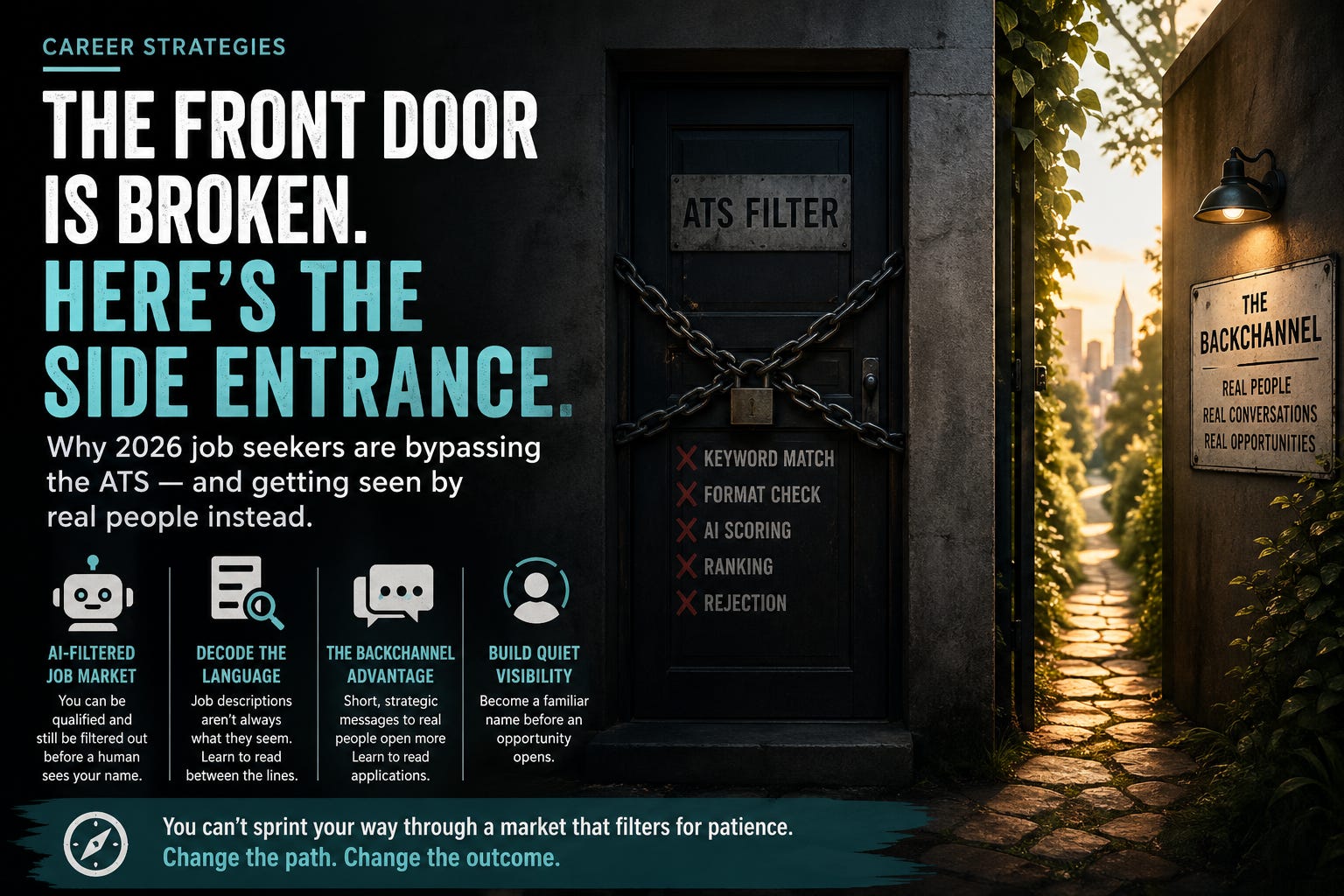
Article 3: The Front Door Is Broken. Here’s the Side Entrance

The Survival Architecture
Six dispatches for professionals rebuilding after the floor dropped out
Based on the book, Job Search Survival Guide 2026: Resilience, Strategy, and Real Stories for Today’s Job Market
This book is free from April 26 to April 30, 2026. All we ask is that you leave an honest review.
In 2026, a qualified candidate can be rejected before a human being ever sees their name.
Not because they weren’t right for the role.
Because the way they described themselves
didn’t match the way an algorithm was trained to read.
That’s the market you’re in.
And if you don’t understand that—
you’ll keep knocking on a door
that was never designed to open for you.
The Front Door Was Never Built for Judgment
“Applicant Tracking System” sounds neutral.
It isn’t.
It’s not a hiring tool.
It’s a volume management system.
It exists for one reason:
To reduce thousands of applicants
into a smaller, manageable set.
Not by understanding people—
but by pattern-matching signals.
Keywords
Formatting
Titles
Timelines
And increasingly—
AI-assisted scoring models that attempt to predict fit
without context.
So what happens?
A hiring manager posts a role.
500 people apply.
The system filters.
And by the time a human sees anything—
you’re either already in the pile…
or already gone.
The New Reality: Digital Exile
This is where most professionals get stuck.
They think:
“I’m being rejected.”
But that’s not what’s happening.
You’re not being evaluated.
You’re being excluded.
Quietly.
Instantly.
At scale.
And it shows up in ways that feel confusing:
You meet every requirement—but hear nothing
You apply early—but never get traction
You tailor your resume—but results don’t change
Because the system isn’t asking:
“Is this person capable?”
It’s asking:
“Does this look like what we’ve already seen succeed?”
That’s not judgment.
That’s pattern recognition.
And if your experience doesn’t map cleanly to that pattern—
you disappear.
The Language Problem No One Tells You About
Your experience is real.
Your results are real.
But your language might be wrong.
That’s the gap.
Most job descriptions in 2026 aren’t written for clarity.
They’re written for:
Internal alignment
AI parsing
Market signaling
Which means what they say…
and what they mean…
are not the same thing.
Example:
“Cross-functional leadership”
Often means:
“Can reduce friction between teams under pressure”
“Strategic thinker”
Often means:
“Can make decisions with incomplete data”
“Owns outcomes”
Often means:
“Will absorb ambiguity without escalation”
If you respond literally—
you miss the signal.
The shift is this:
You don’t apply to what the job says.
You apply to what the job is trying to solve.
Reverse-Engineering the Role
Before you apply—
pause.
Read the description once.
Then ask:
What problem exists if this role stays unfilled for 90 days?
Where is the pressure likely coming from?
What would “success” actually look like in practice?
Now rewrite the role in plain language.
Not HR language.
Not corporate language.
Human language.
Because once you see the problem clearly—
you can position yourself as the answer.
And that changes everything.
Why the Best Candidates Don’t Rely on the System
Here’s what most people don’t realize:
The professionals landing roles fastest
aren’t just applying better.
They’re bypassing the system entirely.
Or treating it as secondary.
Because they understand something simple:
The ATS is the front door.
But most real opportunities—
don’t come through the front door.
They come through people.
The Side Entrance: The Backchannel
This isn’t networking the way you’ve been taught.
It’s not:
“Just checking in”
“Wanted to connect”
“Let me know if you hear of anything”
That’s noise.
The backchannel is different.
It’s targeted.
Specific.
Built around their context—not yours.
The Anti-Hustle Outreach System
Most outreach fails for one reason:
It centers your need.
Not their problem.
So it reads like this:
“I’m currently exploring opportunities…”
“I’d love to learn more about your company…”
“Let me know if there are any roles…”
And the moment someone reads that—
they disengage.
Because now they have to do the work.
Here’s what works instead:
Short
Context-aware
Problem-oriented
Structure:
One sentence of relevance
One observation about their world
One low-friction ask
That’s it.
Example (under 75 words)
“I saw your team is expanding in [area]. Most orgs hit coordination issues at that stage—especially between [X] and [Y].
In my last role, I helped reduce that friction by [specific outcome].
Not sure if that’s relevant yet, but if it is, I’d be glad to share what worked.”
No pressure.
No ask for a job.
No performance.
Just signal.
And that signal does something the ATS never will:
It creates interpretation.
A real person sees you.
Understands you.
Places you in context.
The One Phrase That Kills Outreach
“I’d love to pick your brain.”
It sounds harmless.
It isn’t.
It signals:
Vagueness
Time cost
Lack of direction
In a market where everyone is overwhelmed—
that phrase gets ignored instantly.
Replace it with:
Something specific
Something contained
Something useful
Because clarity reduces resistance.
Visibility Without Burnout
Here’s another shift most people miss:
You don’t need to be loud.
You need to be visible.
Consistently.
Quietly.
In ways that build familiarity over time.
That means:
Commenting with insight—not agreement
Sharing observations—not content dumps
Posting occasionally—but with clarity
Not to impress—
but to become recognizable.
Because when your name shows up later—
it doesn’t feel new.
It feels known.
And “known” moves faster than “qualified.”
The Strategic Reframe
Most people are still playing this game like it’s 2015:
Apply
Wait
Repeat
But the market has changed.
Now it looks like this:
Signal
Be seen
Be interpreted
Then apply
The order matters.
Because once someone has context for you—
everything else becomes easier.
You Can’t Force Your Way Through a Filter
This is where people burn out.
They try to outwork the system.
More applications
More tailoring
More effort
But the system isn’t designed to reward effort.
It’s designed to reduce it.
So the move isn’t:
“Try harder.”
It’s:
“Change the path.”
Hope Anchor
You are not being overlooked because you lack value.
You’re being filtered
before that value is ever understood.
Shift the way you enter the system—
and you change what happens next.
Closing Bridge
Now you understand the structure.
The front door isn’t broken by accident.
It’s working exactly as designed.
Which means your strategy has to evolve.
Because even when you find a better path—
even when you start getting traction—
there’s another challenge waiting:
Time.
The longer this search goes—
the heavier it becomes.
Not just practically—
but psychologically.
Next: Article 4 — When the Search Goes Long: How to Stay Intact Without Results
Before You Go
If this clarified something you’ve been feeling but couldn’t name—
that’s the point.
Most professionals think they’re doing something wrong.
When in reality—
they’re using a strategy built for a market that no longer exists.
That’s why I wrote:
Job Search Survival Guide 2026: Resilience, Strategy, and Real Stories for Today’s Job Market
Not as motivation.
Not as noise.
But as something steadier—
A way to move forward
without losing yourself in the process.
About the Author
Byron K. Veasey is a career strategist and leader in data quality engineering focused on helping professionals navigate job searches, burnout, and career reinvention.
He writes Career Strategies, a newsletter read by over 4,300 professionals navigating today’s evolving job market.
👉 Subscribe to Career Strategies
The "front door is broken" framing maps to a sharper version on the Indian side. In the candidate funnel I track, ATS rejection isn't even the primary problem most senior Indian engineers run into. It's that the side entrance you describe (referrals plus problem-oriented outreach) is itself bifurcating: GCC referrals operate on internal-mobility points and skill-graph adjacencies, while product-startup referrals still run on personal trust. Same outreach script, two different doors. The professionals winning right now are the ones who can read the door before knocking, and frame the message around the door's logic, not their own.
Zia. AI career strategist for Indian professionals. itszia.ai