
Article 3: Stop Competing in the System Built to Filter You Out

The math no one wants to say out loud
From the series: The Age-Proof Playbook — Five dispatches for experienced professionals who refuse to disappear
Based on the book, Age-Proof Your Job Search: Modern Tactics, AI Tools & Personal Branding for Mature Career Changers
This book is free from April 19 to April 23, 2026. All we ask is that you leave an honest review.
At senior levels, a majority of roles get filled before they’re ever posted.
Not “some.”
Not “occasionally.”
Most.
The jobs that actually match your scope—your judgment, your pattern recognition, your ability to reduce risk—often never touch a job board.
They move quietly.
They move internally.
They move through conversation, not application.
And the people who land them?
They didn’t get lucky.
They stopped waiting for permission.
The system you’re competing in was never designed for you
Applicant tracking systems aren’t broken.
They’re doing exactly what they were designed to do:
Filter at scale.
Reduce noise.
Standardize inputs.
Surface candidates who look easy to evaluate quickly.
That works for early-career roles.
It breaks down completely at your level.
Because what you offer doesn’t compress well into keywords:
Judgment under uncertainty
Pattern recognition across years
The ability to see around corners
The instinct to reduce risk before it materializes
None of that parses cleanly.
So the system does what it’s built to do:
It filters you out—not because you’re unqualified, but because you’re not legible in that format.
That’s the real shift:
This is no longer a competition of qualifications.
It’s a competition of access.
The cover letter is dead. Something replaced it.
Most people still think the next step after applying is writing a better cover letter.
It isn’t.
The cover letter—generic, reactive, attached to an application—has lost its leverage.
What replaced it is something far more direct:
The cold pitch.
Short.
Specific.
Research-driven.
Aimed at a real human who owns a real problem.
And here’s the advantage most experienced professionals don’t realize:
At senior levels, decision-makers don’t hire based on keyword alignment.
They hire based on one question:
“Do I trust this person to solve a problem I care about?”
A strong cold pitch answers that question before the process even begins.
The three-part cold pitch formula (word-for-word)
This is the structure that consistently gets responses:
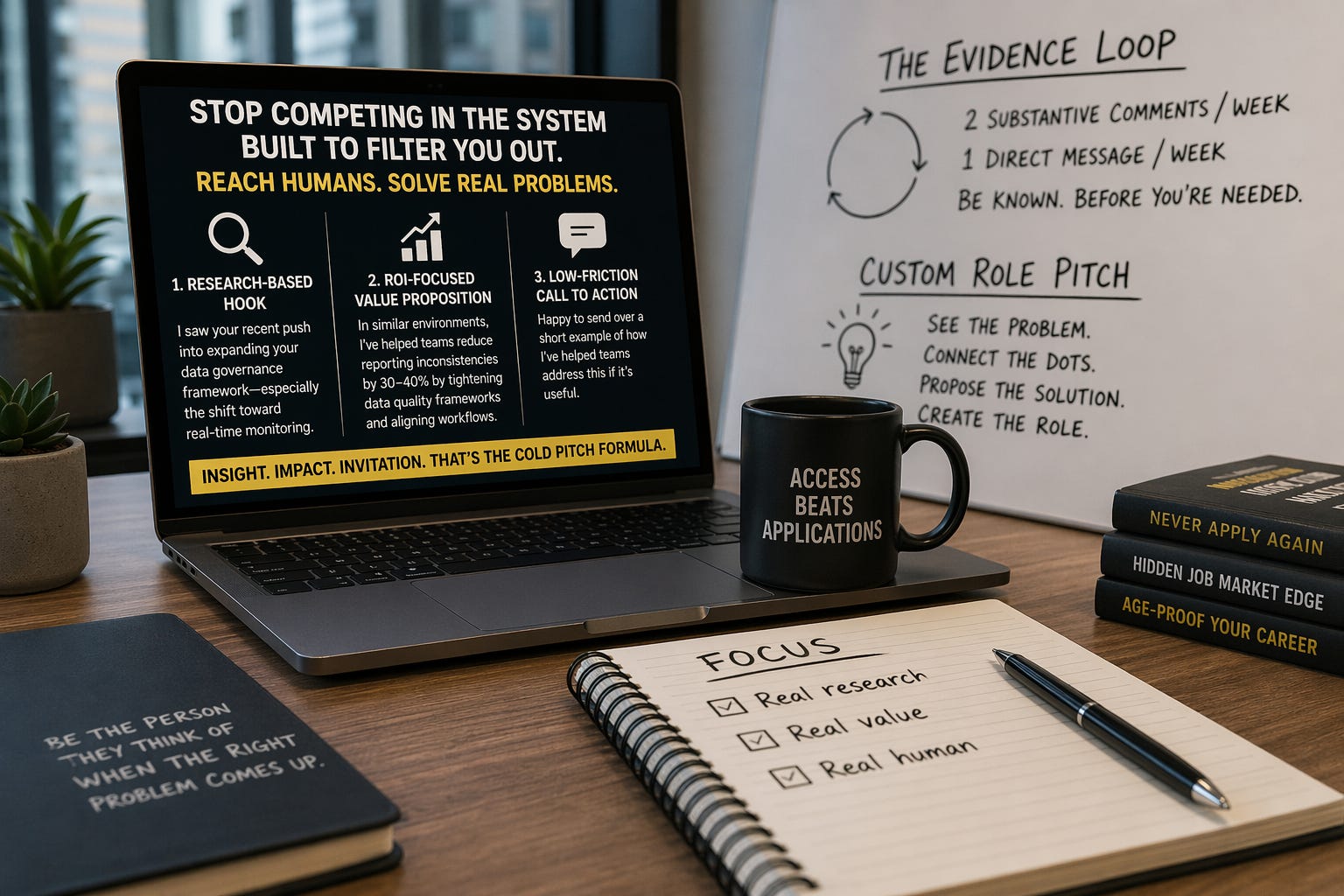
1. Research-Based Hook
Open with something specific that proves you’ve done the work.
Not flattery. Not vague awareness.
A real observation.
“I saw your recent push into expanding your data governance framework—especially the shift toward real-time monitoring.”
Or:
“I noticed your team is scaling customer analytics into new markets, and the reporting layer is becoming more complex.”
This does two things instantly:
Signals relevance
Lowers skepticism
You’re not another applicant.
You’re someone paying attention.
2. ROI-Focused Value Proposition
This is where most people collapse into generalities.
Don’t.
Translate your experience into a clear outcome:
“In similar environments, I’ve helped teams reduce reporting inconsistencies by 30–40% by tightening data quality frameworks and aligning engineering workflows with business logic.”
Or:
“I’ve worked with organizations at this stage to streamline analytics pipelines so leadership can trust what they’re seeing without adding reporting overhead.”
Notice what’s missing:
No job titles
No long history
No “20+ years of experience”
Just outcome.
Just impact.
Just risk reduction.
3. Low-Friction Call to Action
This is where most messages die.
Because people default to:
“I’d love to connect and explore opportunities.”
That line gets ignored for a reason:
It creates work.
It’s vague.
It signals no urgency.
It asks the other person to define the purpose.
Replace it with something specific and easy:
“If you’re open to it, I’d be glad to share a quick breakdown of how I’ve approached this in similar situations—no pitch, just a useful perspective.”
Or:
“Happy to send over a short example of how I’ve helped teams address this if it’s useful.”
You’re not asking for a meeting.
You’re offering value.
That’s the shift.
Why “I’d love to connect” gets ignored every time
Because it asks for time before it offers value.
Because it sounds like every other message in their inbox.
Because it forces the recipient to do the mental work of deciding:
Is this worth it?
High-performing professionals flip that equation:
They make the value obvious first.
They remove friction second.
They let the conversation emerge naturally.
The Evidence Loop: becoming known before you apply
This is where the real leverage lives.
Most job seekers operate like this:
Apply → wait → follow up → repeat.
High-signal professionals operate differently:
They become known inside the company before a role exists.
This is the Evidence Loop.
It’s simple, but not easy:
Two substantive comments per week
Not “great post.” Not agreement.
Add perspective. Extend the idea. Show how you think.One direct message per week
Not a pitch. Not a request.
A thoughtful extension of something they shared.
Over time, something subtle happens:
Your name becomes familiar.
Your thinking becomes associated with their problems.
You move from “stranger” to “known entity.”
So when something opens—or is about to—
You’re not starting from zero.
You’re already in the room.
The Custom Role Pitch: when the job doesn’t exist yet
This is the highest-leverage move in the entire strategy.
And almost nobody does it.
Because it requires something the system doesn’t reward:
Thinking independently.
Here’s the pattern:
You study a company closely enough to see a gap.
Not a posted role.
A real operational or strategic problem:
Data inconsistencies across systems
Scaling issues in reporting
Customer experience breakdowns
Inefficiencies between teams
Then you do something most candidates never consider:
You pitch yourself as the solution.
Not in a resume.
In a short, direct message:
“I’ve been following how your team is scaling X, and it looks like Y might become a bottleneck as you grow. I’ve worked through this exact challenge in similar environments—happy to share what worked if it’s helpful.”
You’re not applying.
You’re initiating.
You’re not asking to be evaluated.
You’re offering to solve.
This is how roles get created.
Quietly.
Before they ever become public.
Why this disproportionately favors experienced professionals
Because everything in this approach rewards what you already have:
Pattern recognition
Judgment
Context
The ability to translate complexity into outcomes
You’re no longer competing on speed.
You’re competing on clarity.
You’re no longer trying to “beat the system.”
You’re stepping outside of it.
The uncomfortable truth—and the opportunity inside it
The traditional path feels safer:
Apply.
Wait.
Hope.
But it’s also where the most competition lives.
Where you’re easiest to ignore.
Where your experience gets flattened into keywords.
The alternative path feels exposed:
Reach out.
Be direct.
Offer value first.
But it’s also where:
Competition drops
Signal increases
Conversations start before processes do
This is the shift:
From being processed → to being considered.
Hope Anchor
You are not being overlooked because you lack value.
You are being filtered because of how that value is being delivered.
The moment you change the channel, the response changes.
Closing move
All of this works exponentially better when your presence supports it.
When someone clicks your name, what they see either reinforces your signal—
or erases it.
That’s next.
Article 4: Your LinkedIn Isn’t a Profile. It’s Your Operating System.
About the Author
Byron K. Veasey is a career strategist and leader in data quality engineering focused on helping professionals navigate job searches, burnout, and career reinvention.
He writes Career Strategies, a newsletter read by over 3,900 professionals navigating today’s evolving job market.
👉 Subscribe to Career Strategies