
Article 3: Most Professionals Are Applying Too Late

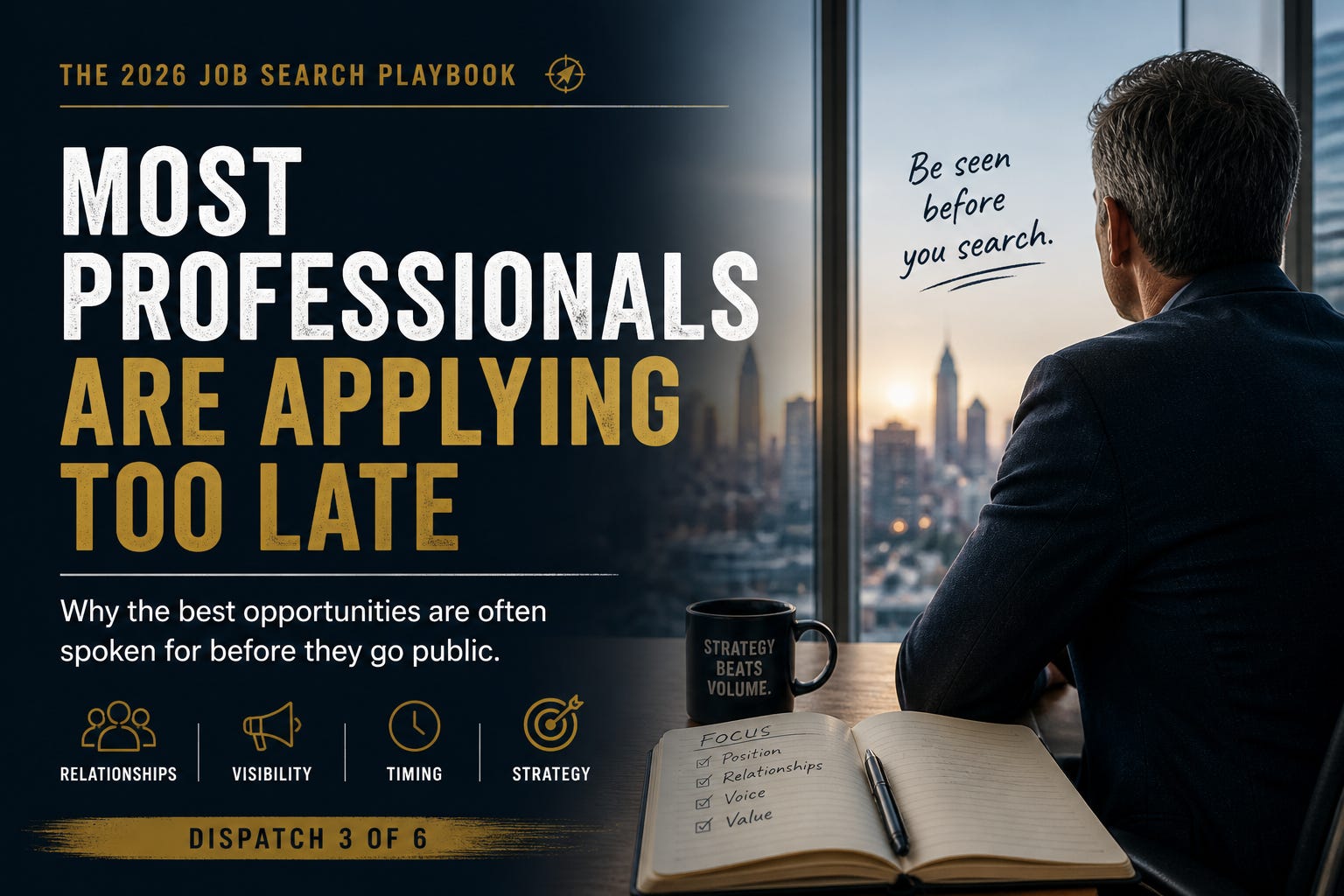
The 2026 Job Search Playbook
Six Dispatches for Professionals Navigating AI Filtering, Career Drift, and the Silent Hiring Market
The hardest part to accept about the modern job market is this:
Many employers effectively fill jobs before they ever become visible.
Not officially.
Not administratively.
But psychologically.
By the time a role appears online, someone internally already has a preferred candidate.
A recruiter already has a shortlist.
A hiring manager already has a mental pattern for who they trust.
A referral has already entered the conversation.
An internal contractor is already being evaluated quietly.
A former colleague has already been contacted informally.
And meanwhile—
thousands of professionals are still approaching the market as if applications are the beginning of opportunity.
Increasingly, they are the end of it.
That realization feels discouraging at first.
But it explains a pattern many professionals keep personalizing unnecessarily:
“How can I be qualified and still hear nothing?”
Because qualification alone no longer determines timing.
Visibility does.
The Hidden Hiring Market Most Professionals Never See
Most hiring does not begin with a public posting anymore.
It begins with uncertainty.
A team starts feeling pressure.
A department notices operational strain.
Leadership sees risk building quietly.
Revenue changes.
Workloads increase.
A manager realizes someone is missing before HR formally opens a role.
That is when real hiring often begins.
Long before applications.
The public job posting is frequently just the administrative layer added afterward.
Which means many professionals are entering conversations after trust is already partially formed.
Not because companies are malicious.
Because hiring managers are overwhelmed.
And overwhelmed people naturally reduce risk by choosing familiarity whenever possible.
That is the hidden force shaping much of the modern market:
Risk reduction.
Not talent discovery.
Why Online Applications Feel Increasingly Powerless
Most professionals still treat applications as the primary mechanism for access.
But application portals now function more like volume management systems.
Not relationship systems.
That distinction matters.
Because once hundreds—or thousands—of applicants enter a pipeline, hiring becomes less about identifying the absolute best candidate and more about narrowing ambiguity quickly.
That creates predictable behavior:
People choose recognizable patterns.
Recognizable brands.
Recognizable referrals.
Recognizable positioning.
Recognizable expertise.
Not necessarily because those candidates are objectively stronger.
Because clarity reduces decision fatigue.
And many experienced professionals unknowingly enter the market with broad capability but weak market positioning.
They are capable of many things.
But difficult to place quickly.
The modern market punishes that ambiguity more aggressively than previous markets did.
The Professionals Winning Earlier in the Process
The professionals gaining traction fastest are often participating before the role fully exists.
Not through manipulation.
Through visibility.
They stay present in conversations.
Maintain relationships before crisis.
Share ideas publicly.
Clarify expertise consistently.
Stay professionally interpretable over time.
So when opportunity pressure appears—
their names surface naturally.
This is why many professionals feel confused watching less experienced candidates move faster.
Because they assume hiring is operating as a meritocracy of depth.
Increasingly, it operates as a marketplace of familiarity and perceived relevance.
The person who becomes mentally available first often gains disproportionate advantage.
Especially in uncertain markets.
Why Experienced Professionals Struggle With This Shift
Many experienced professionals built careers during a different hiring era.
An era where:
good work created reputation,
reputation created opportunity,
and opportunity arrived through organizational visibility.
That world rewarded patience and consistency.
Today’s market rewards external legibility.
That is a very different skill.
And many highly capable professionals were never taught how to create it because previous systems handled visibility internally.
Now professionals must often create interpretability themselves.
Publicly.
Repeatedly.
Strategically.
Not performatively.
Strategically.
There’s a difference.
Performative visibility seeks attention.
Strategic visibility reduces uncertainty.
And hiring managers increasingly move toward people who feel easier to trust quickly.
The Dangerous Myth of “Just Apply More”
This is also why mass application strategies often fail experienced professionals.
Because volume without positioning usually creates exhaustion faster than traction.
The market starts feeling random.
Emotionally destabilizing.
Professionals begin questioning their value because effort no longer produces proportional response.
But the issue is often not effort.
It is timing and market entry point.
Submitting applications after opportunity becomes public places professionals inside the loudest, most saturated part of the system.
That is where differentiation becomes hardest.
And many professionals stay trapped there because applications feel measurable.
Visible.
Trackable.
Concrete.
Whereas relationship-building feels slower and less controllable.
But relationships increasingly determine access before postings ever appear.
Especially at higher compensation levels.
The Shift From Applicant to Known Entity
This is the strategic transition many professionals eventually need to make:
Stop operating only as an applicant.
Start becoming a known entity inside your professional ecosystem.
That can look like:
reconnecting with dormant relationships,
sharing insight publicly,
clarifying your positioning,
creating visible proof of thinking,
joining industry conversations,
building niche credibility,
or becoming associated with specific outcomes.
Not because networking is magic.
Because familiarity lowers perceived hiring risk.
And in uncertain economies, perceived risk shapes far more hiring decisions than most professionals realize.
The Emotional Damage Caused by Delayed Visibility
One of the cruelest parts of the modern market is that silence often arrives before explanation.
So professionals internalize rejection long before they understand structural dynamics.
They think:
“I must be less valuable than I thought.”
When often the real issue is this:
The market never understood where to place them fast enough.
That distinction matters psychologically.
Because once professionals stop interpreting silence as personal invalidation—
they regain strategic clarity.
And clarity changes behavior.
Instead of frantically applying everywhere,
they start building recognition deliberately.
Instead of chasing visibility randomly,
they start reducing ambiguity intentionally.
Instead of waiting to be discovered,
they start becoming easier to remember.
The Professionals Who Recover Fastest
The professionals who regain momentum fastest are rarely invisible for long.
Not because they are always the smartest.
Because they become recognizable faster.
They learn how to:
create strategic visibility,
build professional familiarity,
clarify market relevance,
and participate upstream before opportunity becomes crowded.
They stop relying exclusively on application systems to introduce them.
And start building ecosystems where opportunities can find them earlier.
Not louder.
Earlier.
Status Upgrade
The goal is not to apply to more opportunities.
The goal is to enter conversations before the market becomes saturated.
Hope Anchor
Visibility created consistently compounds long before results become visible externally.
Final Line
In the modern hiring market, the professionals who move first are not always the most qualified.
They are often the ones the market already recognizes before the posting ever appears.
About the Author
Byron K. Veasey is a career strategist and leader in data quality engineering focused on helping professionals navigate job searches, burnout, and career reinvention.
He writes Career Strategies, a newsletter read by over 4,600 professionals navigating today’s evolving job market.
👉 Subscribe to Career Strategies