
Article 2: The Silence Isn’t Neutral. It’s Rewriting You.

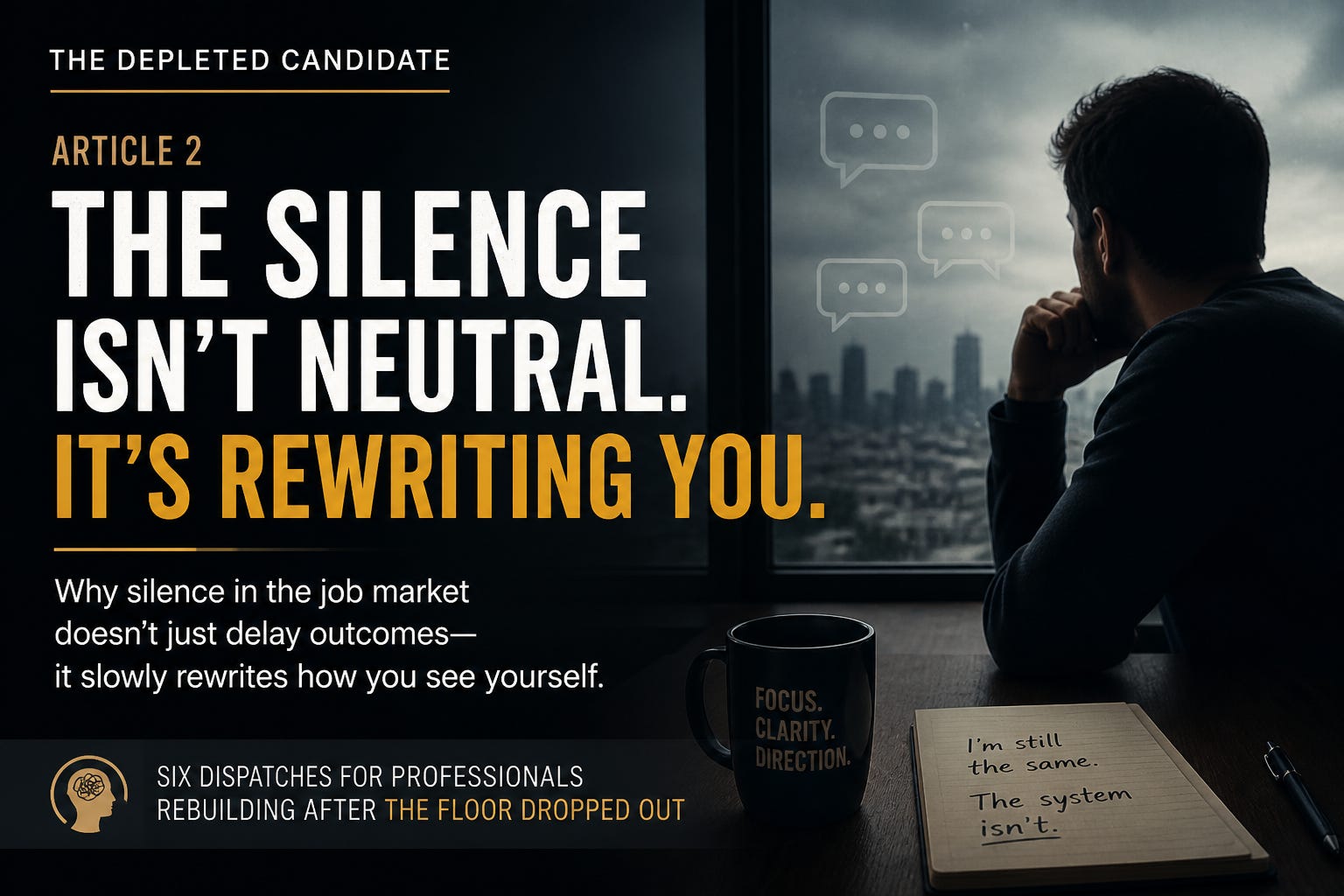
The Depleted Candidate: Rebuilding Yourself in a Job Market That Doesn’t Respond
Six dispatches for professionals rebuilding after the floor dropped out
Based on The Depleted Candidate: How to Stop Executing While Depleted — and the Framework That Actually Works
This book is free from May 3 to May 7, 2026. All we ask is that you leave an honest review.
The job search didn’t just get harder.
It got quieter.
And that silence isn’t passive.
It’s doing something to you.
The Misinterpretation No One Warns You About
After the initial shock wears off, something more subtle begins.
Not panic.
Not collapse.
Distortion.
Because the human brain is not built to operate in a vacuum.
It needs feedback to stay calibrated.
And when feedback disappears, it doesn’t stay neutral.
It fills in the gaps.
Silence Feels Like Information
Here’s the problem:
In a normal environment, silence means very little.
A delayed email.
A busy manager.
A missed message.
But in a signal-starved environment like the modern job market?
Silence starts to feel like data.
You apply → no response
You follow up → no response
You interview → no response
At first, you interpret it externally:
“They’re busy.”
“Hiring is slow.”
“Timing is off.”
But over time, something shifts.
You stop interpreting silence as lack of response
and start interpreting it as negative feedback
Even though nothing was actually said.
The Brain Doesn’t Tolerate Ambiguity for Long
Your brain is a meaning-making system.
When it lacks external input, it generates internal explanations.
Not because it’s accurate.
Because it’s necessary.
So the loop becomes:
No response → no data
No data → forced interpretation
Forced interpretation → self-referencing
And eventually:
“This must mean something about me.”
Not because it does.
Because your brain refuses to accept “unknown” indefinitely.
Identity Drift Begins Quietly
This is where the real damage starts.
Not in rejection.
In ambiguity.
Because rejection is clear.
Silence is not.
So instead of adjusting strategy, you start adjusting identity.
You soften your positioning.
You second-guess your experience.
You dilute your story to make it “fit.”
You start asking:
“Maybe I’m not as strong as I thought.”
“Maybe I’ve been overestimating my value.”
“Maybe I need to start over.”
Nothing external confirmed that.
But the absence of signal made it feel true.
The Invisible Erosion
This doesn’t happen all at once.
It happens in small, almost invisible ways:
You hesitate before hitting “submit”
You rewrite things that were already strong
You delay outreach you would have done instantly before
You compare yourself more—and trust yourself less
Your capability didn’t change.
Your relationship to it did.
That’s identity drift.
And it rarely announces itself.
Why Effort Alone Makes It Worse
Here’s where most professionals get trapped.
They respond to silence with more effort.
More applications.
More networking.
More “trying harder.”
But without feedback, effort becomes disorienting.
Because you can’t tell:
What’s working
What’s not
What to adjust
So instead of building momentum…
You build exhaustion.
And exhaustion amplifies doubt.
This Isn’t Rejection. It’s Distortion
Let’s correct the frame:
You are not being clearly rejected.
You are being filtered inside a system that doesn’t return signal.
That distinction matters.
Because rejection allows adjustment.
Distortion creates confusion.
And confused professionals don’t perform at their actual level.
The Silence Loop, Expanded
Here’s the full mechanism:
You act → no response
No response → internal interpretation
Interpretation → subtle identity shift
Identity shift → weaker signal
Weaker signal → more silence
And now the loop reinforces itself.
Not because your capability declined.
Because your signal became less clear under pressure.
The Real Risk
The biggest risk in a silent job market is not that you won’t get hired.
It’s that you will slowly become someone who no longer recognizes their own value.
That’s the part no one prepares you for.
And by the time you notice it, it already feels real.
The Reframe That Changes Everything
You have to interrupt the assumption:
Silence = judgment
Because it doesn’t.
Silence = absence of feedback in a system not designed to give it
That’s it.
Once you see that clearly, something shifts:
You stop over-interpreting
You stop self-correcting based on nothing
You stop shrinking your signal to match imagined expectations
And you start protecting the one thing the system can’t give you back:
Your internal reference point.
Status Upgrade
Stop asking:
“What does this silence say about me?”
Start asking:
“What system am I operating in that produces no signal?”
Hope Anchor
You are not being quietly evaluated.
You are operating inside a system that doesn’t speak.
And silence is not a verdict.
It’s a missing feedback loop.
What Comes Next
In the next article, we’ll go deeper into the structural layer:
Why the front door of the job market no longer works the way you think it does—
and how the professionals landing roles are approaching the system differently.
Final Line
Silence doesn’t just delay outcomes.
If you’re not careful—
it rewrites how you see yourself.
About the Author
Byron K. Veasey is a career strategist and leader in data quality engineering focused on helping professionals navigate job searches, burnout, and career reinvention.
He writes Career Strategies, a newsletter read by over 4,600 professionals navigating today’s evolving job market.
👉 Subscribe to Career Strategies