
Article 2: Rebuilding Energy Without Relying on Motivation

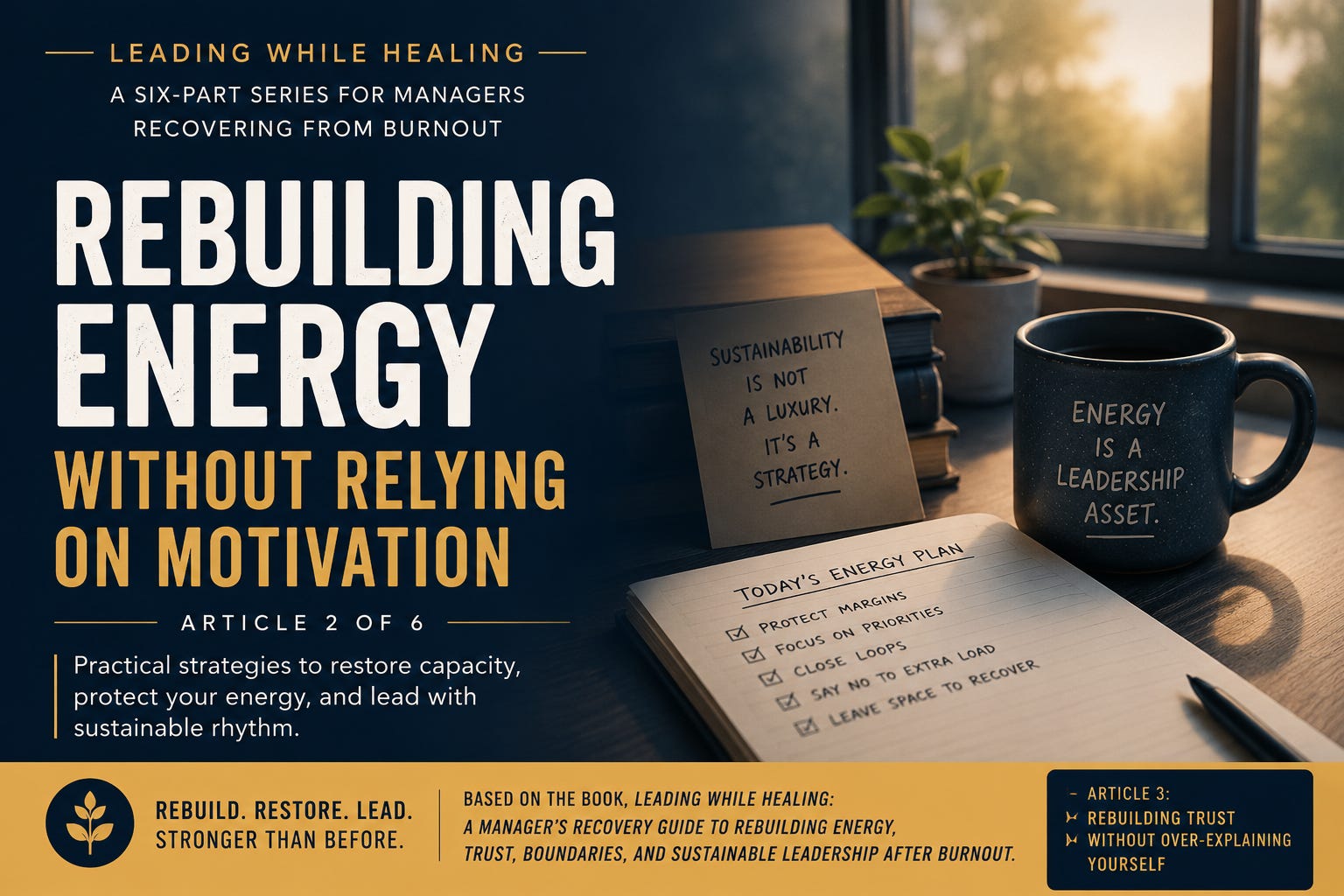
Leading While Healing
Article 2 of 6
A six-part series for managers rebuilding energy, trust, boundaries, and sustainable leadership after burnout.
Based on the book, Leading While Healing: A Manager’s Recovery Guide to Rebuilding Energy, Trust, Boundaries, and Sustainable Leadership After Burnout.
You may be waiting to feel motivated again.
Waiting for the old drive to return.
Waiting for the spark.
Waiting for the morning when you wake up ready.
Waiting for your ambition to feel clean instead of heavy.
Waiting for work to feel exciting again.
Waiting for leadership to feel natural again.
Waiting for yourself to come back.
But after burnout, motivation is often one of the last things to return.
Not because you are lazy.
Not because you stopped caring.
Not because you lost your edge.
Not because you are no longer a leader.
But because motivation requires energy.
And burnout drains the system that motivation depends on.
That is why so much advice fails burned-out managers.
It tells you to get inspired.
Get disciplined.
Get focused.
Get back in the game.
Reconnect with your why.
Push through the resistance.
Change your mindset.
But if your system is still depleted, those words can feel like noise.
You do not need another motivational speech.
You need energy restoration.
You need recovery that is practical enough to survive your calendar.
You need a way to lead when your internal engine is not producing the same power it used to.
Because the truth is uncomfortable:
You cannot motivate your way out of depletion.
You have to rebuild capacity.
The Problem With Waiting to Feel Ready
Before burnout, motivation may have carried you.
You could push through long days.
Handle pressure.
Absorb conflict.
Solve problems quickly.
Stay late.
Show up early.
Take on one more meeting.
Answer one more email.
Carry one more person’s urgency.
You may have built an identity around being the person who could keep going.
The dependable one.
The steady one.
The high-capacity one.
The leader who did not need much help.
The person people trusted when things became difficult.
Then burnout changed the equation.
Now the things that once activated you may drain you.
The urgency that once sharpened your focus may trigger shutdown.
The challenge that once energized you may feel like threat.
The meeting that once gave you momentum may require recovery afterward.
The role you once knew how to inhabit may now feel too loud, too fast, too demanding, or too expensive.
So you wait.
You tell yourself:
When I feel motivated again, I will rebuild.
When I feel like myself again, I will get organized.
When I have more energy, I will set boundaries.
When I feel stronger, I will make changes.
When the fog lifts, I will lead better.
But waiting for motivation can become another trap.
Because motivation often follows stabilization.
It does not always create it.
Sometimes you do not feel better first.
Sometimes you build the conditions that make feeling better possible.
Motivation Is Not a Recovery Strategy
Motivation is useful.
But it is unstable.
It rises and falls.
It depends on sleep, stress, pressure, clarity, feedback, environment, health, meaning, and emotional load.
Burned-out managers often become frustrated because they are trying to use motivation as the fuel source for recovery.
But recovery is not powered by motivation.
Recovery is powered by rhythm.
Small decisions.
Protected margins.
Reduced friction.
Honest assessment.
Energy awareness.
Better pacing.
Less self-betrayal.
More realistic expectations.
A manager recovering from burnout does not need to ask:
How do I get motivated again?
The better question is:
What conditions help my energy return?
That question changes everything.
It moves you from pressure to design.
It moves you from shame to observation.
It moves you from forcing output to rebuilding input.
It stops treating low motivation as a character problem and starts treating it as a capacity signal.
Energy Comes Back in Layers
After burnout, energy usually does not return all at once.
It returns unevenly.
You may have one good morning and a difficult afternoon.
You may feel clear on Monday and foggy by Wednesday.
You may handle one hard conversation well and then feel strangely exhausted afterward.
You may have enough energy for your team but not enough left for yourself.
You may be productive for two hours and then unable to make one more decision.
This can be confusing if you expect recovery to move in a straight line.
It does not.
Energy comes back in layers.
Physical energy.
Cognitive energy.
Emotional energy.
Relational energy.
Decision energy.
Creative energy.
Identity energy.
These are not the same.
You may have the physical energy to sit at your desk but not the cognitive energy to solve a complex problem.
You may have the cognitive energy to review a document but not the emotional energy to manage conflict.
You may have the emotional energy to support your team but not the relational energy to attend another meeting.
You may have the decision energy to handle routine items but not the identity energy to think about your future.
This is why “I should be fine” is not specific enough.
Fine where?
Fine physically?
Fine emotionally?
Fine cognitively?
Fine relationally?
Fine as a worker?
Fine as a leader?
Fine as a human being?
Burnout recovery requires more precise language.
Because vague expectations create vague shame.
The Calendar Does Not Measure Energy
Your calendar may say you had six meetings.
But it does not show what those meetings cost.
It does not show the emotional labor of keeping your voice calm.
It does not show the effort of tracking details while your mind feels slow.
It does not show the tension of managing personalities.
It does not show the cost of absorbing uncertainty.
It does not show the pressure of making decisions while still recovering.
It does not show the recovery time you needed but did not take.
That is why burned-out managers often feel confused at the end of the day.
On paper, the day looked manageable.
In the body, it felt overwhelming.
You may look at your schedule and think:
Why am I so tired?
I did not do that much.
But burnout recovery is not only about how much you did.
It is about how much load your system carried while doing it.
Some tasks are light.
Some are heavy.
Some are short but expensive.
Some are long but manageable.
Some people are easy to lead.
Some require more emotional regulation.
Some meetings give clarity.
Some create more ambiguity.
Some decisions close loops.
Some open five new ones.
If you only measure time, you will misunderstand your recovery.
You have to start measuring energy.
Stop Spending Energy You Do Not Have
Many managers recovering from burnout make one quiet mistake.
They keep spending energy as if their reserves are still full.
They say yes too quickly.
They accept back-to-back meetings.
They keep the same response-time expectations.
They absorb too much emotional weight.
They continue being the buffer for everyone else’s anxiety.
They let every request become urgent.
They try to lead at the old pace with a reduced internal budget.
Then they wonder why they keep crashing.
This is not a discipline problem.
It is an accounting problem.
Your energy has a budget.
After burnout, that budget may be smaller.
Not because you are less capable.
Because your system is rebuilding.
And if you do not change how you spend energy, recovery becomes impossible.
You cannot rebuild energy while constantly overdrawing it.
You cannot recover while every available ounce goes back into performance.
You cannot restore capacity while pretending depletion is just another leadership challenge to overcome.
At some point, you have to stop treating exhaustion like a bill you can pay later.
The Recovery Budget
A recovery budget is a simple idea:
Before you spend energy, you acknowledge that your energy is limited.
Not unlimited.
Not imaginary.
Not based on who you used to be.
Limited.
A recovery budget asks:
What must be done today?
What can wait?
What requires my best energy?
What can be simplified?
What should not be scheduled back-to-back?
What conversation needs preparation?
What decision needs a clearer window?
What can be delegated?
What can be declined?
What can be done at 80 percent instead of 110 percent?
This is not lowering standards.
This is protecting the system that produces your standards.
High performers often resist this because they confuse energy limits with weakness.
But limits are not weakness.
Limits are information.
A leader who ignores limits eventually becomes less clear, less patient, less present, less consistent, and less trustworthy.
A leader who respects limits can rebuild.
Motivation Often Returns After Safety
Many burned-out managers want their ambition back.
They miss wanting things.
They miss feeling driven.
They miss caring in a way that feels alive instead of obligated.
They miss the version of themselves who could see a goal and move toward it.
But ambition does not thrive in a system that feels unsafe.
If your body associates work with threat, pressure, criticism, overload, ambiguity, or collapse, it may resist re-engagement.
Not because you are unmotivated.
Because your system remembers the cost.
This is one reason motivation can feel unavailable after burnout.
Your mind may say:
I want to get moving again.
But your body may say:
Last time we did that, we were harmed.
So the first layer is not motivation.
The first layer is safety.
A safer pace.
Safer expectations.
Safer boundaries.
Safer communication.
Safer recovery windows.
Safer decision rhythms.
Safer ways to say no.
Safer ways to stop.
When your system begins to trust that leadership will not require self-abandonment, energy can begin to return.
Not overnight.
But gradually.
Reduce Friction Before Increasing Effort
When leaders feel depleted, they often try to increase effort.
They push harder.
Wake earlier.
Work later.
Add more structure.
Create more goals.
Try to force themselves back into performance.
But sometimes the better move is not more effort.
It is less friction.
Friction is anything that makes a task harder than it needs to be.
Unclear priorities.
Messy calendars.
Back-to-back calls.
Constant notifications.
Unmade decisions.
Vague expectations.
Too many open loops.
Meetings without outcomes.
Emails that require emotional translation.
Work that requires you to switch contexts every ten minutes.
People who create urgency without clarity.
Burnout recovery requires friction reduction.
Because every unnecessary friction point spends energy.
And when your energy is limited, friction becomes expensive.
Before asking yourself to try harder, ask:
What is making this harder than it needs to be?
That question is powerful.
It turns recovery into design.
It helps you stop blaming yourself for exhaustion caused by broken systems, unclear expectations, or unsustainable rhythms.
Build Energy Anchors
An energy anchor is a small, repeatable practice that helps your system stabilize.
Not a dramatic life overhaul.
Not a perfect morning routine.
Not a wellness performance.
An anchor.
Something simple enough to repeat even when you are tired.
For a recovering manager, energy anchors may look like:
Five minutes of silence before the first meeting.
Ten minutes between calls.
A short walk after a difficult conversation.
Writing down the top three priorities before opening email.
Ending the day by closing loops instead of carrying them into the evening.
Preparing for emotionally heavy meetings before entering them.
Refusing to schedule conflict conversations when you are already depleted.
Eating before making major decisions.
Turning off notifications during deep work.
Naming your current capacity before accepting more work.
These practices may seem small.
But small is the point.
Burnout recovery is not built through heroic gestures.
It is built through repeatable protection.
You are teaching your system:
We do not have to abandon ourselves to lead.
We do not have to sprint every day.
We do not have to respond to everything immediately.
We do not have to spend all available energy just because someone else created urgency.
We can lead with rhythm.
The Danger of Borrowed Energy
Many burned-out leaders continue functioning by borrowing energy.
Borrowing from sleep.
Borrowing from weekends.
Borrowing from family time.
Borrowing from health.
Borrowing from silence.
Borrowing from emotional reserves.
Borrowing from the future.
This can work for a while.
That is what makes it dangerous.
You can keep performing.
You can meet expectations.
You can deliver.
You can appear committed.
You can make others comfortable.
But borrowed energy always comes due.
It may show up as irritability.
Brain fog.
Resentment.
A short temper.
Avoidance.
Decision fatigue.
Sunday dread.
Sleep disruption.
Emotional numbness.
A loss of meaning.
A body that feels tense even when nothing is happening.
Borrowed energy helped many leaders survive.
But it cannot become the recovery plan.
Recovery requires paid-for energy.
Energy built through rest, rhythm, boundaries, clarity, nutrition, movement, connection, repair, and honest limits.
Not borrowed from tomorrow.
Built today.
You Need Fewer Open Loops
One of the most draining parts of post-burnout leadership is the open loop.
The unanswered message.
The unclear decision.
The unresolved conflict.
The meeting with no next step.
The project with no owner.
The expectation that was implied but never stated.
The conversation you keep replaying.
The request you have not declined.
The boundary you know you need but have not named.
Open loops drain energy because your mind continues to carry them.
Even when you are not actively working on them.
Even when your laptop is closed.
Even when the day is technically over.
Burnout recovery requires closing more loops.
Not because you need to control everything.
But because ambiguity is expensive.
A simple next step can restore energy.
A clear owner can restore energy.
A written decision can restore energy.
A direct answer can restore energy.
A boundary can restore energy.
A “not now” can restore energy.
A “this is no longer a priority” can restore energy.
Many managers do not need more motivation.
They need fewer unresolved demands living in their nervous system.
Rebuild Through Small Wins That Do Not Cost Too Much
After burnout, confidence often returns through evidence.
Not hype.
Not forced positivity.
Evidence.
You need proof that you can function without collapsing.
Proof that you can lead without overextending.
Proof that you can set a boundary and survive the discomfort.
Proof that you can make progress without sprinting.
Proof that you can recover after a hard moment.
Proof that your energy can return when you stop spending all of it.
That is why small wins matter.
But they must be the right kind of small wins.
Not small wins that secretly require over-functioning.
Not small wins that depend on ignoring your body.
Not small wins that recreate the old pattern.
The best recovery wins are sustainable wins.
You ended a meeting on time.
You took ten minutes before responding.
You clarified the decision owner.
You declined one unnecessary meeting.
You stopped working before you crashed.
You named what you could actually carry.
You prepared for a hard conversation instead of walking into it depleted.
You left margin in the day.
You did less, but did it more honestly.
These are not small things.
They are signs of a new operating system.
Energy Is Rebuilt by Keeping Promises to Yourself
Burnout often damages self-trust.
You may not trust your energy.
You may not trust your limits.
You may not trust your ambition.
You may not trust your ability to keep going.
You may not trust yourself to stop before it becomes too much.
One way self-trust returns is by keeping small promises to yourself.
Not grand promises.
Small ones.
I will not schedule over lunch today.
I will take five minutes after that meeting.
I will not answer email from a place of panic.
I will ask for clarity before accepting responsibility.
I will stop working at the agreed time.
I will not turn every request into an emergency.
I will tell the truth about my capacity.
Every kept promise teaches your system something.
I am listening now.
I am not ignoring the signals.
I am not using myself up the way I did before.
I can be trusted with my own recovery.
This matters because sustainable leadership is not only about how others trust you.
It is also about whether you can trust yourself.
A Practical Starting Point
For the next week, do not chase motivation.
Track energy.
At the end of each work block, ask:
Did this restore energy, spend energy, or drain more than expected?
Before each meeting, ask:
What energy will this require?
After each meeting, ask:
Do I need recovery, clarity, or closure?
Before saying yes, ask:
What will this cost me later?
At the end of the day, ask:
Where did I borrow from tomorrow?
Then make one small adjustment.
Not ten.
One.
Create space between two meetings.
Clarify one expectation.
Close one loop.
Decline one unnecessary commitment.
Move one difficult conversation to a better time.
Protect one recovery window.
Stop one hour earlier than your old survival pattern would have allowed.
The goal is not to transform your life in a week.
The goal is to begin telling the truth about energy.
Because what you can see, you can redesign.
You Are Not Unmotivated
You may not be unmotivated.
You may be under-recovered.
You may be overloaded.
You may be carrying too many open loops.
You may be spending energy on emotional labor no one sees.
You may be trying to lead from a system that has not yet rebuilt trust.
You may be waiting for motivation when your body is asking for safety.
You may be judging yourself for not sprinting when what you need is rhythm.
The answer is not to shame yourself into motion.
The answer is to build a leadership life your nervous system can survive.
Energy first.
Motivation later.
Rhythm first.
Momentum later.
Safety first.
Ambition later.
You are not done.
You are rebuilding.
And rebuilding energy is not a soft part of leadership.
It is the foundation.
Because the leader who keeps borrowing energy from tomorrow eventually has nothing left to give today.
But the leader who learns to protect, restore, and spend energy wisely can begin to lead again.
Not from pressure.
Not from panic.
Not from performance.
From capacity.
And that is the beginning of sustainable leadership.
Article 3 publishes next: Rebuilding Trust Without Over-Explaining Yourself.
About the Author
Byron K. Veasey is a career strategist and leader in data quality engineering focused on helping professionals navigate job searches, burnout, and career reinvention.
He writes Career Strategies, a Substack newsletter read by over 4,900 professionals navigating today’s evolving job market.
👉 Subscribe to Career Strategies