
Article 1: Your Brain Is Not Broken. It’s Doing Exactly What It Was Built to Do.

The Survival Architecture
Six dispatches for professionals rebuilding after the floor dropped out
The meeting starts in fifteen minutes.
The calendar invite is already there.
HR.
Your manager.
No agenda.
You already know.
The meeting lasts seven minutes.
By minute eight, your laptop is a shell.
Your email is gone.
Your access is gone.
The systems that used to organize your day—your identity—are gone.
And then something quieter happens.
You don’t just lose the job.
You lose the signal.
What You’re Feeling Isn’t Weakness. It’s Biology.
The fog.
The strange paralysis.
The hollow feeling that hits around 2 p.m. for no clear reason.
Most people mislabel this moment.
They think:
“Something is wrong with me.”
But that’s not what’s happening.
Your nervous system just lost the environment it was calibrated to.
And it’s responding exactly as designed.
Your Brain Thinks You Were Exiled
For most of human history, losing your place in the group wasn’t inconvenient.
It was dangerous.
Isolation meant vulnerability.
Vulnerability meant risk.
So your brain evolved to treat social disconnection as a threat.
Not metaphorically.
Biologically.
That’s why job loss doesn’t feel like a career event.
It feels like something deeper:
Disorientation.
Heightened alertness.
A constant low-grade sense that something is wrong.
Because to your brain—
Something is.
The Dopamine Collapse Nobody Warns You About
Before this moment, your days were full of signals.
Replies.
Meetings.
Deadlines.
Decisions.
Recognition—subtle or direct.
You didn’t think of them as rewards.
But your brain did.
Each one delivered a small hit of dopamine—just enough to reinforce:
You’re moving. You matter. You’re in the system.
And then it stops.
Cold.
Now it’s 9 a.m.
The time you used to log in.
But there’s nothing to respond to.
No urgency.
No feedback loop.
No signal.
So your brain does what it’s wired to do:
It starts searching.
And when it can’t find a signal—
It creates one.
Enter: The Prosecutor Brain
At 3 a.m., it sounds convincing.
Not loud.
Precise.
Methodical.
It builds a case.
“You should’ve seen it coming.”
“You stayed too long.”
“You’re behind.”
“Other people are moving faster.”
“You might not recover from this.”
This isn’t random thinking.
It’s a system.
Your brain is trying to solve the threat by analyzing it.
But instead of generating clarity—
It generates indictment.
It cherry-picks evidence.
Replays moments.
Reconstructs decisions.
And then presents one conclusion:
You are the problem.
The Problem Isn’t That Voice Exists
The problem is that it’s the only voice in the room.
So here’s the shift:
You don’t silence the Prosecutor.
You build the Defense.
Demand the Full Record
When the Prosecutor speaks, most people absorb.
They don’t question.
They don’t interrupt.
They don’t ask for evidence on both sides.
But you can.
You can say:
“What evidence supports that?”
“What evidence contradicts that?”
“What would I say to someone else in this position?”
“What’s incomplete about this conclusion?”
This isn’t positive thinking.
It’s cognitive balance.
And it breaks the monopoly.
Stabilization Before Strategy
This is where most people get it wrong.
They go straight to:
Resume updates
Job boards
Applications
Networking scripts
But if your biology is dysregulated—
None of it sticks.
You don’t need more effort.
You need stability.
Start With the Body
Before you open a single job board, do this:
1. The Physiological Reset
A slow inhale through the nose.
A second short inhale.
Long exhale through the mouth.
Repeat 3–5 times.
You’re signaling your nervous system:
We’re not in immediate danger.
2. Cold Water on the Face
Ten to fifteen seconds.
It activates the vagus nerve.
It grounds you faster than thought ever will.
3. Morning Movement
Not optimization.
Not performance.
Just movement.
A walk.
Light stretching.
Anything that tells your system:
We’re still in motion.
4. Provisional Structure
You don’t need a perfect routine.
You need a temporary container.
Something simple:
Wake time
Movement
Two focused hours
Break
One outreach
Stop
Not to maximize output.
To restore rhythm.
Because Right Now, Rhythm Is Everything
You’re not trying to win the job search today.
You’re trying to rebuild the system that makes winning possible.
The Truth Most Advice Skips
You don’t need motivation right now.
Motivation assumes stability.
You don’t have that yet.
What you need is a scaffold.
Something that holds you up
when your energy drops
when your confidence dips
when your thoughts turn on you
Because they will.
That’s not failure.
That’s phase one.
Hope Anchor
This isn’t you breaking.
This is your system reacting to signal loss.
And systems can be rebuilt.
Closing Bridge
Right now, your brain is searching for something to organize around.
In the absence of structure, it defaults to doubt.
So the next step isn’t “try harder.”
It’s build one piece of infrastructure that works
regardless of how you feel.
That’s what we’ll build next.
Before You Go
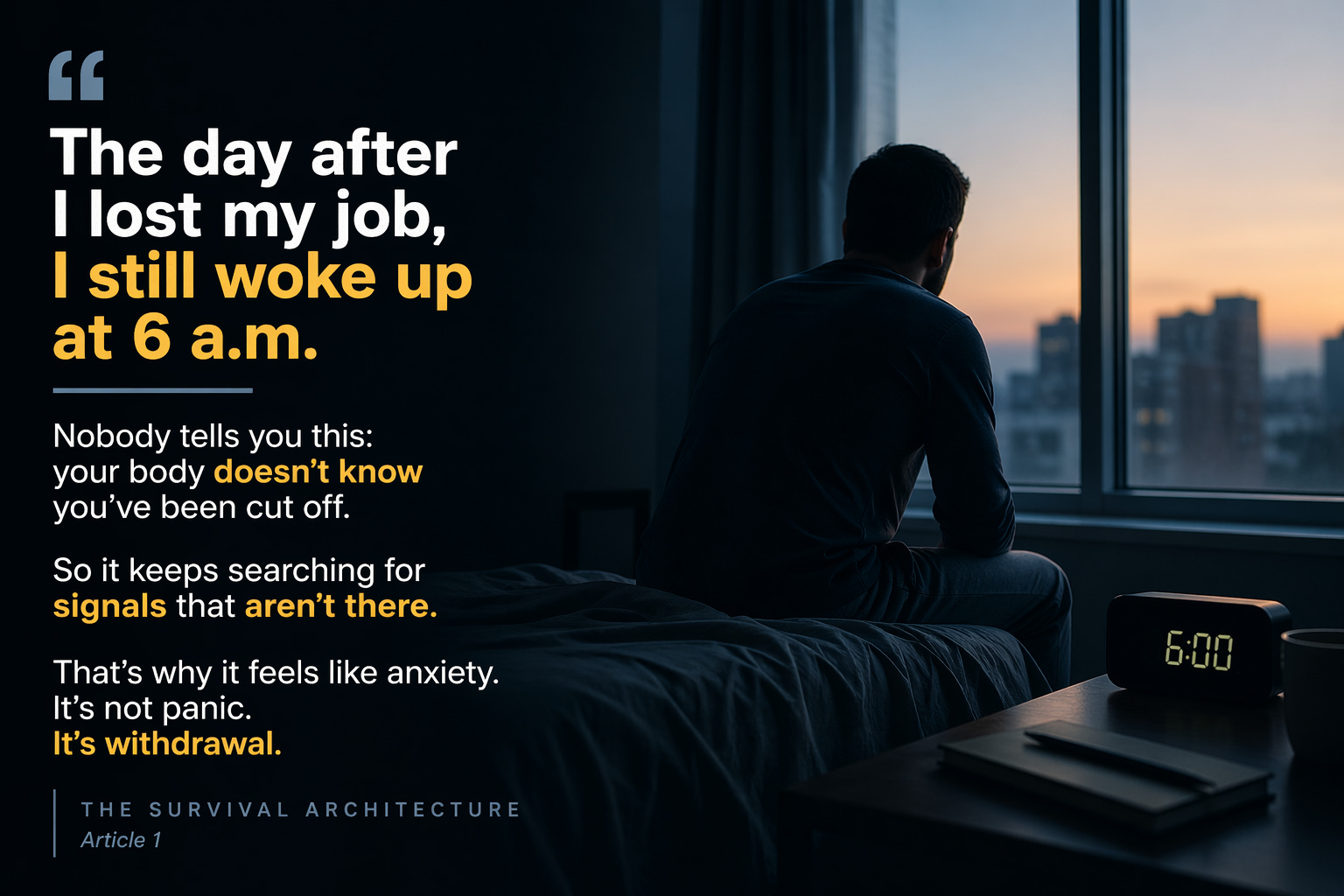
There’s a moment most people don’t talk about.
It’s not the layoff itself.
It’s the morning after.
You wake up at the same time.
Your body still expects the rhythm.
For a few seconds, everything feels normal.
And then you remember.
And the silence hits again.
That moment—right there—is where most job search advice fails.
Because it assumes you’re starting from clarity.
You’re not.
You’re starting from disruption.
That’s why I wrote:
Job Search Survival Guide 2026: Resilience, Strategy, and Real Stories for Today’s Job Market
Not as motivation.
Not as theory.
But as something steadier.
A way to understand what’s happening to you
while you’re still inside it.
👉 Job Search Survival Guide 2026: Resilience, Strategy, and Real Stories for Today’s Job Market
About the Author
Byron K. Veasey is a career strategist and leader in data quality engineering focused on helping professionals navigate job searches, burnout, and career reinvention.
He writes Career Strategies, a newsletter read by over 4,600 professionals navigating today’s evolving job market.
👉 Subscribe to Career Strategies