
Article 1: The Leader Who Looks Fine But Isn’t Fine

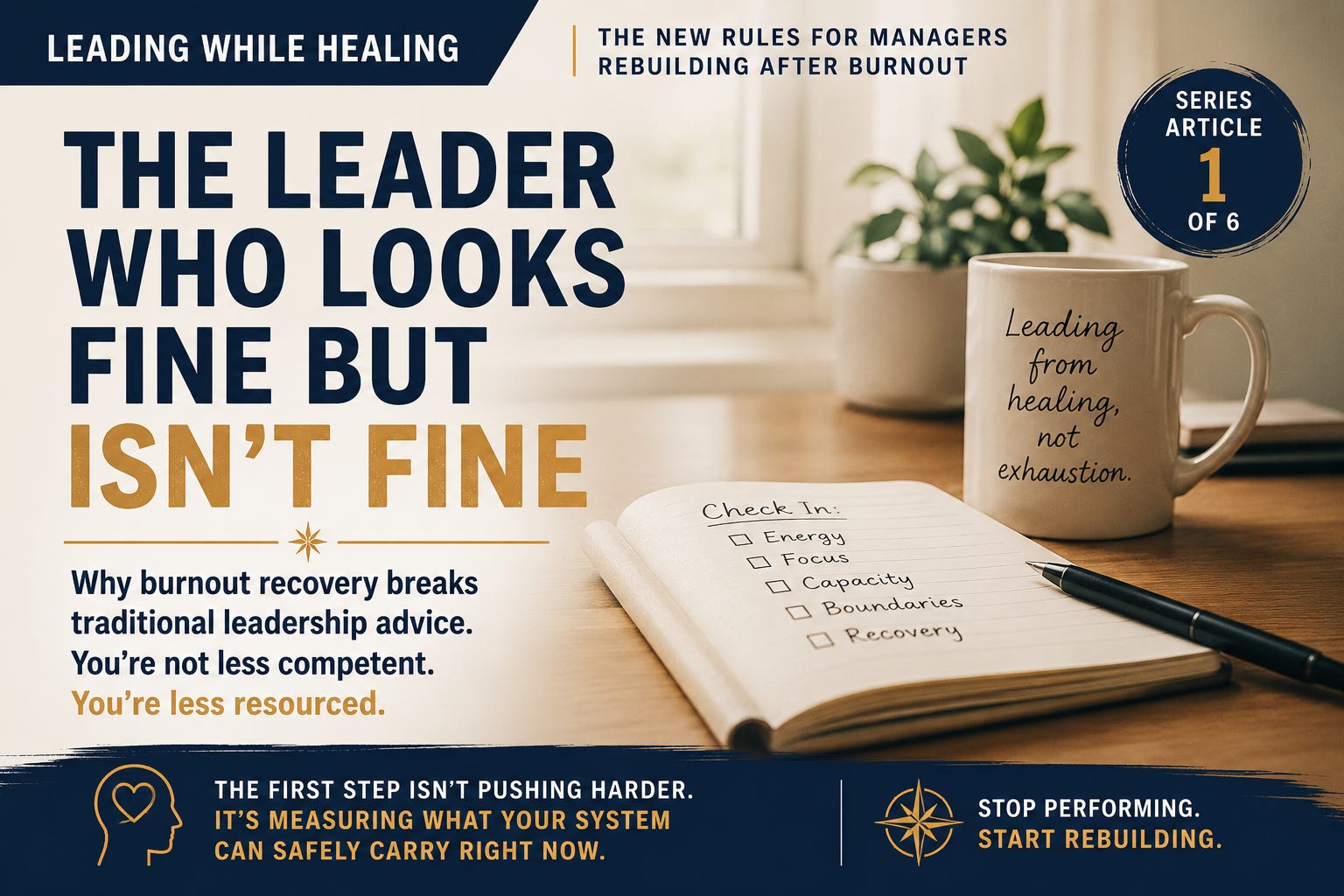
Leading While Healing
Article 1 of 6
A six-part series for managers rebuilding energy, trust, boundaries, and sustainable leadership after burnout.
Based on the book, Leading While Healing: A Manager’s Recovery Guide to Rebuilding Energy, Trust, Boundaries, and Sustainable Leadership After Burnout.
You can still make decisions.
You can still run the meeting.
You can still answer the email.
You can still show up on camera.
You can still listen to the update, ask the question, approve the next step, and keep the team moving.
That is what makes post-burnout leadership so dangerous.
Because from the outside, you look functional.
Inside, every normal task costs twice as much.
The meeting ends.
You smile.
You close the laptop.
Then your body drops.
Not dramatically.
Not visibly.
Just enough for you to realize something has changed.
The same meeting that once felt routine now leaves you drained.
The same decision that once took five minutes now sits in your mind for hours.
The same email that once felt simple now feels like one more demand on a system that has already been overdrawn.
And because you are still performing, people assume you are fine.
Sometimes you assume it too.
You tell yourself:
I am back.
I should be able to handle this.
I have done harder things than this.
I know how to lead.
I know how to manage pressure.
I know how to keep going.
But post-burnout leadership is not the same as ordinary leadership under stress.
Burnout changes the system you are leading from.
And if you do not understand that, you may spend your recovery judging yourself against a version of you that no longer has the same capacity.
The Performance Mask
Many burned-out managers become very good at looking okay.
They know how to sit upright in the meeting.
They know how to keep their voice steady.
They know how to ask the right follow-up question.
They know how to appear calm while their nervous system is quietly overloaded.
They know how to make everyone else feel stable while they are privately trying not to unravel.
This is the performance mask.
It is not fake leadership.
It is survival leadership.
It is what happens when you have spent years being responsible for outcomes, people, deadlines, escalations, conflict, expectations, and emotional tone.
You learn to hold the room.
Even when you cannot hold yourself.
You learn to absorb pressure.
Even when there is nowhere for that pressure to go.
You learn to keep the work moving.
Even when your body is asking for stillness.
That mask can help you survive a season.
But it can also confuse you.
Because when you can still perform, you may believe you should be fully recovered.
You may think functionality means capacity.
It does not.
You can be functional and depleted.
You can be articulate and exhausted.
You can be responsible and dysregulated.
You can be respected and running on fumes.
You can look like a leader while privately wondering why leadership now feels so expensive.
Why Traditional Leadership Advice Starts to Fail
Most leadership advice assumes something that post-burnout managers may not have.
It assumes emotional surplus.
It assumes cognitive bandwidth.
It assumes a regulated baseline.
It assumes you have enough internal capacity to pause, reflect, listen deeply, respond thoughtfully, hold complexity, manage conflict, absorb ambiguity, and still return to yourself afterward.
That is a lot to assume.
Advice like “be more present” sounds simple when your nervous system is stable.
It feels very different when presence itself requires effort.
Advice like “communicate more clearly” sounds reasonable when your mind is sharp.
It feels different when burnout has made your thoughts slower, heavier, or harder to organize.
Advice like “set better boundaries” sounds empowering when you have enough energy to tolerate disappointment.
It feels different when your system has been trained to keep peace by overextending.
Advice like “lead with empathy” sounds noble when you have emotional margin.
It feels different when everyone else’s needs feel like one more demand on a body already carrying too much.
This is why burned-out leaders often feel like they are failing at advice that used to make sense.
The advice may not be wrong.
But it may be incomplete.
It is speaking to the leader you were before depletion.
Not the leader you are while repairing.
You Did Not Lose Your Leadership Skills
One of the most painful parts of burnout recovery is the fear that you have lost something permanent.
You may notice that you are less patient.
Less creative.
Less decisive.
Less available.
Less confident.
Less emotionally generous.
Less tolerant of noise.
Less able to switch quickly between problems.
Less able to carry everyone’s urgency.
And if you are used to being capable, this can feel frightening.
You may ask:
What happened to me?
Why am I struggling with things I used to handle?
Why do small issues feel so heavy?
Why do normal conversations take so much energy?
Why can’t I lead like I used to?
But the first answer is not that you became weak.
The first answer is not that you became less competent.
The first answer is not that you stopped caring.
The first answer is this:
You are not less competent.
You are less resourced.
That distinction matters.
Competence is what you know how to do.
Capacity is what your system can currently carry.
Burnout does not erase your competence.
It reduces your access to it.
The skills may still be there.
The judgment may still be there.
The wisdom may still be there.
The experience may still be there.
But the internal system that helps you use those skills may be under repair.
That is why leadership after burnout can feel so confusing.
You know what to do.
But doing it costs more.
Capacity Is Not Character
Burned-out managers often turn capacity problems into character judgments.
They say:
I should be better at this.
I should be stronger.
I should be more patient.
I should be able to handle the pressure.
I should not need this much recovery time.
I should not be this affected.
I should be past this by now.
But “should” is often the language of a leader who has not yet accepted the condition of their system.
Capacity is not character.
Capacity is not commitment.
Capacity is not ambition.
Capacity is not professionalism.
Capacity is the amount of emotional, cognitive, physical, and relational load your system can carry without breaking down.
After burnout, that amount may be lower than it used to be.
Not forever.
But for now.
And “for now” deserves honesty.
Because when you ignore your actual capacity, you do not recover faster.
You overdraw the system again.
You keep borrowing against tomorrow.
You keep performing wellness instead of rebuilding it.
You keep leading from depletion and calling it discipline.
Eventually, your body tells the truth your calendar refuses to admit.
The Hidden Cost of Normal Tasks
After burnout, the problem is not always the size of the task.
It is the cost of the task.
A thirty-minute meeting may seem small.
But if it includes ambiguity, tension, decision pressure, emotional labor, and the need to appear composed, it may drain more energy than the calendar suggests.
A quick email may seem simple.
But if it requires careful tone, political awareness, conflict avoidance, or a decision you do not have the energy to make, it may sit in your mind all day.
A team check-in may seem routine.
But if you are carrying guilt about being less available, anxiety about trust, or pressure to appear fully back, it may feel heavier than expected.
This is why post-burnout recovery requires a different kind of measurement.
You cannot only count time.
You have to count load.
Some tasks are short but heavy.
Some conversations are brief but costly.
Some decisions are small but emotionally expensive.
Some days look manageable on paper but overwhelming in the body.
That is not weakness.
That is information.
The Body Keeps a Different Calendar
Your work calendar may say you are back.
Your title may say you are responsible.
Your team may say they need you.
Your inbox may say everything is urgent.
But your nervous system may be on a different timeline.
It may still be recovering from months or years of overextension.
It may still be scanning for threat.
It may still be reacting to ambiguity as danger.
It may still be bracing before meetings.
It may still be struggling to downshift after work.
It may still be treating every request as one more pressure point.
That is why “getting back to normal” can be such a misleading goal.
Normal may have been the system that burned you out.
Normal may have rewarded over-functioning.
Normal may have taught you to ignore warning signs.
Normal may have depended on your silence.
Normal may have required you to be available beyond what was sustainable.
Normal may have been praised by others while it was damaging you.
The goal is not to return to the old normal.
The goal is to build a healthier operating system.
Recovery Is a Leadership Operating System
Many managers treat recovery as something separate from leadership.
They think:
I will recover, then I will lead well again.
But in reality, if you are still in the role, recovery and leadership are happening at the same time.
You are not stepping away from responsibility completely.
You are trying to lead while repairing the system that leadership depends on.
That means recovery cannot be treated as an after-hours activity.
It has to become part of how you lead.
How you plan.
How you communicate.
How you set expectations.
How you make decisions.
How you manage energy.
How you protect focus.
How you rebuild trust.
How you say yes.
How you say no.
How you notice warning signs before they become collapse.
This is not self-care as decoration.
This is leadership infrastructure.
A burned-out manager does not need motivational pressure.
A burned-out manager needs a new operating system.
The First Rule: Stop Comparing Yourself to the Old Version of You
The old version of you may have been impressive.
The old version may have carried more.
Stayed later.
Responded faster.
Solved more problems.
Absorbed more pressure.
Made things look easier.
Handled chaos without showing strain.
But the old version may also have been burning through reserves that were never meant to be permanent.
That version of you may have been effective but unsustainable.
Praised but depleted.
Reliable but overextended.
Strong but unsupported.
So when you compare yourself to the leader you used to be, be careful.
You may be comparing yourself to a survival pattern.
Not a healthy standard.
The question is not:
How do I get back to being who I was?
The better question is:
What kind of leader can I become without abandoning myself again?
That question changes the recovery process.
It moves you away from shame.
It moves you toward design.
What Your System Can Safely Carry
The first step after burnout is not pushing harder.
It is not proving you are fine.
It is not pretending nothing changed.
It is not trying to restore everyone else’s comfort by ignoring your own limits.
The first step is assessment.
What can your system actually carry right now?
Not what your title demands.
Not what your old habits expect.
Not what your team hopes for.
Not what your guilt says you owe.
Not what your fear says you must prove.
What can your system safely carry today?
That question may feel uncomfortable because it forces honesty.
You may realize you have less margin than you wanted.
You may realize certain meetings drain you more than you admitted.
You may realize conflict affects you longer than it used to.
You may realize back-to-back calls are no longer neutral.
You may realize decision fatigue is real.
You may realize you need more recovery space between leadership demands.
That is not failure.
That is the starting point.
You cannot rebuild from an imaginary capacity.
You can only rebuild from the truth.
Signs You Are Leading Beyond Current Capacity
You may be leading beyond your current capacity if:
You finish normal workdays feeling emotionally flattened.
You avoid messages because every response feels like another demand.
You become irritated by small questions.
You need long periods of silence after meetings.
You feel resentment toward people who need direction.
You struggle to make decisions that used to feel simple.
You feel physically tense before routine conversations.
You lose patience faster than usual.
You cannot fully recover after a weekend.
You feel like you are performing leadership instead of inhabiting it.
These signs are not proof that you are a bad leader.
They are signals that your system is carrying more than it can currently process.
Ignore them, and burnout recovery slows.
Listen to them, and leadership can become safer again.
The New Leadership Question
Before burnout, the leadership question may have been:
How much can I handle?
After burnout, the better question is:
How much can I handle without damaging my recovery?
That is a different standard.
It does not lower your professionalism.
It makes your professionalism more sustainable.
Because leadership is not just output.
Leadership is also regulation.
Discernment.
Presence.
Clarity.
Consistency.
Trust.
If your system is overloaded, those qualities become harder to access.
You may still complete tasks.
But the quality of your leadership begins to suffer.
You may become more reactive.
More distant.
More controlling.
More avoidant.
More impatient.
More emotionally unavailable.
Not because you stopped caring.
Because depletion changes how leadership comes through you.
That is why capacity work is leadership work.
Rebuilding Begins With Permission to Tell the Truth
The leader who looks fine but is not fine does not need another lecture about resilience.
They need permission to tell the truth.
The truth may be:
I am functioning, but I am not fully restored.
I can lead, but I need a different rhythm.
I am capable, but my capacity is limited.
I care about my team, but I cannot keep abandoning myself to prove it.
I want to be effective, but I need to lead in a way that does not recreate the conditions that burned me out.
This kind of honesty is not weakness.
It is the beginning of recovery.
It is also the beginning of better leadership.
Because a leader who understands capacity can stop confusing exhaustion with commitment.
A leader who understands nervous system repair can stop treating every limit like a flaw.
A leader who understands sustainability can stop building trust on self-sacrifice.
The goal is not to lead less seriously.
The goal is to lead more truthfully.
A Practical Starting Point
For the next week, do not begin by changing everything.
Begin by noticing.
After each meeting, ask:
Did this give me energy, drain energy, or require recovery?
After each decision, ask:
Was this simple, heavy, or delayed because my system was overloaded?
At the end of each day, ask:
What did my calendar fail to measure?
After each moment of irritation, ask:
Am I reacting to this person, or am I reacting from depletion?
Before saying yes, ask:
Do I have the capacity to carry this well?
These questions are not about becoming fragile.
They are about becoming accurate.
Burnout recovery requires accuracy.
Not shame.
Not denial.
Not forced positivity.
Accuracy.
Because once you can see the real cost of your leadership load, you can begin to redesign it.
You Are Not Starting Over
Burnout can make you feel like you have lost your edge.
But you are not starting over.
You are learning to lead from a different level of self-awareness.
You are learning that capacity matters.
You are learning that your body is part of your leadership system.
You are learning that recovery is not passive.
You are learning that sustainable leadership requires boundaries, rhythm, repair, and honesty.
You are learning that the old way of pushing through may have worked until it didn’t.
And now you need a better way.
Not a weaker way.
A better way.
The leader who looks fine but is not fine does not need to disappear.
They need to stop pretending that looking functional means being fully restored.
They need to stop measuring recovery by outward performance alone.
They need to stop asking:
What should I be able to handle?
And start asking:
What can my system actually carry today?
That question is not the end of leadership.
It is the beginning of leading while healing.
Article 2 publishes next: Rebuilding Energy Without Relying on Motivation.
About the Author
Byron K. Veasey is a career strategist and leader in data quality engineering focused on helping professionals navigate job searches, burnout, and career reinvention.
He writes Career Strategies, a Substack newsletter read by over 4,900 professionals navigating today’s evolving job market.
👉 Subscribe to Career Strategies