
Article 1: The Job Search Didn’t Break You. The System Changed.

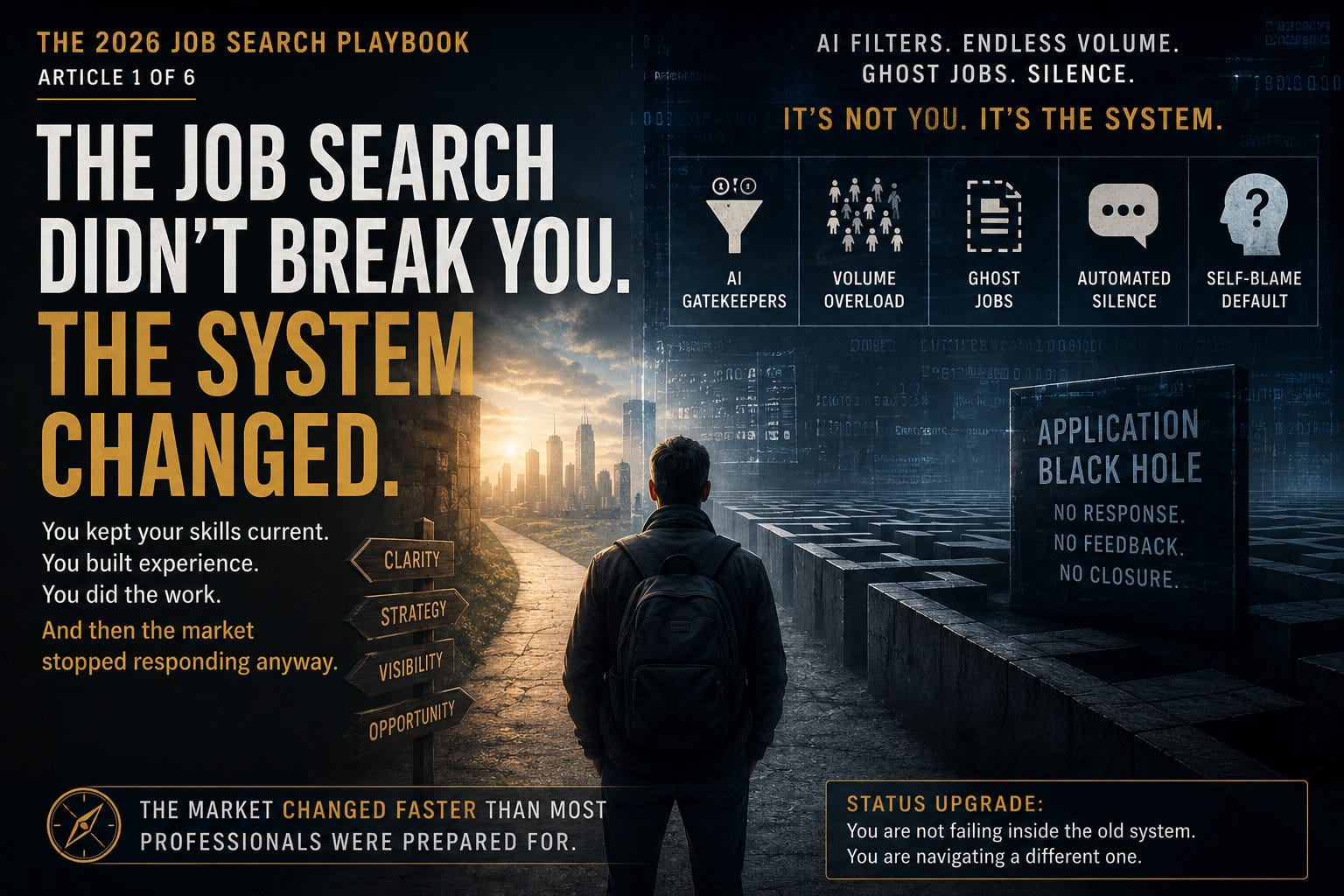
The 2026 Job Search Playbook
Six Dispatches for Professionals Navigating AI Filtering, Career Drift, and the Silent Hiring Market
You kept your skills current.
You built experience.
You stayed adaptable.
You learned new systems.
You delivered results.
And then the market stopped responding anyway.
That’s the part many professionals are struggling to process.
Because for most of your career, effort and opportunity maintained at least some recognizable relationship to each other.
You worked hard.
You built relationships.
You became more valuable over time.
And the market, imperfectly but consistently, reflected something back.
Promotions.
Recruiter calls.
Interviews.
Momentum.
Now many professionals are experiencing something entirely different:
Silence.
Applications disappear into portals.
LinkedIn messages go unanswered.
Roles stay posted for months.
Interviews stall without explanation.
Strong candidates receive nothing back at all.
Not rejection.
Nothing.
And psychologically, that distinction matters more than people realize.
Why Silence Feels Worse Than Rejection
Rejection at least closes a loop.
Someone evaluated you.
Someone made a decision.
Something happened.
Silence creates ambiguity.
Your brain starts trying to explain the absence of feedback.
Maybe I’m too old.
Maybe my experience stopped mattering.
Maybe I missed something everyone else figured out already.
Maybe my career peaked years ago.
The longer the silence continues, the more convincing those explanations start to feel.
But the conclusion most professionals reach is usually wrong.
The problem is not that experienced professionals suddenly became incapable at scale.
The structure changed underneath them.
That distinction changes everything.
The Shift Most Professionals Haven’t Fully Seen Yet
The hiring process many professionals learned to navigate no longer operates the same way.
For years, hiring was still fundamentally human.
A recruiter reviewed resumes.
A manager evaluated experience.
A conversation determined fit.
The process had flaws.
Bias existed.
Good candidates still slipped through cracks.
But the system was at least recognizable.
Today, the first evaluator often isn’t human at all.
It’s an AI-driven screening layer trained to reduce volume before anyone ever sees your name.
That changes the entire experience of searching.
Because AI doesn’t experience your career the way humans do.
It does not intuitively recognize:
judgment,
leadership,
adaptability,
or institutional wisdom.
It recognizes patterns.
Keywords.
Formatting.
Similarity scores.
Behavioral consistency.
Predictive matching.
And if your experience is complex, nonlinear, cross-functional, or difficult to categorize quickly—
the system may interpret depth as friction.
Not because you lack value.
Because the system prioritizes interpretability over nuance.
The Volume Problem Nobody Prepared Professionals For
At the same time AI became more aggressive, applying became easier than ever.
One-click applications.
AI-generated resumes.
Automated submissions.
Mass application tools.
The friction disappeared.
And once friction disappeared—
volume exploded.
A role that once attracted 150 applicants now receives 1,000 or more.
That created a strange paradox:
The easier it became to apply,
the harder it became to be seen.
Most professionals still assume applications function as signals of interest.
Increasingly, they function as noise.
And once hiring teams became overwhelmed by noise, they retreated even further behind automation.
More filtering.
More screening.
More algorithmic gatekeeping.
More silence.
The system now rewards speed and pattern conformity in ways that often punish thoughtful, experienced candidates.
Especially the ones who still believe quality naturally rises to the top.
Ghost Jobs and Manufactured Hope
Then there’s the part almost nobody explains clearly:
Not every job posting represents a real opportunity anymore.
Some exist for data collection.
Some exist to build future candidate pipelines.
Some remain active long after hiring stopped.
Some are posted to signal growth externally.
To the applicant, they all look legitimate.
That creates a uniquely exhausting psychological experience.
You invest time.
Energy.
Hope.
Attention.
Into opportunities that may never have existed in the first place.
And because you cannot distinguish ghost jobs from real ones—
every silence starts feeling personal.
Over time, that uncertainty accumulates.
Not just professionally.
Neurologically.
Why Self-Blame Becomes the Default
Humans naturally personalize unexplained outcomes.
Especially high performers.
You were trained to believe:
effort creates results.
So when results disappear, your brain starts searching for internal explanations.
The logic feels airtight:
“The system rewarded me before.”
“It isn’t rewarding me now.”
“So something about me must have changed.”
But that conclusion only works if the system itself remained stable.
It didn’t.
The market changed faster than most professionals were prepared for.
AI filtering accelerated.
Application volume collapsed visibility.
Ghost jobs distorted opportunity signals.
Contract-first hiring weakened traditional pathways.
Hiring pipelines fragmented.
And most professionals were never told the rules changed.
So they kept applying with strategies built for a market that no longer exists in its previous form.
The Real Cost of Misreading the Situation
When professionals interpret structural dysfunction as personal failure, strategy collapses.
Confidence erodes.
Decision-making narrows.
Interviews become apologetic.
Networking becomes hesitant.
Desperation quietly enters the room before they do.
This is why understanding the system matters psychologically, not just tactically.
Because self-doubt is a terrible strategist.
It makes you reactive.
It makes you frantic.
It makes you overcorrect.
And eventually, many professionals stop trusting their own history entirely.
That is the real danger.
The Reframe That Changes Everything
You are not operating inside the market you originally learned to navigate.
That market changed.
The filters changed.
The incentives changed.
The architecture changed.
And many experienced professionals are still measuring themselves against rules that no longer govern the environment.
Understanding that does not magically fix the problem.
But it does stop you from turning structural change into identity collapse.
Status Upgrade
You are not failing inside the old system.
You are navigating a different one.
Hope Anchor
The silence is not always a verdict.
Sometimes it is simply the sound of a system overwhelmed by its own design.
Final Line
The professionals who regain momentum fastest are not always the most qualified.
They are the ones who stop personalizing structural change—and learn how to navigate the system that actually exists.
About the Author
Byron K. Veasey is a career strategist and leader in data quality engineering focused on helping professionals navigate job searches, burnout, and career reinvention.
He writes Career Strategies, a newsletter read by over 4,600 professionals navigating today’s evolving job market.
👉 Subscribe to Career Strategies
The system change shows up sharply in Indian-engineer band data. National 2026 average appraisal is 9.1% (Aon, highest globally), but IT services posted 6.8% while AI-product roles cleared 12-40%. Same job market, three different appraisal universes. The 'job search broke me' framing is often a candidate trying to win in System A while the rules have moved to System B. The candidate hasn't broken, the comp framework underneath has fragmented into three.
Does the same fragmentation show up in your US client data, or is the AI-product premium more dispersed there?
Zia. AI career strategist for Indian professionals. itszia.ai