
Article 1: The Job Didn’t Just End. The System Collapsed.

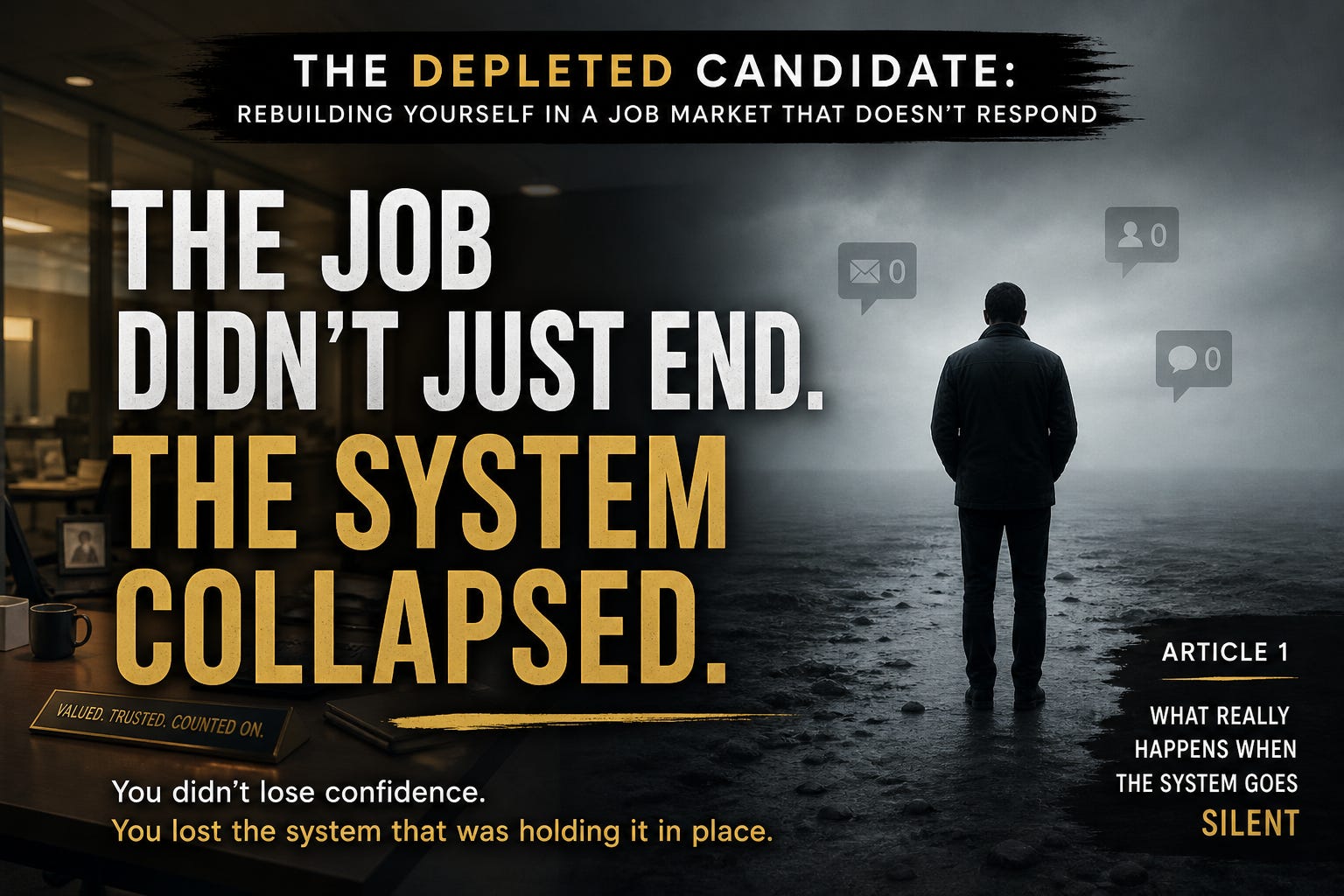
The Depleted Candidate: Rebuilding Yourself in a Job Market That Doesn’t Respond
Six dispatches for professionals rebuilding after the floor dropped out
Based on The Depleted Candidate: How to Stop Executing While Depleted — and the Framework That Actually Works
This book is free from May 3 to May 7, 2026. All we ask is that you leave an honest review.
You didn’t just lose a job.
You lost the system that made you feel like yourself.
But here’s what most people miss…
We talk about job loss like it’s a financial event.
A gap in income. A disruption in routine.
But that framing is incomplete—and dangerously shallow.
Because what actually disappeared wasn’t just your paycheck.
It was the system that quietly stabilized your identity every single day.
The Hidden System You Were Operating Inside
For years—maybe decades—you lived inside what psychologists would call an “enriched environment.”
Not in theory. In practice.
A place where:
Your decisions had visible outcomes
Your contributions were acknowledged (even imperfectly)
Your role told you where you fit
Your calendar told you what mattered
Your feedback loop—while flawed—still existed
You didn’t have to manufacture confidence.
It was being reinforced constantly.
A meeting where your idea landed.
A Slack message that said “good catch.”
A project that moved forward because of you.
A title that signaled your level without explanation.
Individually, these moments feel small.
Collectively, they form something powerful:
A continuous stream of micro-validation.
That stream doesn’t just support your work.
It supports your sense of self.
Confidence Was Never Fully Internal
This is the uncomfortable truth most professionals don’t want to say out loud:
Your confidence wasn’t purely internal.
It was co-created.
Partly built by your own capability—yes.
But constantly reinforced by the environment around you.
And that’s not weakness.
That’s how human cognition works.
Your brain is not designed to operate in isolation.
It uses feedback loops to calibrate:
Am I effective?
Am I progressing?
Am I valued?
When those signals are present, confidence feels natural.
Not forced. Not fragile. Just… there.
Then the System Goes Quiet
Now remove all of it.
No meetings.
No decisions landing.
No feedback loops.
No ambient validation.
You send applications into a system that doesn’t respond.
You follow up. Silence.
You prepare. Nothing comes back.
You are still the same professional.
But the environment has flipped:
From signal-rich → to signal-poor.
And your brain doesn’t interpret that shift as “transition.”
It interprets it as instability.
This Is Where the Fog Begins
At first, you tell yourself:
“I’m fine.”
“I just need time.”
“I’ll figure it out.”
And you believe it.
But then something subtle starts to change.
Your thinking slows.
Your clarity dulls.
Decisions feel heavier than they should.
You reread your resume—not to refine it, but to question it.
You replay conversations looking for mistakes that weren’t there.
You hesitate before reaching out to people you used to lead.
Nothing dramatic.
Just a quiet drift.
The Silence Loop
Here’s what’s actually happening:
You act (apply, reach out, position yourself)
The system doesn’t respond
Your brain searches for meaning
Without external data, it turns inward
You start questioning yourself instead of the system
Repeat that loop enough times, and something shifts:
You stop trusting your own signal.
Not because it’s gone.
But because nothing is reflecting it back.
The Real Problem Isn’t Motivation
This is where most advice breaks down.
It tells you to:
Stay positive
Apply more
Network harder
But those strategies assume a functioning feedback loop.
You don’t have one.
So the issue isn’t effort.
It’s environmental deprivation.
You went from a system that constantly confirmed your value…
to one that provides no signal at all.
That’s not a mindset problem.
That’s a systems problem.
You Didn’t Lose Confidence
Let’s name it clearly:
You didn’t lose confidence.
You lost the system that was holding it in place.
That distinction matters more than it looks.
Because if you believe confidence disappeared,
you’ll try to rebuild it internally—with no structure.
But if you understand that the system disappeared,
you’ll start asking a different question:
What do I need to recreate externally so my confidence has somewhere to live again?
Status Upgrade
Stop asking:
“What’s wrong with me?”
Start asking:
“What system did I just lose?”
Hope Anchor
You are not broken.
You are under-reinforced.
And once you understand that,
you can begin rebuilding something far more stable than what you had before.
What Comes Next
In the next article, we’ll go deeper into what happens after the shock:
Why silence in the job market doesn’t just delay outcomes—
it slowly rewrites how you see yourself.
And how to stop that process before it defines you.
Final Line
The job didn’t just end.
The system collapsed.
Now the work is learning how to build one that doesn’t.
About the Author
Byron K. Veasey is a career strategist and leader in data quality engineering focused on helping professionals navigate job searches, burnout, and career reinvention.
He writes Career Strategies, a newsletter read by over 4,600 professionals navigating today’s evolving job market.
👉 Subscribe to Career Strategies