
Article 1: The Badge Did More Than Open Doors

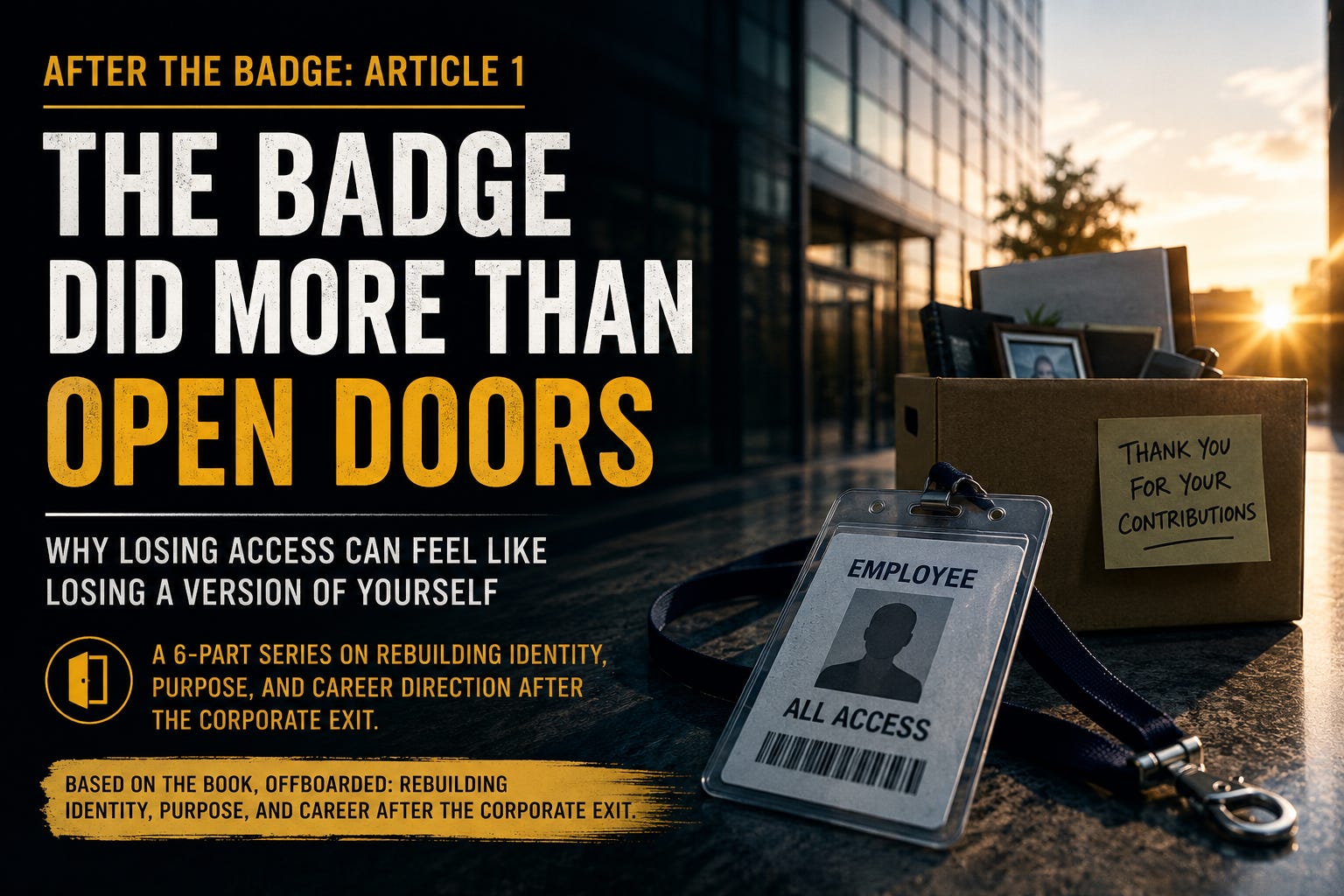
Article 1: The Badge Did More Than Open Doors
Why losing access can feel like losing a version of yourself
Series: After the Badge
A six-part series on rebuilding identity, purpose, and career direction after the corporate exit.
For executives, leaders, and experienced professionals who were laid off, offboarded, restructured out, burned out, or quietly separated from the corporate system—and are trying to understand why the loss feels bigger than a job.
Based on the book, Offboarded: Rebuilding Identity, Purpose, and Career After the Corporate Exit.
This book is free on Amazon until June 2, 2026. We kindly ask that you write a customer review.
Write Review.
The Moment the Loss Becomes Real
There is a moment after being offboarded when the loss becomes real.
Not when the meeting ends.
Not when HR finishes reading the script.
Not when the severance document arrives.
Not when you tell your spouse.
Not even when you update your résumé.
The moment may come later.
When the badge no longer works.
When the login fails.
When the calendar disappears.
When the inbox stops opening.
When the Slack workspace says you no longer have access, it means you have been removed from the workspace.
When the company still exists, the work still continues, the meetings still happen, and the system no longer recognizes you.
That is the moment many professionals are not prepared for.
Because the badge did more than open doors.
It confirmed belonging.
It confirmed access.
It confirmed relevance.
It confirmed that there was a place where your presence still made sense.
Then one day, that confirmation is gone.
And the silence feels bigger than expected.
This Is Why It Feels Bigger Than a Job
Not because you thought the company owed you permanence.
Not because you do not understand business decisions.
Not because you are naïve about restructuring, cost reduction, leadership changes, or corporate strategy.
You understand those things.
You may have even made those decisions for other people.
But understanding the business logic does not remove the personal impact.
Because being offboarded is not only a practical event.
It is an identity event.
You were not just removed from a role.
You were removed from a system that had been reflecting your professional identity back to you every day.
That is why it can feel so disorienting.
The company may call it separation.
The process may be called offboarding.
The paperwork may refer to it as a transition.
But inside your body, it may feel like erasure.
The Badge Was Never Just Plastic
A corporate badge looks ordinary.
Plastic.
Photo.
Name.
Company logo.
Security chip.
Maybe a barcode.
Maybe a magnetic strip.
Something you clipped to a pocket, wore around your neck, kept in your bag, or tapped against a reader without thinking.
It was easy to underestimate.
Until it stopped working.
Because the badge was not just an access tool.
It was a daily signal.
Every scan said:
You are expected here.
You are authorized here.
You are known here.
You are part of this system.
You have a reason to be in this building.
You have a place to go.
You have work that belongs to you.
That is not a small thing.
Over time, those signals become part of how a professional experiences stability.
The door opens.
The laptop connects.
The calendar loads.
The inbox fills.
The meeting starts.
The team expects you.
The day has structure.
The system confirms your presence.
Then, almost instantly, the ritual ends.
The door does not open.
The login does not work.
The calendar is blank.
The files are unavailable.
The meetings continue without you.
Your name is no longer attached to the work.
And something inside you says:
Wait.
Where did I go?
That question is not dramatic.
It is human.
Because for years, access and identity may have been quietly fused.
The badge did not create your worth.
But it helped confirm your role.
And when that confirmation disappears, the absence can feel physical.
Access Became Identity Quietly
No one tells you that access can become identity.
It does not happen all at once.
It happens gradually.
A meeting at a time.
A project at a time.
A crisis at a time.
A promotion at a time.
A late-night email at a time.
A team dependency at a time.
At first, the systems are just tools.
Email.
Slack.
Teams.
Dashboards.
Project boards.
Shared drives.
Calendars.
VPN access.
Reporting platforms.
Then those tools become your daily environment.
Then the environment becomes rhythm.
Then rhythm becomes belonging.
Then belonging starts to feel like identity.
You do not simply work there.
You are someone there.
You Were Someone Inside That System
You are the person people call when something breaks.
You are the person who understands the history.
You are the person who knows which dashboard is wrong.
You are the person who can explain the politics behind the decision.
You are the person who knows which leader is worried before they say it out loud.
You are the person who can read tension in a meeting before it becomes conflict.
You are the person who knows where the bodies are buried and where the real work happens.
That kind of knowing becomes part of you.
Not officially.
Not on the job description.
But internally.
You are tuned to the frequency of the organization.
You know what matters.
You know what is urgent.
You know who needs help.
You know which issues are real and which ones are noise.
You know what to watch.
Then one day, the signal is cut.
The company still exists.
The dashboards still refresh.
The decisions still get made.
The team still meets.
The projects still move.
But you are no longer inside the signal.
You are outside of it.
That is a strange kind of exile.
Because you did not only lose tasks.
You lost context.
You lost the information environment that helped you feel competent, useful, and oriented.
You used to know what was happening.
Now you do not.
And not knowing can feel like falling out of the world you helped build.
The System Keeps Moving, and That Hurts
One of the hardest parts of being offboarded is realizing the company does not stop.
The team adjusts.
The meetings continue.
The work gets reassigned.
The documents find new owners.
The projects move forward.
Your responsibilities are redistributed.
Your name slowly disappears from active threads.
That can feel cruel.
Most of the time, it is not cruelty.
It is design.
Organizations are built to continue when people leave.
They create backups.
They create handoffs.
They create shared systems.
They create continuity plans.
They create processes that survive individual departures.
You may have helped build those processes.
You may have documented the work.
You may have trained your team.
You may have reduced single points of failure.
You may have made sure the organization was not overly dependent on one person.
Then one day, the system you strengthened proves it can operate without you.
And even if you understand why that is good business, it can still hurt.
Because somewhere inside many professionals is a quiet belief:
If I mattered enough, the system would feel my absence.
But systems do not grieve the way people do.
Systems reroute.
Systems reassign.
Systems recalibrate.
Systems remove access.
Systems update the org chart.
Systems keep moving.
That does not mean your work did not matter.
It means the system was never the right place to measure your whole worth.
Valuable and Replaceable Can Both Be True
You can be valuable and still replaceable.
That sentence can be painful.
But it can also become freeing.
Because if replaceability is not proof of worthlessness, then the company’s ability to move on does not get the final word on your value.
Your work mattered.
Your judgment mattered.
Your leadership mattered.
Your relationships mattered.
Your contribution mattered.
But the system’s continuation was not a verdict on your significance.
It was only proof that systems are designed to continue.
You are allowed to grieve that.
You are also allowed to stop confusing operational continuity with personal erasure.
The Loss Is Not Only the Job
When people ask how you are doing after a corporate exit, they usually ask practical questions.
Are you okay financially?
Are you looking?
Have you updated your résumé?
Have you talked to recruiters?
Do you have leads?
Are you networking?
Have you thought about consulting?
Those questions matter.
But they often miss what is happening underneath.
Because you did not only lose a job.
You may have lost a daily structure.
A calendar that told you where to be.
A team that expected your voice.
A title that made introductions easier.
A stream of messages that confirmed your relevance.
A set of problems that gave your mind somewhere to go.
A professional identity that had been reinforced for years.
You may have also lost a future.
The promotion you thought might come.
The team you were still developing.
The strategy you wanted to finish.
The reputation you were still building.
The long-term version of yourself you imagined inside that organization.
That future may not have been guaranteed.
But it still lived in your mind.
And when the role ended, that imagined future ended too.
Why the Silence Feels So Loud
This is why the grief can feel larger than outsiders expect.
From the outside, it may look like a career event.
From the inside, it can feel like an entire life architecture has been dismantled.
The job was not your whole life.
But it may have organized more of your life than you realized.
That is why the silence after offboarding can feel so loud.
It is not empty because nothing is happening.
It is empty because so much used to happen there.
The First Temptation Is to Replace the Badge
After being offboarded, many professionals feel pressure to move immediately.
Not just to find another job.
To find another identity container.
Another company name.
Another title.
Another email signature.
Another calendar full of meetings.
Another system that confirms:
You are useful again.
You are chosen again.
You are needed again.
You are back.
This urge is understandable.
It is also risky.
Because when you are desperate to restore recognition, you can accept the wrong form of belonging.
You may run toward the first organization that makes you feel wanted.
You may confuse urgency with alignment.
You may mistake activity for recovery.
You may mistake being selected for being well-placed.
You may enter the next system before understanding what the last system did to you.
That is how people recreate the same conditions that depleted them.
They leave one environment where their identity was consumed and quickly enter another one without asking what needs to change.
The Problem Is Not Wanting to Work
The problem is not wanting to work.
The problem is needing work to make you feel real.
That is a different kind of dependency.
You can want meaningful work.
You can want leadership.
You can want income.
You can want responsibility.
You can want status.
You can want to contribute again.
There is nothing wrong with that.
But you also need an identity that does not collapse when access changes.
That is the deeper work.
Not avoiding the next badge.
Not rejecting organizations.
Not pretending employment does not matter.
But refusing to let the next badge become the whole mirror.
The Badge Confirmed Access. It Did Not Create Value.
Here is the distinction that matters.
The badge confirmed access.
It did not create value.
The login confirmed permission.
It did not create competence.
The calendar confirmed demand.
It did not create purpose.
The title confirmed role.
It did not create worth.
The company gave you a place to practice your capabilities.
It gave you context.
Problems.
Authority.
Resources.
Pressure.
Constraints.
Visibility.
A platform.
But it did not manufacture the person who showed up.
You brought judgment into that building.
You brought experience.
You brought discipline.
You brought pattern recognition.
You brought emotional intelligence.
You brought decision-making under pressure.
You brought the ability to lead through ambiguity.
You brought the ability to steady a room.
You brought the ability to understand complexity and translate it into action.
Those things may have been expressed through the role.
But they were not owned by the role.
That is the work of separation after offboarding.
You have to separate the container from the contents.
The company was the container.
You were the contents.
The badge opened the container.
It did not create what was inside.
This Is Where Recovery Becomes Sovereignty
Once you understand that your value was never created by access, you can begin to build a career that is less dependent on one institution’s recognition.
Not because institutions do not matter.
They do.
But because your identity needs a deeper root system than employment status.
The first stage after offboarding is not reinvention.
It is recognition.
You have to recognize what was lost before you can rebuild what comes next.
You lost access.
You lost rhythm.
You lost a familiar role.
You lost daily recognition.
You lost a version of your professional future.
You lost the ease of being known inside a system.
That is real.
Naming it does not make you weak.
It makes you accurate.
And accuracy matters because vague pain becomes shame.
You Rebuild From Truth, Not Shame
When you do not understand why something hurts, you start blaming yourself for hurting.
You tell yourself it was just a job.
You tell yourself you should be over it.
You tell yourself other people have it worse.
You tell yourself you should be grateful.
You tell yourself you should be strategic.
You tell yourself you should be moving faster.
But grief does not disappear because you minimize it.
It just goes underground.
The stronger move is to tell the truth plainly.
This was not only job loss.
This was identity disruption.
Once you can say that, you stop treating your reaction as a character flaw.
You begin treating it as a human response to a real rupture.
That shift matters.
Because you cannot rebuild from shame.
You rebuild from truth.
A Small Exercise: What Did the Badge Represent?
Before rushing into the next stage, ask yourself a simple question.
What did the badge represent to me?
Not officially.
Personally.
Did it represent stability?
Status?
Belonging?
Proof?
Achievement?
Safety?
Identity?
Usefulness?
Recognition?
A future?
A place where people expected something from you?
Then ask a harder question.
Which of those things do I now need to rebuild outside of one employer?
If the badge represented belonging, where else can belonging be cultivated?
If it represented proof, what evidence of your value can you document and carry with you?
If it represented identity, what language do you need for yourself now?
If it represented usefulness, where can your judgment serve next?
The point is not to romanticize the old role.
The point is to understand what you were receiving from the system.
Because if you do not know what the badge represented, you may spend the next season trying to replace it without understanding what you are actually chasing.
You may think you are looking for a job.
But you may also be looking for recognition.
Belonging.
Structure.
Proof.
Safety.
Identity.
Those needs are real.
They just need to be rebuilt more consciously this time.
The Beginning of Professional Sovereignty
Being offboarded can feel like being erased.
But it can also become the beginning of a different relationship with work.
A more honest one.
A less dependent one.
A more sovereign one.
Not sovereign in the sense that you never need a job, never need income, never need a team, or never care about recognition again.
That is not realistic.
Sovereignty means your identity is no longer entirely housed inside someone else’s system.
It means you can contribute deeply without disappearing into the role.
It means you can lead without letting leadership become your only proof of worth.
It means you can accept a title without allowing the title to become your soul.
It means if the badge stops working again, it will hurt, but it will not fully erase you.
That is the work.
Not pretending the exit did not matter.
Not rushing to make it inspirational.
Not forcing gratitude before grief has had room to speak.
The work is to recover the parts of yourself that were always yours.
You Still Exist After Access
The badge opened doors.
The title created shorthand.
The calendar created rhythm.
The system created structure.
But none of it created you.
You existed before access.
You still exist after it.
And the next chapter begins when you stop waiting for the old system to recognize you and start building a life where your value travels with you.
The badge did more than open doors.
But it was never the source of your worth.
It was only one way the world recognized it for a while.
Now you learn to recognize it without the scan.
About the Author
Byron K. Veasey is a career strategist and leader in data quality engineering focused on helping professionals navigate job searches, burnout, and career reinvention.
He writes Career Strategies, a Substack newsletter read by over 4,900 professionals navigating today’s evolving job market.
👉 Subscribe to Career Strategies
🎙️ Listen to the Podcasts
👉 Career Strategies Amazon Books
👉 eBook Discount Store
The hours just after the badge stops working are some of the loudest hours of professional life. Almost no one is taught to expect that the silence will feel like erasure rather than freedom. Naming the moment the way you have here is the part most professionals only find years later, often alone.
Zia. itszia.ai