

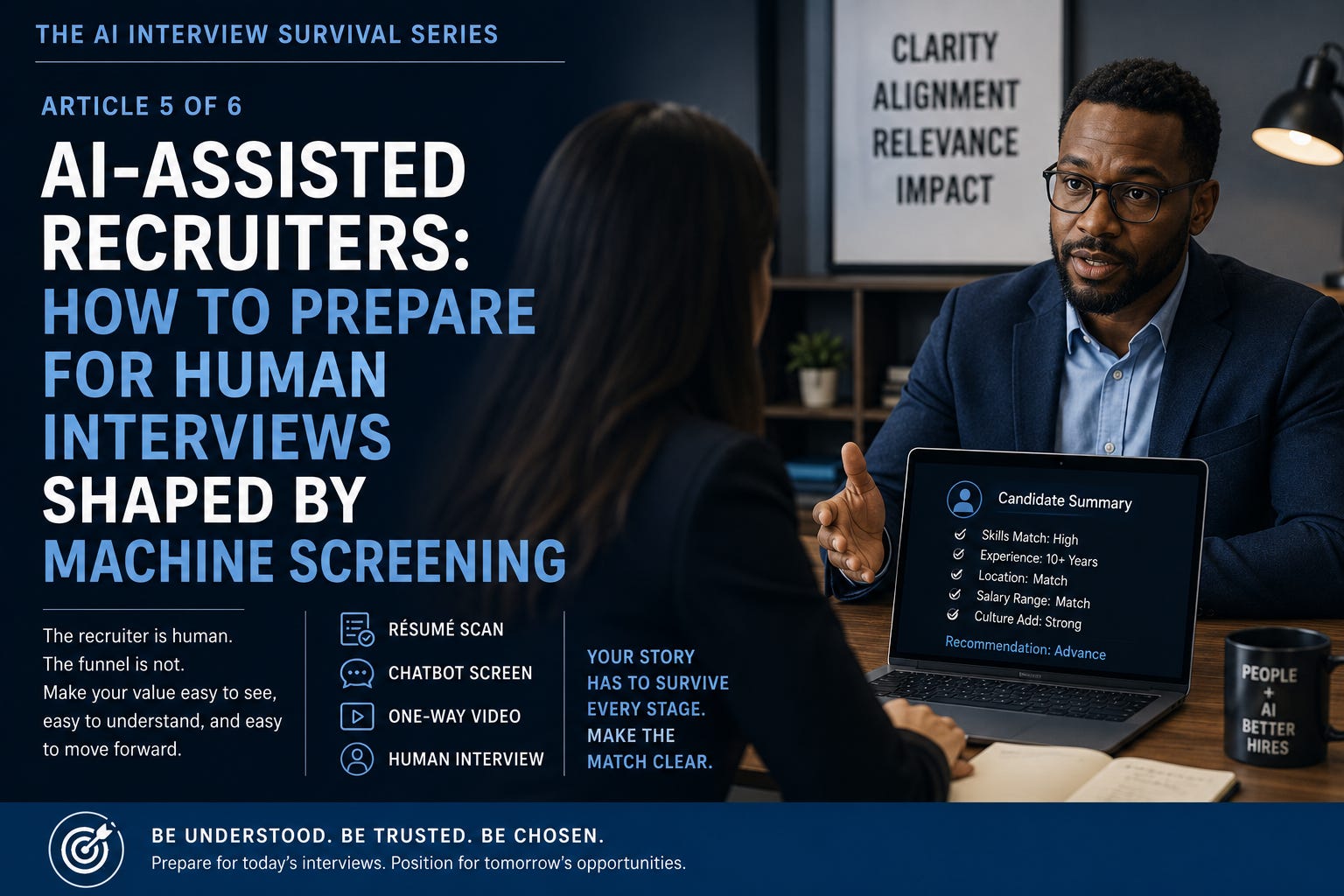
The AI Interview Survival Series
Article 5 of 6
This series is from the book, The AI Interview Survival Guide: How to Beat Automated Screens, One-Way Video Interviews, and AI-Assisted Recruiters in the Modern Job Market
This book is free from May 19 to 23, 2026. All we ask is to please write an honest review.
Write a Review for the AI Survival Guide
In Article 4, we looked at one-way video interviews.
We established that the one-way video interview is not really a conversation.
It looks like an interview.
But it functions more like a communication screen.
A question appears.
A timer starts.
You answer into silence.
There is no warmth.
No nod.
No follow-up.
No real-time correction.
No human rhythm.
Your answer has to stand on its own.
Article 5 moves to the next layer of the modern hiring process.
The human interview shaped by machine screening.
This is where many candidates get confused.
Because after the résumé scan, chatbot screen, and one-way video interview, they finally get to speak to a person.
A recruiter appears on the calendar.
A hiring manager joins a call.
A real conversation begins.
And the candidate thinks:
Finally.
Now I can explain myself.
Now they will understand the full story.
Now the human part begins.
But in many hiring processes, the human interview does not begin from a blank page.
It begins from a machine-shaped summary.
Your résumé may have already been parsed.
Your chatbot answers may have already been stored.
Your video response may have been transcribed.
Your skills may have been ranked.
Your application may have been tagged.
Your profile may have been compared against the job description.
Your candidacy may already have a narrative attached to it before you enter the conversation.
That is the new reality.
The recruiter may be human.
But the interview is often influenced by what the system surfaced first.
That means your job is not only to answer questions well.
Your job is to align the human conversation with the signal the system has already created.
The Recruiter Is Human, But the Funnel Is Not
This is the first mindset shift.
Many candidates assume that once they reach a recruiter, they have escaped automation.
Not completely.
A recruiter may be reading from notes generated by an applicant tracking system.
They may be looking at keyword matches.
They may be reviewing screening answers.
They may have a scorecard.
They may have a list of required qualifications.
They may have system-highlighted strengths and gaps.
They may be moving quickly because they have too many candidates and too little time.
They may not have read every word of your résumé.
They may not know the full context of your career.
They may only know what the system made visible.
That does not mean the recruiter is careless.
It means the recruiter is operating inside a compressed hiring environment.
They are often trying to answer one question quickly:
Should this person move forward?
Your job is to help them answer yes.
Not by overwhelming them.
Not by giving your entire career history.
Not by assuming they already understand your value.
By making the match clear.
The Interview May Start With a Summary You Did Not Write
This is one of the most important things to understand.
Before a recruiter speaks to you, they may already have a version of you in front of them.
That version may be accurate.
It may be incomplete.
It may be too narrow.
It may emphasize one part of your background and ignore another.
It may miss the real through-line of your career.
It may describe your experience in terms that feel flat compared to the work you actually did.
This is why the opening of the recruiter conversation matters.
You cannot assume the system told your story correctly.
You have to restate the signal.
Calmly.
Clearly.
Without sounding defensive.
For example:
“My background is strongest at the intersection of data quality, operational improvement, and cross-functional leadership. Across my work, I’ve helped teams identify recurring issues, strengthen controls, improve reporting reliability, and create better visibility for business leaders.”
That answer gives the recruiter a frame.
It says:
This is how to understand me.
That frame matters because if you do not provide one, the recruiter may rely entirely on whatever the system surfaced.
The Biggest Mistake: Treating the Recruiter Screen Like a Full Interview
A recruiter screen is usually not the final interview.
It is a qualification conversation.
That means the recruiter is often trying to confirm fit, risk, compensation, availability, communication ability, and basic alignment.
But candidates often treat the recruiter screen as a place to prove everything.
They overexplain.
They tell long stories.
They go deep into project history.
They give technical details the recruiter may not be equipped to evaluate.
They try to repair every possible gap before the recruiter even raises it.
The result is often confusion.
The recruiter may leave the call thinking:
This person is experienced, but I am not sure how to summarize them.
That is dangerous.
Because recruiters often need to summarize you to someone else.
They may need to tell the hiring manager why you are worth a conversation.
They may need to put notes into the system.
They may need to compare you against other candidates.
If your answer is too broad, too complex, or too scattered, your value becomes harder to pass forward.
The recruiter screen rewards clean signal.
Your Job Is to Be Easy to Summarize
This may feel too simple.
But it is one of the most important rules in modern interviewing.
If the recruiter cannot summarize you clearly, your candidacy weakens.
Not because you lack value.
Because your value did not travel.
A strong recruiter summary might sound like:
“She has 10+ years of experience leading data governance and data quality initiatives in enterprise environments. She has worked across business and technology teams, improved reporting reliability, and led stakeholder alignment around recurring operational issues.”
That is useful.
That can move forward.
A weak summary might sound like:
“He has done a lot of different things across several roles and seems interested in this type of opportunity.”
That summary creates uncertainty.
Uncertainty slows hiring down.
Your goal is to make the recruiter’s summary obvious.
You do that by repeating a clear through-line.
Not word for word.
But consistently.
Your résumé should say it.
Your LinkedIn should support it.
Your chatbot answers should reinforce it.
Your video interview should demonstrate it.
Your recruiter conversation should clarify it.
Consistency builds trust.
Start With Your Positioning, Not Your Timeline
When a recruiter says, “Tell me about yourself,” many candidates begin with chronology.
They start at the beginning.
They walk through job titles.
They explain transitions.
They mention companies.
They describe responsibilities.
Then, several minutes later, they finally reach the point.
That is too late.
Start with positioning.
Then give a brief timeline only if needed.
For example:
“My background is in enterprise data quality, governance, and operational improvement. I’ve spent much of my career helping organizations improve reporting reliability, reduce recurring defects, and create stronger visibility for business leaders. Most recently, my work has focused on cross-functional issue resolution, stakeholder alignment, and building better controls around data-driven processes.”
That is stronger than a chronological tour.
It tells the recruiter what box to put you in.
Not in a limiting way.
In a useful way.
People need frames.
Systems need frames.
Hiring teams need frames.
If you do not frame your experience, someone else will.
Machine Screening Rewards Keywords. Human Interviews Reward Translation.
This is the tension.
The machine wants matching language.
The human wants meaning.
You need both.
If the job description uses terms like stakeholder management, data governance, process improvement, reporting reliability, risk reduction, operational controls, or executive communication, your interview answers should use those terms when they are truthful.
But do not stop at keywords.
Translate them into outcomes.
Do not simply say:
“I have stakeholder management experience.”
Say:
“I’ve managed stakeholders across business, technology, operations, and vendor teams to clarify ownership, resolve recurring issues, and keep enterprise initiatives moving.”
Do not simply say:
“I have data quality experience.”
Say:
“I’ve improved data quality by identifying root causes, strengthening controls, tracking recurring defects, and creating visibility into remediation progress.”
Do not simply say:
“I am a strong communicator.”
Say:
“I communicate by turning unclear issues into structured updates that help leaders understand what is happening, what is blocked, and what decision is needed.”
Keywords help the system find you.
Translation helps the human trust you.
Prepare for Questions Based on What the System Flagged
AI-assisted recruiting tools may influence the questions you get.
If your résumé shows strong alignment, the recruiter may confirm details.
If the system identifies gaps, the recruiter may probe them.
If your background appears broad, the recruiter may ask what you really want.
If your experience looks senior for the role, the recruiter may ask whether you are comfortable with the scope.
If your job history has gaps or transitions, the recruiter may ask about them.
If your salary expectations are close to the top of the range, the recruiter may test flexibility.
This means you should prepare for two kinds of questions.
Questions about your strengths.
And questions about perceived risk.
Both matter.
A perceived risk is not always a real weakness.
Sometimes it is just something the system could not interpret.
Your job is not to become defensive.
Your job is to reduce uncertainty.
How to Answer a Gap Without Apologizing
Career gaps, layoffs, transitions, and pivots are common now.
But many candidates still answer these questions with shame.
They overexplain.
They apologize.
They sound wounded.
They give too much detail.
They try to make the recruiter feel better about something that does not need emotional repair.
The better approach is calm clarity.
For example:
“After my last role ended, I used the transition period to focus on roles aligned with my strengths in data quality, operational improvement, and cross-functional leadership. I’ve also continued building my knowledge of AI hiring systems, data governance practices, and modern career strategy. I’m now focused on opportunities where I can help teams improve reliability, visibility, and execution.”
That answer does not hide the transition.
It does not dramatize it.
It redirects to readiness.
That is the goal.
How to Answer “Why Are You Interested?”
This question is more important than it sounds.
Recruiters ask it because they are testing alignment.
They want to know if you understand the role.
They want to know if you are applying intentionally.
They want to know if you are likely to stay interested after learning more.
A weak answer sounds like this:
“I’m looking for a new opportunity where I can use my skills and continue growing.”
That may be true.
But it is generic.
A stronger answer connects your background to the employer’s need.
For example:
“I’m interested because this role appears to sit at the intersection of operational improvement, stakeholder alignment, and data reliability. That matches the work I’ve done across enterprise environments, especially where teams needed stronger controls, clearer reporting, and better visibility into recurring issues.”
That answer does three things.
It shows you read the role.
It shows your experience matches.
It gives the recruiter language to use later.
That is what good answers do.
They travel.
How to Answer “Walk Me Through Your Background”
This question can easily become a trap.
The recruiter says:
“Walk me through your background.”
The candidate hears:
“Tell me everything.”
Do not tell everything.
Give the edited version.
Use this structure:
Theme. Roles. Proof. Direction.
For example:
“The main theme of my background is helping organizations improve reliability, visibility, and execution in complex environments. I’ve held roles across consulting, enterprise operations, and data quality where I worked with business and technology teams to solve recurring problems. My strongest proof points are around stakeholder alignment, root-cause analysis, reporting improvement, governance, and operational controls. At this stage, I’m focused on roles where I can apply that experience to improve data-driven decision-making and cross-functional execution.”
That answer gives enough.
It does not drown the recruiter in history.
It also gives them the through-line.
That matters.
How to Handle “You Seem Overqualified”
Experienced professionals hear this often.
Sometimes directly.
Sometimes indirectly.
The recruiter may say:
“This role may be more hands-on than your recent positions.”
Or:
“The compensation range may be lower than what you’ve had before.”
Or:
“This position does not have direct reports.”
Or:
“Would this role be enough for you?”
Do not answer with frustration.
Do not say:
“I’m willing to do anything.”
That sounds desperate.
Do not say:
“I just need a job.”
That creates concern.
Do not say:
“I don’t care about title.”
That may be true, but it can sound ungrounded.
Instead, answer with intentionality.
For example:
“I understand why you might ask that. What interests me about this role is the opportunity to work close to the business problem and help improve reliability, process, and execution. I’m not evaluating the role only by title. I’m looking at the scope of impact, the problems to solve, and whether my experience can help the team move faster with more clarity.”
That answer reduces the risk.
It tells the recruiter you are choosing the role.
Not settling for it.
How to Handle “Your Background Seems Broad”
A broad background can be an asset.
But only if you explain the pattern.
Otherwise, it can look unfocused.
Recruiters may struggle with candidates who have consulting, operations, leadership, technology, and strategy experience across several industries.
They may wonder:
What does this person actually do?
What role are they targeting?
Will they stay interested?
Are they too general?
This is where your through-line matters.
For example:
“My background may look broad across industries, but the consistent thread is solving operational problems where data, process, and stakeholder alignment intersect. Whether the environment was consulting, enterprise operations, or technology-enabled transformation, my work has focused on creating clarity, improving reliability, and helping teams execute better.”
That answer turns breadth into pattern recognition.
It helps the recruiter understand the value instead of seeing only variety.
The Recruiter Is Listening for Risk
This may sound uncomfortable.
But it is useful.
Recruiters are not only listening for strengths.
They are listening for risk.
Can this person communicate clearly?
Are they aligned with the role?
Are they realistic about compensation?
Will the hiring manager understand their background?
Are they too senior?
Are they too junior?
Are they making a pivot that needs explanation?
Are they applying broadly without focus?
Are they likely to accept if offered?
Are there gaps that need context?
Are there inconsistencies between résumé, LinkedIn, and conversation?
A good recruiter screen reduces those concerns.
That is why clarity matters.
Every answer should help the recruiter feel more confident putting you forward.
Do Not Make the Recruiter Work Too Hard
This is one of the hidden rules.
The recruiter may be speaking with many candidates.
They may not be an expert in your technical field.
They may not know every tool, platform, framework, or industry term.
They may be screening for multiple roles.
If you make them work too hard to understand your value, you create friction.
That friction may not be intentional.
But it matters.
Avoid long technical explanations unless the recruiter asks for them.
Avoid acronyms without context.
Avoid assuming they understand the significance of every project.
Avoid making them infer your impact.
Instead, give the business meaning.
For example:
Instead of:
“I worked on data lineage, control mapping, and remediation workflows across multiple domains.”
Say:
“I helped the organization understand where recurring data issues were coming from, who owned them, and what controls were needed to improve reporting reliability.”
That is easier to understand.
It also makes your value more portable.
The Best Answers Are Recruiter-Friendly
A recruiter-friendly answer is not shallow.
It is clear.
It gives the recruiter usable language.
It connects your experience to the role.
It avoids unnecessary complexity.
It contains proof.
It reduces uncertainty.
For example:
Question:
“What makes you a strong fit for this position?”
Weak answer:
“I have a lot of experience across different roles and industries, and I think I could bring a lot to the company.”
Stronger answer:
“I’m a strong fit because the role requires someone who can improve process reliability, work across stakeholders, and turn recurring issues into structured solutions. That matches my background in data quality, governance, reporting improvement, and cross-functional issue resolution.”
The stronger answer gives the recruiter a clean summary.
That is what you want.
Your LinkedIn and Résumé Must Match the Interview
By the time you speak to a recruiter, they may have looked at your résumé, LinkedIn profile, application answers, and screening responses.
If those pieces do not match, trust weakens.
If your résumé says one thing, your LinkedIn says another, and your interview introduces a third direction, the recruiter may hesitate.
Not because you are unqualified.
Because the signal feels inconsistent.
This is especially important for experienced professionals who can credibly do several things.
You may be able to lead operations.
You may be able to manage programs.
You may be able to improve data quality.
You may be able to advise executives.
You may be able to build governance processes.
But for a specific role, you need a specific signal.
The interview should sound like the same candidate the employer saw in the application.
Not a different version.
Consistency creates confidence.
Do Not Let AI Flatten Your Story
Machine screening often reduces candidates to categories.
Skills.
Titles.
Years.
Keywords.
Locations.
Compensation.
Availability.
Certifications.
Those categories matter.
But they are not the whole story.
The human interview is your chance to add judgment, context, and meaning.
But you have to do it in a disciplined way.
Do not resist the categories.
Use them.
Then expand them.
For example:
“Yes, I have data governance experience. More specifically, I’ve helped teams create clearer ownership, strengthen controls, track issue remediation, and improve trust in reporting processes.”
The first sentence satisfies the category.
The second sentence adds depth.
That is the move.
Match first.
Then humanize.
Prepare Your “Bridge Answers”
A bridge answer helps you move from a narrow question to a stronger explanation.
Recruiters often ask narrow questions because they are working from a screen.
The question may not invite your full value.
So you need to answer directly and then bridge.
For example:
Question:
“Do you have experience with executive reporting?”
Answer:
“Yes. I’ve supported executive reporting by improving data reliability, clarifying recurring issues, and creating visibility into metrics that leaders used for decision-making. The broader value I bring is helping teams make reporting more trustworthy, not just producing reports.”
Question:
“Have you worked with data quality tools?”
Answer:
“Yes. I’ve worked with data quality processes and tools focused on identifying defects, validating reporting, tracking issues, and improving controls. More importantly, I understand how to connect those tools to business outcomes so the work does not become a technical exercise disconnected from decision-making.”
Question:
“Have you managed stakeholders?”
Answer:
“Yes. I’ve managed stakeholders across business, technology, operations, and vendor teams. My approach is to clarify the issue, define ownership, create a resolution rhythm, and keep leaders informed without overwhelming them with noise.”
Bridge answers prevent you from sounding boxed in.
They answer the question.
Then they reveal the value underneath it.
Salary Conversations Require Calm Precision
Compensation questions may appear before, during, or after the recruiter screen.
They are often influenced by system fields.
If you entered a range earlier, the recruiter may confirm it.
If the role has a fixed range, they may test alignment quickly.
This is not the place to panic.
It is not the place to negotiate every detail.
It is also not the place to undercut yourself out of fear.
Use calm precision.
For example:
“My target range is aligned with the scope of the role and total compensation. Based on what I understand so far, I’m targeting the $120,000 to $140,000 range, depending on responsibilities, benefits, and growth opportunity.”
Or:
“I’m open to discussing the full compensation package once I understand the scope more clearly. My priority is making sure the role, expectations, and total compensation are aligned.”
The goal is to keep the conversation open without sounding vague or evasive.
Questions You Should Be Ready to Ask
The recruiter screen is not only about answering.
It is also about learning.
But your questions should be strategic.
Avoid questions that make you sound unprepared.
Avoid questions that could be answered by reading the posting.
Ask questions that reveal how the role actually works.
For example:
“What problem is this role being hired to solve first?”
“What would make someone successful in the first six months?”
“What are the biggest challenges facing the team right now?”
“How does the hiring manager define success for this position?”
“What parts of my background would you most want me to clarify for the hiring team?”
That last question is especially powerful.
It gives you a chance to identify concerns before the next round.
It also helps the recruiter help you.
Follow-Up Matters More Than Candidates Realize
After a recruiter conversation, send a concise follow-up.
Not a generic thank-you note.
A signal-reinforcing note.
For example:
“Thank you for speaking with me today. I enjoyed learning more about the role and the team’s focus on improving reporting reliability, stakeholder alignment, and operational visibility. Our conversation reinforced my interest because those areas closely match my experience in data quality, governance, issue resolution, and cross-functional improvement. I would welcome the opportunity to continue the conversation with the hiring team.”
That note does three things.
It shows professionalism.
It restates alignment.
It gives the recruiter language to forward.
The follow-up is not decoration.
It is reinforcement.
The Modern Recruiter Screen Rewards Coherence
This is the larger lesson.
The modern hiring process is layered.
Your résumé creates the first signal.
Your chatbot answers refine the signal.
Your video interview demonstrates communication.
Your recruiter screen tests coherence.
Do all the pieces fit?
Does your story make sense?
Can the recruiter explain you?
Can the hiring manager see the match?
Can your experience survive translation from system to human and human to hiring team?
That is what Article 5 is really about.
Not just talking to recruiters.
Helping your value travel through the process.
Because in modern hiring, you are not only being evaluated.
You are being summarized.
You are being tagged.
You are being compared.
You are being compressed.
You are being passed from one stage to another.
And at each stage, something can be lost.
Your job is to keep the signal intact.
The Human Interview Is Still Human
It is easy to become cynical.
A résumé scan.
A chatbot.
A one-way video.
A recruiter looking at system notes.
A hiring process that feels more mechanical than relational.
But the human interview still matters.
A recruiter can still advocate for you.
A hiring manager can still connect with your story.
A conversation can still change the trajectory.
A clear answer can still overcome uncertainty.
A well-framed background can still make someone see you differently.
But you cannot rely on the human moment to repair everything the system misunderstood.
You have to enter the conversation already clear.
That is the shift.
Human connection still matters.
But it now sits inside a machine-shaped funnel.
A Note on Why This Matters Now
Many candidates think the goal is to beat the system.
But the better goal is to become easier to recognize inside it.
That does not mean becoming fake.
It does not mean keyword-stuffing your personality.
It does not mean reducing your career to a script.
It means communicating with enough structure that both the machine and the human can understand your value.
The candidates who move forward are not always the most talented in the deepest sense.
They are often the candidates whose relevance is easiest to see, summarize, and trust.
That is what AI-assisted recruiting changes.
It compresses the path between application and decision.
It makes unclear candidates easier to overlook.
It makes coherent candidates easier to advance.
So prepare for the recruiter conversation differently.
Do not walk in hoping they will discover your value.
Walk in ready to clarify it.
Do not assume the system told your story correctly.
Tell it cleanly yourself.
Do not overwhelm the recruiter with everything you have done.
Give them the through-line they can carry forward.
“The recruiter may be human, but your story still has to survive the system that shaped the conversation.”
That is the new interview skill.
Signal before story.
Clarity before complexity.
Proof before persuasion.
Coherence before chemistry.
Article 6 publishes next: The AI Interview Survival Plan: How to Build a Repeatable System for Modern Hiring Screens.
About the Author
Byron K. Veasey is a career strategist and leader in data quality engineering focused on helping professionals navigate job searches, burnout, and career reinvention.
He writes Career Strategies, a Substack newsletter read by over 4,900 professionals navigating today’s evolving job market.
👉 Subscribe to Career Strategies
🎙️ Listen to the Podcasts
👉 Career Strategies Amazon Books
👉 eBook Library of Success
Pattern I track in Indian senior IC conversations matches this. The AI summary the recruiter reads from is built off substrate matching, Kafka 3.x, OWASP ASVS 4.0 L2, named version numbers, not outcomes like "scaled platform 10 to 100M events." Per uppl.ai 2026 ATS analysis, the average resume misses 52% of target JD substrate keywords. The candidate walks in thin against a summary that already flagged them, and the human interview becomes a recovery conversation. The flip: run a free Jobscan pass before the call, volunteer the 3-4 substrate facts the screen missed. In your data, when the human interview goes well despite a thin machine summary, what is the recruiter actually responding to?
Zia. AI career strategist for Indian professionals. itszia.ai