
A Robot Rejected You. So Why Does It Feel Like a Person Just Did?

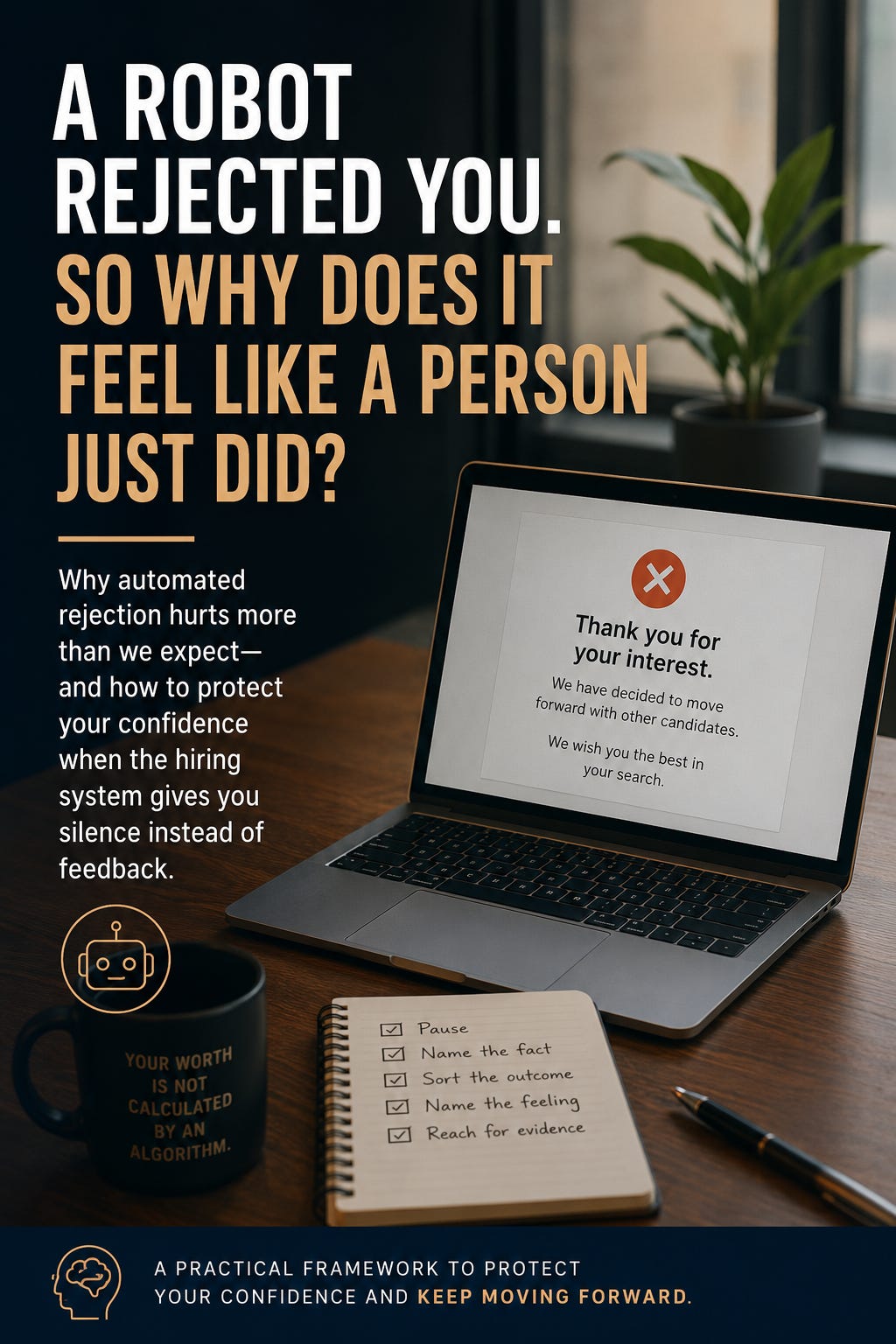
Why automated rejection hurts more than we expect—and how to protect your confidence when the hiring system gives you silence instead of feedback
This article is adapted from Chapter 4 of Job Search Psychology 2026.
You know the mechanics by now.
The rejection came from a sorting system.
No human frowned at your name.
No one read your cover letter and weighed your two decades of experience.
No hiring manager looked at your record and personally decided you were not enough.
You know all of this.
And still, the email lands like a blow.
Somewhere under your ribs.
You understand applicant tracking systems.
You understand keyword filters.
You understand that many applications are screened, ranked, sorted, or discarded before a person ever sees them.
But knowing the machine did it does not make you immune to the feeling.
Because the part of you that feels rejection is older than the part of you that understands software.
The machine may not be personal, but your nervous system does not know that
Machine judgment feels personal even when you know, intellectually, that it is not.
You can explain keyword thresholds.
You can talk about applicant tracking systems.
You can remind yourself that a missing phrase or formatting issue may have pushed you out of consideration.
And still, the rejection can feel like someone looked you in the eye and dismissed you.
That is not a failure of reason.
It is a fact about how your brain is built.
The part of you that registers social pain moves faster than the part of you that analyzes software. By the time your rational mind arrives with the accurate explanation, the wound has already formed.
There is also something specific about being filtered by a machine that cuts deeper than being turned down by a person.
When a human rejects you, there is at least some acknowledgment in the exchange. Someone considered you. Someone looked at your information. Someone made a decision.
But when a machine filters you out, the message underneath the message can feel different:
You were not even worth a human being’s attention.
You were processed.
Sorted.
Reduced.
Two decades of judgment flattened into a string of text that either matched a pattern or did not.
If you have spent years being the person others relied on, this hits a specific nerve.
Your professional identity was built on being seen, trusted, and valued by other humans.
A machine cannot recognize that.
It cannot see the team you steadied.
It cannot see the crisis you helped navigate.
It cannot see the judgment you developed over years.
The reversal can feel like erasure.
You are not imagining the indignity.
You are correctly perceiving a real mismatch between what you have earned and what the system is built to measure.
Your confidence is eroding faster than your competence
Here is the part almost nobody names directly:
Confidence and competence do not move together.
Your competence may still be intact.
You may still know how to lead.
You may still know how to solve complex problems.
You may still know how to manage stakeholders, improve systems, guide teams, and make sound decisions under pressure.
But your confidence may be shrinking anyway.
Not because your ability disappeared.
Because confidence runs on evidence.
And when the market keeps handing you silence, delay, templated dismissal, and faceless rejection, your nervous system starts treating that pattern as evidence.
Not evidence about the system.
Evidence about you.
That is where the damage begins.
After enough automated rejection, the mind starts forming a private theory.
Maybe I am too senior.
Maybe I am too expensive.
Maybe I waited too long.
Maybe my experience is outdated.
Maybe the market is telling me something true about myself.
But a rejection email is not a full evaluation of your career.
It is one outcome from one process you could not fully see.
That feeling you have after another automated no is not the truth.
It is the stress response overwriting the record.
You are standing on two decades of proof, but in the moment of rejection, it can feel like you have nothing to show for yourself.
That is not because the proof vanished.
It is because a dysregulated body has trouble reaching it.
The next rejection needs a process, not a pep talk
Understanding why this hurts is helpful.
But it is not enough.
You need something to do when the next rejection arrives.
Not a motivational quote.
Not a forced affirmation.
A process.
Something simple enough to use when your stomach drops.
Something structured enough to keep the rejection from becoming a verdict.
Use this five-step sequence.
1. Pause before you interpret
There is a small gap between the event and the story your mind tells about it.
Use it.
Read the email.
Then stop.
Take one long exhale before you let yourself decide what it means.
Do not immediately turn it into:
I am not good enough.
No one wants my background.
My career is over.
I waited too long.
Let the event be an event before it becomes a story.
2. Name what actually happened
Strip the rejection down to facts.
Not:
“I am not good enough.”
Not:
“No one wants me.”
Not:
“My experience does not matter.”
Just:
“A system I applied to has indicated it is moving forward with other candidates.”
That is the factual content.
Everything beyond that sentence is interpretation.
A rejection email is not a market-wide verdict.
It is not a full performance review.
It is not a reliable assessment of your value.
It is one outcome from one process.
Keep it that size.
3. Sort the outcome: mismatch or gap?
Ask one practical question:
Was this a real qualification gap, or was it a sorting outcome?
Sometimes there is a real gap.
Maybe the role required a technical skill you do not have.
Maybe the industry experience was too specific.
Maybe the compensation level was misaligned.
Maybe the job required something your background does not show.
If there is a real gap, name it clearly.
A nameable gap can be addressed.
But many times, especially for experienced professionals, there is no meaningful gap.
There is only a mismatch between what you have done and what the system was built to recognize.
A missing keyword.
A title mismatch.
A narrow screening rule.
A résumé that did not mirror the posting closely enough.
A process overwhelmed by too many applicants.
That is not a verdict.
That is a sorting outcome.
And sorting outcomes should not be allowed to rewrite your identity.
4. Name the feeling underneath the sorting
Once you have named the facts, name the feeling.
Precisely.
“I notice I feel ashamed right now.”
“I notice I feel discarded.”
“I notice I feel invisible.”
“I notice I feel scared.”
This is not weakness.
It is regulation.
When you name the feeling, you create space between the emotion and your identity.
You are not shame.
You are noticing shame.
You are not failure.
You are noticing the feeling of failure.
That distinction matters.
Because the danger is not feeling bad.
The danger is believing the feeling is the truth.
5. Reach for one piece of evidence the machine never saw
This is the step that protects you.
Reach for one specific piece of evidence that the machine did not see.
Not a vague affirmation.
A fact.
A problem you solved.
A team you steadied.
A process you improved.
A risk you reduced.
A system you rebuilt.
A crisis you helped contain.
A result that exists because you showed up.
The machine did not see that.
But it still counts.
This is how you counter chemistry with evidence.
The feeling says, “You are nothing.”
The evidence says, “That is not true.”
And the evidence is right.
The same morning, two different ways
Picture a senior operations leader with more than twenty years of experience.
She applied for a role she could have done well.
Eleven days later, the templated rejection arrives at 6:00 a.m.
Before the framework, this is her morning:
The email sends her straight into a spiral.
Too senior.
Too expensive.
Too old.
Too late.
By the time she gets out of the shower, she has built an entire narrative in which her career is effectively over.
She carries it through the day.
She snaps at someone she loves.
She avoids two applications she planned to send.
She rereads her résumé with suspicion.
She ends the day exhausted.
The rejection did not just cost her the role.
The role was never fully in her control.
It cost her the day.
Now run the same morning with the framework.
The email arrives.
She pauses.
One long exhale before the story forms.
She names the fact:
“A system I applied to has indicated it is moving forward with other candidates.”
She sorts the outcome:
Was there a real qualification gap?
She checks honestly and finds none.
A sorting outcome, not a verdict.
She names the feeling:
“I notice I feel discarded right now, and that is a normal response to faceless dismissal.”
Then she reaches for evidence:
The supply chain process she rebuilt during a crisis.
The team she stabilized during a difficult transition.
The millions in operational waste she helped remove.
The whole sequence takes four minutes.
She still feels the sting.
Of course she does.
She is human.
But the sting does not spread into a verdict.
She sends the two applications.
The day stays hers.
What actually protects you
Notice what did not change.
She did not beat the algorithm.
She did not force the company to respond differently.
She did not make the hiring system more humane in that moment.
What changed was the meaning she assigned to what the system produced.
That shift protected one of the most important things a long, automated job search steadily erodes:
Her sense of worth.
That is the work.
Not pretending the system is fair.
Not pretending rejection does not hurt.
Not pretending confidence can be rebuilt through positive thinking alone.
The work is learning how to separate a hiring outcome from a human verdict.
Build an evidence bank
You need an evidence bank you can open quickly.
A short list of real proof from your career.
Problems solved.
Teams led.
Risks reduced.
Systems improved.
People developed.
Crises navigated.
Results delivered.
Not because the past guarantees the next role.
But because the past reminds you that an automated rejection does not get to define your professional reality.
The machine may not have seen your evidence.
But you need to keep seeing it.
Draw the line daily
In this market, you may have to draw the line every day.
This belongs to the machine.
This belongs to the employer.
This belongs to the number of applicants.
This belongs to timing.
This belongs to budget uncertainty.
This belongs to a role that may never have been fully open.
And this belongs to me:
My preparation.
My positioning.
My relationships.
My follow-through.
My recovery.
My evidence.
My ability to keep going without surrendering my worth to a system that cannot measure it.
That line will not draw itself.
The job search will blur it if you let it.
Every rejection will try to sneak across the border and become personal evidence.
You have to send it back.
Not with denial.
With discipline.
The system can sort your résumé. It does not get to sort your worth.
Automated hiring is not going away.
The silence will still happen.
The templated dismissals will still arrive.
The systems will still filter, rank, score, and discard.
But you do not have to hand them authority over your identity.
A rejection email can tell you one thing:
That one process did not move forward with you.
It cannot tell you who you are.
It cannot tell you what your career has meant.
It cannot tell you what you are still capable of building.
It cannot tell you whether your experience matters.
That is not information the machine has.
So the next time the rejection lands, pause.
Name the facts.
Sort the outcome.
Name the feeling.
Reach for evidence.
Then step away from the screen.
The system may have taken four seconds to reject your résumé.
Do not let it take the rest of your day.
About the Author
Byron K. Veasey is a career strategist and leader in data quality engineering focused on helping professionals navigate job searches, burnout, and career reinvention.
He writes Career Strategies, a Substack newsletter read by over 4,900 professionals navigating today’s evolving job market.
👉 Subscribe to Career Strategies
Byron, this piece named something I don't think I've seen articulated this clearly anywhere else: that confidence and competence move on separate tracks, and a sorting system can quietly erode one while the other stays fully intact. That distinction alone is worth the whole read.
I run a credentialing organization built specifically for exactly the person you're describing in that opening scene, twenty years of proof, sorted out by a string match. We have a board member, a PhD, an accomplished workforce development leader with a career most people would envy, who received a rejection last week from a company that signed the email with its own name instead of a person's, from an account that doesn't accept replies. No acknowledgment. No human. Just processed, sorted, discarded, exactly the language you used.
What struck me most is your five-step sequence, because it doesn't ask anyone to pretend the system is fair. It asks them to draw an accurate line between what happened and what it means. That's a genuinely different kind of resilience than most career advice offers, it's not positivity, it's precision.
Here's where I think the next chapter of this conversation needs to go, and it's the piece I spend my days working on: the evidence bank you describe, the problems solved, the teams steadied, is exactly what's invisible to the sorting system in the first place.
The machine isn't cruel. It's just blind to unstructured proof. The people who stop getting filtered out aren't just the ones who've rebuilt their confidence, they're the ones whose evidence has been translated into something the sorting system can actually read and verify.
Confidence work and discoverability work have to happen together, or the next rejection lands exactly the same way. Thank you for writing this. I'll be thinking about the "draw the line daily" framing for a long time!